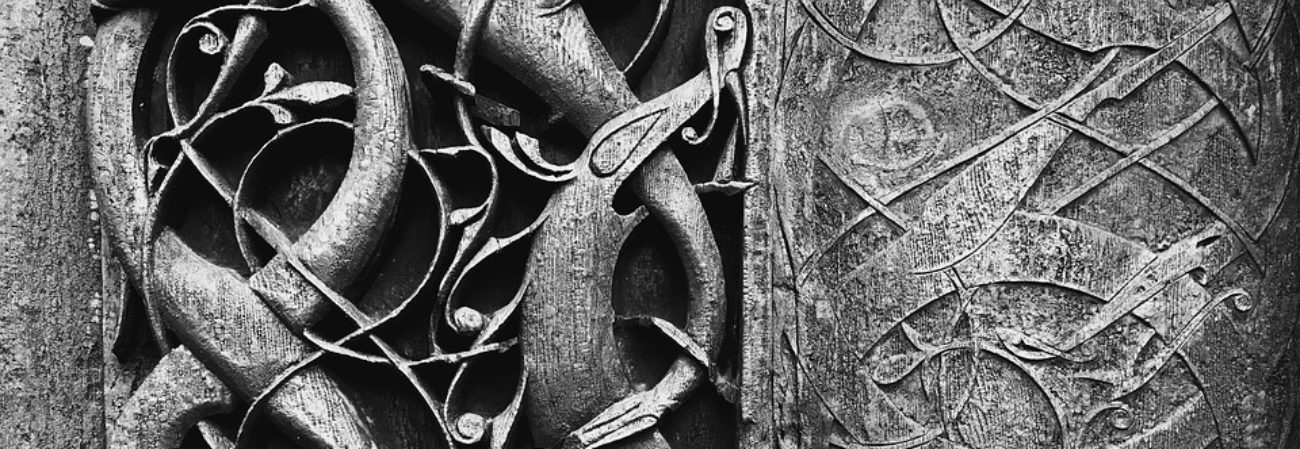
 In The Serpentine Key, Sven Thorvaldson serves as emissary to Vladimir, Prince of Kiev, from Basil II, Emperor of the Eastern Roman Empire, bringing in the Norsemen who would eventually become the Varangian Guard.
Varangian was a term used by the Byzantines to denote anyone from the area we now call the Ukraine, as well as Scandinavia.
In 986 Basil II was in a difficult situation. His nobles were rebelling against him, he had a shortage of military, he had just been catastrophically ambushed at Trajan’s Gate by the Bulgarians and he no one he could really trust. It was not for nothing that the Byzantines were known for political intrigue. In fact the name came to mean political intrigue in later centuries.
Basil had a sister who was yet unmarried and in 988 he came to a decision that was to change the course of history. He sent a proposition to Vladimir, prince of Kiev who was then making himself all too well at home in one of Basil’s Cities, Cherson in the Crimea. If Vladimir would convert to Christianity and send six thousand of his finest warriors, Vladimir could then have the coveted hand of his sister, the Porphyrogenita in marriage.
Ann’s title, the Porphyrogenita, meant literally “Purple Born: she had been born in the chambers made of porphyry, a kind of purple stone and that meant her place in the imperial family as was her brother’s a high status one. One simply did not go marrying one’s imperial sister off to a pagan barbarian war lord who already had eight wives and numerous concubines. There was an uproar in the city. It was the scandal of the century.
What was in this for Vladimir besides the hand of the most eligible bachelorette in all Christendom?
By marrying Anna, Vladimir could ally himself with a very powerful neighbor, one with whom the Rus had long been at odds with. Furthermore, Vladimir had already been religion shopping. He had rejected Judaism and Islam and western Christianity, but the the reports of the high-domed Hagia Sophia– now that he liked. Eastern Orthodox Christianity it would be for him. The six thousand warriors, Vladimir had amassed to take down his brother Yaropolk were getting a tad bit restless. Many of these were mercenaries who had been sent by Vladimir’s kinsman, the king of Norway, to aid Vladimir during his tempestuous little civil war with his brother for control of the land left by their father Sviatoslav. It was said that they told Vladimir when he had no money to pay them as promised, “Show us then, the way to the King of the Greeks!” For before this time, it was not unheard of for Scandinavians to be mercenaries in Byzantine forces, for which the Byzantines paid very well.
So in this way, Vladimir got out of a potentially sticky situation, got the girl (though he had to send away all the extra ladies, of course) and got a new religion with which to bind his divided kingdom of Norse and Slavs together. Basil married off his sister and got some of the most feared fighting forces in the world at the time. One cannot but wonder if some of them were not the legendary Jomsvikings, but that is a subject for another time.
 There has been some debate on what Greek Fire actually was. Most historians agree that it made use of petroleum and others throw around combinations of pine resin, quicklime, calcium phosphide, sulfur, or niter. So then let us briefly examine some of these components to the best of my ability, bearing in mind that chemistry has never one of my strong subjects!
 A case has been made for the fly agaric mushroom. Despite the fact that this red fungus, speckled with white shows up in almost every European fairy tale picture book you ever read as a child, it grew in Europe in only isolated areas. It certainly does not grow in Iceland where there is much mention of the berserkers. Furthermore, the effects of the mushroom, unless used very carefully, are more likely to produce real illness than the desired level of hallucination in those who ingest it. The potency of the mushroom is affected by many things: the time of the year it is harvested, where it has been harvested and how it is collected. There is not enough uniformity to produce the desired outcome.
 Icelandic Egil’s Saga whose father Skallagrim was a berserker and the son of Kveldulf Bjalfson or Evening Wolf, also a berserker. This very much indicates the condition was genetic and places some weight on its being something like IED which we have today.
 “There was a man named Ulf, son of Bjalf… Ulf was a man so tall and strong that none could match him and in his youth he roved the seas as a freebooter….he was a berserker.” Egil’s Saga.
