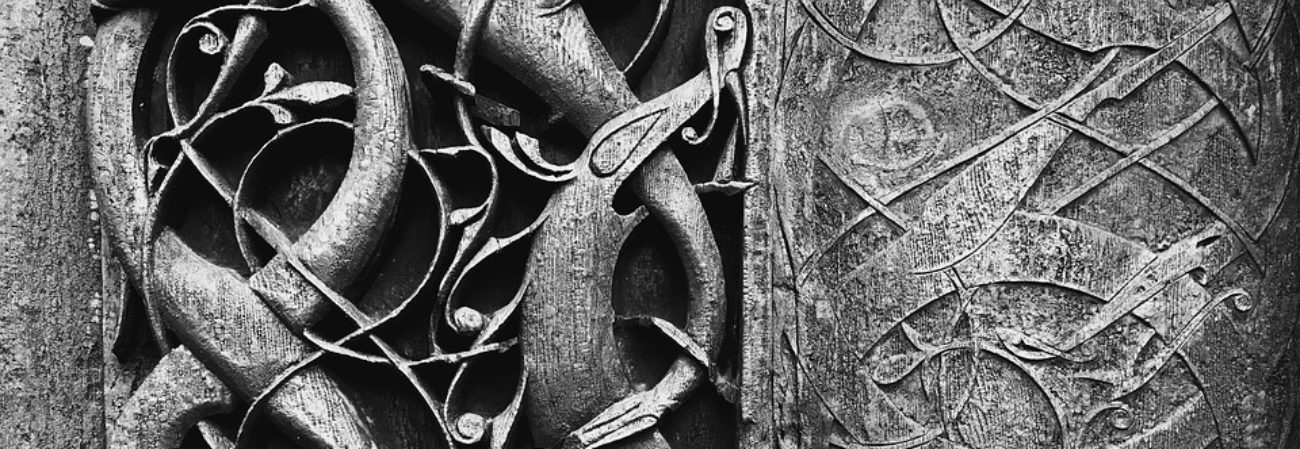

 Of any book in my personal library, Maria Kvilhaug’s Seed of Yggdrasil is the most breathtaking in its depth, scope and insight. A graduate of the University of Oslo and a long time scholar of Germanic culture and myths as well as a scholar of the Norse language, Ms. Kvilhaug presents a fascinating foray into the Norse myths as you have never seen them. I found myself murmuring as I read this book “Well that makes sense!” as she explored the myths from the perspective of an open-minded scientist and historian. When you see the myths, not as stories but as allegories, things begin to click into place. When you begin to see evolutionary flow in the stories, you then realize that all of it was intended to be allegory, as any religion founded in Nature, is.
She also writes of spiritual allegory. “When one realizes that a Viking prince has to fight a giant called Hatred, another called Rage and must be reborn in order to win a battle he lost in his previous life, the Battle of the Rock of Greed, in order to restore the Peace of Wisdom and gain entry into the divine afterlife, what at first sight appears to be just another heroic legend of a tough guy who fights giants, become s a spiritual parable. In fact, the moment I started to apply my translated names to the old texts, a whole new world unraveled itself, a world of spiritual concerns, ageless wisdom and metaphysical and philosophical speculation; speculation that is sometimes almost compatible with modern scientific theories.”
Even if you have only a casual interest in the subject of Norse mythology, The Seed of Yggdrasil makes the myths much easier to understand. Furthermore, since the author is a Norse scholar, she is qualified to make judgement calls on translations of certain words, to which she adds her explanation as to why she does. Not only did I gain greater insight into the stories and the all probable likelihood of their place on, I gained greater insight into how the people of the Norse Culture saw their world.
Easy to read and understand, The Seed of Yggdrasil takes on an almost meditative, spiritual experience. Her deeply delving understanding of the Old Norse texts and her unwillingness to take anything previous scholars have written at mere face value without holding it up to the light of in-depth research, her a highly qualified writer on the subject. Because of her extensive studies in Old Norse, she is not simply regurgitating anything that has already been written. She writes about translating a passage from Konungsbók (The Book of the King, written around 1200 CE) while at the University of Oslo and remembers doing a double take at a passage that read “The Earth is as round as a globe.” Clearly the early medieval people comprehended much more than we give them credit for. As any reader of this book will see, Kvilhaug delves extensively into the cosmic myths of the Norse and when seen under her lens, they are seen with fresh insight. It is truly a remarkable experience.
My only pique with this book was not the price, though it was considerable. I paid over fifty dollars for it on Amazon, yet considered it immensely worth it. My issue stems from the fact it does not contain an index. I bought it for research purposes and I found the lack of an index somewhat debilitating. However, I was not adverse to reading such a book cover to cover merely for enjoyment. At well over six hundred pages, it is not a quick read, but certainly a memorable one.


 As the ways of the old gods fades to twilight and the religion of the White Christ sweeps Britain, we are brought into the dark cold world of A Gathering of Ravens, a beautiful compilation of both historical fiction and fantasy genres. Scott Oden’s writing is easily readable, yet hauntingly poetic and evocative in style of the Eddas or even the Anglo-Saxon Beowulf itself. The author gives us a theme with characters sharing a little of each side of the yawning chasm of morality with themselves and the readers. Ultimately, morality is defined for us as honor, to oneself and to those to whom one has sworn allegiance, a basic and ancient code integral to the Norse culture.
 The Norse made extensive use of saunas. Among the Rus, their bathhouses were called banyas. An Old East Slavic illuminated manuscript, the Radzivill Chronicle mentions the banya in the in the story of Princess Olga’s revenge for the murder of her husband, Prince Igor, by the Drevlians in 945 AD. When an emissary from the Drevlians came to Olga with an offer of marriage, “… Olga commanded that a bath should be made ready for them and said, ‘Wash yourselves and come to me.’ The bath-house was heated and the unsuspecting Drevlians entered and began to wash themselves. [Olga’s] men closed the bath-house behind them and Olga gave orders to set it on fire from the doors, so that the Drevlians were all burned to death” Incidentally, Olga was the grandmother of the Prince Vladimir who was given Basil II’s sister Ann in marriage in exchange for six thousand Varangian troops and a promise of conversion to Christianity. While the Varangian inhabitants of Constantinople and indeed most of the common native people as well, were unlikely to make use of the extensive cosmetics that highborn women such as Theophana would use, cleanliness was nevertheless highly valued, weakening the popular image of the medieval Scandinavian as dirty and unwashed.
 The Abbot of St. Albans write with no little chagrin of the Danes who settled in England that “thanks to their habit of combing their hair every day, of bathing every Saturday and regularly changing their clothes, were able to undermine the virtue of married women and even seduce the daughters of nobles to be their mistresses.” Apparently even Anglo-Saxon women were crazy about a sharp dressed (Danish) man.
 It didn’t happen any too soon. Bardas Phokas, the chief of the rebels and a one time trusted general of Basils’ was closing in on the imperial city. Or rather, one of his next in command, Kalyokyros Delphinas, who took charge of storming Chrysopolis, a city across the Golden Horn from Constantinople. It took a quite a long time for negotiations to take place, but once they did, either in late 988 or early 999, numerous long ships could be seen on the horizon and with them six thousand Norsemen. They soundly defeated Delphinas’ men. Delphinas himself went on to meet a nasty death of impalement. The Varangians then went on to Abydos where they were again victorious, albeit helped out some by Bardas Phokas inexplicably keeling over on the battlefield. Stroke? Heart attack? Poison? We can’t be sure.
 In The Serpentine Key, Sven Thorvaldson serves as emissary to Vladimir, Prince of Kiev, from Basil II, Emperor of the Eastern Roman Empire, bringing in the Norsemen who would eventually become the Varangian Guard.
 A case has been made for the fly agaric mushroom. Despite the fact that this red fungus, speckled with white shows up in almost every European fairy tale picture book you ever read as a child, it grew in Europe in only isolated areas. It certainly does not grow in Iceland where there is much mention of the berserkers. Furthermore, the effects of the mushroom, unless used very carefully, are more likely to produce real illness than the desired level of hallucination in those who ingest it. The potency of the mushroom is affected by many things: the time of the year it is harvested, where it has been harvested and how it is collected. There is not enough uniformity to produce the desired outcome.
 Icelandic Egil’s Saga whose father Skallagrim was a berserker and the son of Kveldulf Bjalfson or Evening Wolf, also a berserker. This very much indicates the condition was genetic and places some weight on its being something like IED which we have today.
 Delving into mythology always brings one to discover interesting archetypes. In The Serpentine Key, Odin plays a minor, yet pivotal role in helping my main character discover something about himself. Odin is a study in contradictions, a multifaceted being who seems to shift and change, perhaps as he is interpreted. But putting such a mythical being in fiction is hardly new.