
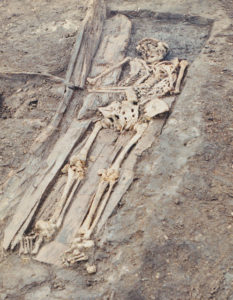
Now that we have cleared that up, the next myth to debunk would the question of medieval people being significantly shorter that they are today. This myth is supposed to have arisen due to the poor health and conditions in cities during the Industrial Revolution. Stephen Nicholas and Richard H, Steckel have this to say in Heights and Living Standards of English Workers During the Early Years of Industrialization 1775-1815:
“Falling height of urban- and rural- born males after 1780 and delayed growth spurt for 13- to 23-year olds, revealed declining living standards among English workers after the Industrial Revolution.”
According to Sebastian Payne, chief scientist for English Heritage, this myth may arise from the shorter doorways of the period that were designed to be heat efficient in winter. Also, children took longer to reach puberty then and continued growing for a longer span of time than they do today. Furthermore, researchers were astonished to discover relatively few skeletons who in life had suffered from polio or tuberculosis. In fact most of the people of this period would have been far hardier, not to mention more wiry and fit than those of modern western civilization today.
While I am about it, I should probably point out that a lack of bathing is another commonly held belief about the middle ages. Public baths, just as in the Roman era, were quite common. In fact, most brothels in London required their patrons to wash before doing the deed with their girls. Not everyone could afford to immerse themselves in a full bath, but even the very poor would wash themselves spit-bath style. Baths were so important to the Norse Rus’ under Prince Oleg in the early tenth century, access to the the city’s baths was one of their requirements for leaving Constantinople unscathed, as well a good supply of food and wine. In fact, the Rus’ were known to be fastidious, utilizing bathhouses and saunas (as they had in Scandinavia) and the Slavic banya, which is very similar and which I may be discussing soon in another article.
So there you have it. While medieval people may not have had standards up the the modern Scope-swishing, Febreze-spraying, germophobic modern, neither were they the beastly smelling, rotten-mouthed, not to mention short-statured people that popular culture has led us to believe.
Good information about teeth and the consumption of sugar. I suppose people have had mouth fresheners as long as herbs have been chewed.