In my novel, The Longhunt, Katie Campbell journeys with a band of longhunters from the canebrake of wild Kentucky to Fort Caswell, later known as Fort Watauga near what is today Elizabethton, Tennessee. It was named for Richard Caswell the governor of North Carolina of which that area was then considered a part.
Today the fort has been reconstructed at Sycamore Shoal State Park, approximately 1500 yards from the original site. Most historians agree that the fort was a collection of dwellings enclosed by a stockade and the current structure reflects that.
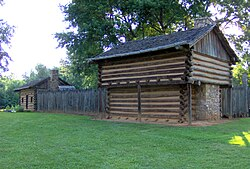
Reconstructed Fort Caswell at Sycamore Shoals State Park near Elizabethton, Tennessee Courtesy of Wikimedia Commons
We get a view of the fort from Johnnie’s and not Katie’s eyes here:
They are down to three men, with their horses, pelts, gear and dogs, riding at their heels, tongues lolling laconically, but even so they make a formidable convoy as they enter the fort. Fort Caswell has not been commissioned for long. Johnnie remembers when it first went up. He remembers when it nearly burned. He remembers how it held his grief…and then his vengeance. The traders are set up here as they were at Anderson’s Blockhouse. But Johnnie rides past them. He has things to do first. He swings his leg over the mare’s neck, dismounting and leaving Katie on the mare. “Wait here,” he says quietly. He wishes to spare her as much attention as possible. He sees her hunched shoulders, the way she shrinks against the mare as if to make herself invisible. John Sevier is waiting by the blockhouse. If Johnnie knows anything about Sevier, he has watched their arrival from the palisade and has been waiting for them.
“You bring anything more than pelts?” Sevier is not a man known for polite conformities.
“Might be,” Johnnie responds. “Might have some maps.”
Sevier nods. “Come in and talk to Carter before you deal with them pelts.” Sevier is Lieutenant Colonel here at the fort. They served together in the campaign against the Cherokee towns. Johnnie nods to Katie and she slides down from the mare, shadowing his step into the blockhouse.
The blockhouse is the spine of the fort — hewn logs stacked tighter than breath, chinked with clay and ash. Inside, the light is scarce. A single window slit pours a blade of sun across the rough plank floor, slicing through dust motes that hover like old ghosts. The hearth is smeared with yesterday’s ash, and the air smells faintly of grease, leather, and cold iron. On the far wall, a rack of muskets leans like sentinels. A cloak hangs on a peg beside a saber with a rusted hilt. Above the doorway, an antler nailed crosswise casts a bent silhouette — not quite ornament, not quite omen.
The fort was constructed around 1775 as a refuge for White settlers settling in the region of the Holston, Watauga, and Nolichucky rivers and later was the muster point for the Overmountain men in the famous Battle of King’s Mountain which resulted in an American victory against Loyalists led by Patrick Ferguson. Among the Overmountain Men was John Sevier who has a minor character role in The Longhunt. He is considered one of the founding fathers of Tennessee.
In the summer of 1776, Cherokee chief Dragging Canoe (Cherokee: Tsiyu Gansini), determined to drive White settlers out of the area once and for all, put his allegiances in with the British Crown. Calls for settlers to leave the area by the British Indian Department were repeatedly ignored. Fort Caswell was just one fort in the way of Cherokee angry at the sale of their lands to settlers. In addition, the Cherokee were as bitter enemies with the Shawnee, as they were with the settlers, the former a long standing hatred.
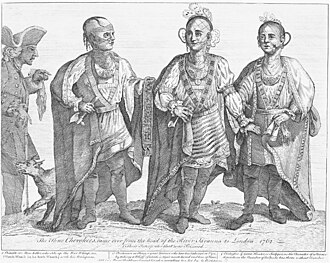
Cherokee Natives. From an old woodcut, public domain
Though not mentioned in sources as extensively as the 1776 attack, there were other skirmishes preying upon the settlements around the fort, leaving settlers in a constant state of high alert and fear. It is just such a round of raiding parties that left wounded and dying, clinging to life and hope, fleeing to the refuge of Fort Caswell as here, in The Longhunt:
The fort is less a refuge and more a crucible of pain. There is a woman who rocks back and forth and asks about her husband. Even though she saw him scalped in front of her. There is a boy who was shot with an arrow in his leg. An easily survivable injury except that it is putrefying. There is a young mother who has just given birth, and she cannot get her baby to nurse. There are those who are suffering from smoke inhalation, broken bones, lacerations. These are the ones who escaped. Some might say they are the lucky ones. But they carry the language of desolation. They are the ones who lived to see their loved ones carried off. Or hacked to death without mercy in front of them.
William Christian, colonel over the Virginia militia arrived and put paid to any more incursions. However, a supply of powder was crucial to the maintenance of the fort’s safety. Well-known in the area was a trader named Jacob Brown. He first cast his lot with fate by buying up large tracts of land from the Natives with the end in sight if selling them at a considerable markup to the White settlers. As a member of the Watauga Association, Jacob’s signature showed up on a document known as Watauga Petition asking for more formal government and protection from North Carolina, something they felt owed as they were still being taxed by said colony. With the Revolution in full swing, resources were spread thin and there really weren’t enough men or arms to go around for the more westerly frontier settlements. In the meantime, Jacob Brown amassed over 500,000 acres of land bought off the Cherokee. His plan failed not least of which he couldn’t get the price he wanted and most of all because it was decreed that the purchases were null and void under a 1763 British proclamation prohibiting such sales. In the end, Jacob Brown is best known for being an adulterer, living with a woman named Nancy Henderson while his wife and children back in South Carolina apparently remained oblivious to the affair until such time came to deal with his estate after his early death due to a hunting accident.
I really have no actual knowledge beyond these few facts of what kind of a man Jacob Brown was, nor his mistress Nancy Henderson and so they have suffered at my hand in the story of The Longhunt.
The trading station is made of reinforced squared off log walls. Gun ports give testament to its defensive use. There is a cabin nearby and an unattended cookfire in front of it. The men dismount near it. A woman comes to the door of the cabin, wiping her hands on her apron. Here is a woman whom life had carved a face as sharp as a tomahawk and about as soft. A woman who wasn’t handed beauty, so she’s taken flint-sharp clarity instead. Her deep-set eyes scan the men in her dooryard. “Jacob’s out back,” she says in a voice that has the rasp of too much pipe tobacco in it, a guess of Johnnie’s that is proved correct as she replaces a clay pipe between her teeth, eyeing them warily. Sevier shrugs and goes to find Jacob Brown.
The others wait in the door yard. In a moment or so, Sevier returns with Jacob. Jacob is as lean and ill-gotten as Johnnie remembers him. He glances at the men, at their blood-stained hunting frocks, at the fresh, stinking scalps on the belts of Johnnie and Davidson. “Trouble?” he says
“Might could be,” Davidson says. “Ran into a pack of Cherokees on the way here. Lost one man.”
“I had group of ‘em come by here yestiddy and take all my whiskey stores and some of my corn flour,” Brown says.
In all, men and women did what they had to, and they lived in a far different era than we do today having to make vastly different choices. Fort Caswell is built on the sacrifices of such men and women, their sorrows, their losses and even their dreams, just as much of America came to be.
The Longhunt is not meant not be a story of an ideal of how moderns think it should be portrayed, but rather as it was. As it had to be, a struggle. A struggle that shapes the characters today of the people of Appalachia. People who are warm hearted, but pragmatic and resourceful. As I state in the beginning of the book:
If you are looking for heroes, you may not find them here. But if you are looking for truth—raw, complex, and unvarnished— you are welcome to walk with me.
Definitely a riveting story of what it was like on the frontier. Those who are interested in early America this is the story for you!