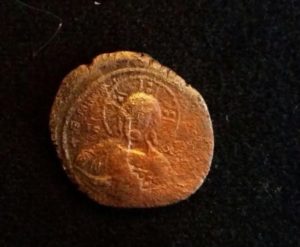
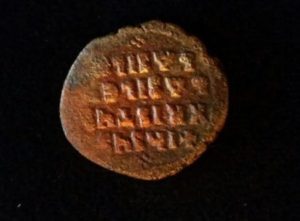
This coin would not have been very valuable in its time. It is not a gold solidii. But it would have been much used. Perhaps it passed through the hands of soldiers, merchants and Arab traders. Did it buy a cup of wine? A loaf of bread? A night with a girl in a brothel? I can only imagine that if it could talk, what a lot of stories it could tell.
At the time of Basil II’s death, the Empire stretched in the north to nearly the entire circumference of the Black Sea (then the Euxine Sea) to Crete in the Mediterranean in the south. To the west it encompassed Croatia and the southern end of Italia; in the east it bordered Syria, still maintaining Antioch and bordering Armenia, Iberia and Mesopotamia. While not as vast as the earlier Western Roman Empire before the division, the empire Basil left was stable. Her borders were secure, her people well cared for, her finances in order. Then began a slow decline for the Empire, till the sack of Constantinople by the Ottomans in 1453.
This coin could have been carried to Baghdad by a Syrian pepper merchant like Ahmed al-Zayeeb.. Perhaps it was spent on a cup of wine by a Varangian Guardsman, like Sven. They were notorious drinkers and a nickname for them was the “Emperor’s wine skins”. Perhaps a coin much like this went for a length of blue wool, for a cloak for Ulfric as described in The Serpentine Key:
Freydis fingered some blue woolen cloth for sale at the cloth merchants. It would make a fine cloak for Ulfric. Winter would be soon closing in. While it was not as harsh as in the Northlands, he was in dire need of a new cloak. The fabric was fine. She ran her fingers over the coin in her hand, feeling the raised profiles of the two Emperors, wondering how much she could haggle the cloth merchant down.
From The Serpentine Key by G.S. Brown
If only my coin could tell its own story. In the meantime, I must be content to weave my own.

