 Lars Brownsworth brings us the Byzantine Empire in all her pomp and glitter, political intrigue, poison, assassination and seduction. Most people who consider themselves somewhat knowledgeable about history and even the Roman Empire, fall short when it comes to knowledge of the eastern half that endured for another eleven centuries after Rome fell to the barbarians in her midst. As Roman troops withdraw from Britain to cover their losses back at home and Christianity begins to sweep the Empire, a new leader emerges to change the face of Rome forever. Any history of Byzantium rightly begins with Constantine and it is on his shoulders that Brownsworth leaves the beginning.
We often define the Byzantine Empire beginning where the Western Roman Empire left off. As Brownsworth aptly illustrates there was no abrupt handover. Rome did not even “fall” in the strictest sense. Yes, the Goths and Visigoths took down her great city, but Rome in the West had been declining gradually for some time, while in the East, the Empire had been experiencing something the West would not see for many more centuries – a Renaissance. Constantine places the new capital between the Black Sea and the Mediterranean, and in a stroke of typical egotism, names it after himself.
Brownsworth covers the next several centuries in a whirl of emperors, Hunnic invasions and Christian heresies. He does so through a series of vignettes, graphic tales and titillating tidbits. He covers Justinian, the Muslim threat from the east, the institution of the Varangian Guard and the Bulgarian wars under the reign of Basil II and the golden age of Byzantium. He spends much more time in the earlier centuries and fewer pages on the golden age of the empire, Constantinople’s tragic role in the Crusades and the downfall of the Byzantine Empire.
For readers of Alan W. Eckart’s works on American frontier history, Brownsworth’s approach is similar, condensing otherwise dry academia into a readable work for the average armchair historian. The strength of this book is that the author has a genuine passion for the history of the Eastern Roman Empire and it shows in his enthusiasm for his subject in these pages while showing a real flair for the dramatic. The major drawback is that he may have sacrificed some academic accuracy for dramatic flair.
The main weakness to this book is that it is attempting to deal a broad stroke at a very broad subject within three hundred or so pages. Brownsworth faces a monumental task in condensing over a thousand years of Byzantine history in a few hundred pages. The Byzantine Empire is a subject that is too expansive a scope to handle in one book. Yet he does a good job of catching the highlights and making them readable. While certainly not for the serious academic, who will need a more in depth approach with more primary sources cited, it is an excellent and entertaining introduction written for the casual reader. Have you read this book? What did you think? Let me know your thoughts below.
You can get the book here:


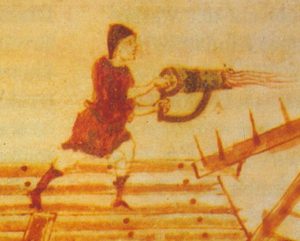 There has been some debate on what Greek Fire actually was. Most historians agree that it made use of petroleum and others throw around combinations of pine resin, quicklime, calcium phosphide, sulfur, or niter. So then let us briefly examine some of these components to the best of my ability, bearing in mind that chemistry has never one of my strong subjects!
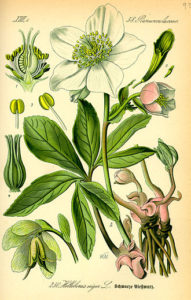 Of the two plants known as hellebore to the ancients, only one was true hellebore. They were not related, but both were very poisonous. Black hellebore Helleborus niger is the true hellebore and sometimes used as a purgative. White hellebore or false hellebore (Veratrum album ) is the subject of this article. It is most famous for its role in its use in poisoning the water supply of the residents of Kirrah by their Greek besiegers. The besieged were so weak from the emetic effects of the plant, they were unable to withstand the assaults of the enemy upon their city.

 immunity to belladonna as related in George Buchanna’s History of Scotland, vol 6:
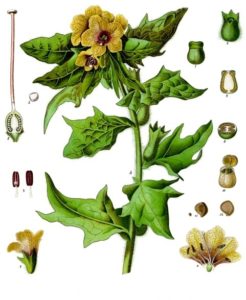 Henbane (
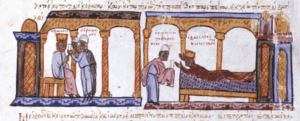 Poison! Just the word would cause a medieval citizen of Constantinople to cast a furtive glance into his or her cup. Almost all the poisons available to the people of the Middle Ages were derived from plants. Not all who were suspected of dying of poison, necessarily did so, but it is a testament to how common it was and much the danger was ever present on the mind of especially upper class Byzantines.
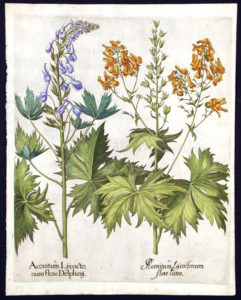 Of the ones we will talk about in this series, most notorious is Aconitum, among many other names also known as Monk’s Hood, Wolfsbane (for its reputation in poisoning wolves) and Queen of Poisons. It belongs to the family Ranunculaceae, including over 250 species. The Byzantines would have been very familiar with this deadly poison, dubbing it lykotonon — “wolf slaying”. Historically, Cleopatra VII of Egypt was said to have poisoned her brother Ptolemy XIV with aconite. In classical mythology, the sorceress Medea attempted to have king Aegeus unwittingly kill his own son, Theseus with a cup poisoned with aconite. It is said to have sprung from the spittle of Cerberus, famed three-headed dog of Greek myth. Even touching this deadly plant, especially the roots, can gain you an unpleasant death.
 A case has been made for the fly agaric mushroom. Despite the fact that this red fungus, speckled with white shows up in almost every European fairy tale picture book you ever read as a child, it grew in Europe in only isolated areas. It certainly does not grow in Iceland where there is much mention of the berserkers. Furthermore, the effects of the mushroom, unless used very carefully, are more likely to produce real illness than the desired level of hallucination in those who ingest it. The potency of the mushroom is affected by many things: the time of the year it is harvested, where it has been harvested and how it is collected. There is not enough uniformity to produce the desired outcome.
 Icelandic Egil’s Saga whose father Skallagrim was a berserker and the son of Kveldulf Bjalfson or Evening Wolf, also a berserker. This very much indicates the condition was genetic and places some weight on its being something like IED which we have today.