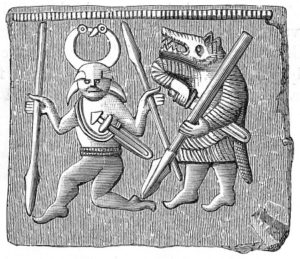
 “There was a man named Ulf, son of Bjalf… Ulf was a man so tall and strong that none could match him and in his youth he roved the seas as a freebooter….he was a berserker.” Egil’s Saga.
In The Serpentine Key, and the two books following, the Norse mercenary, Sven Thorvaldson and his son struggle with being ulfhednar, wolf berserkers, something they were born to and that have shaped who they are.
Most people have at one point in their lives used the word berserk. But what does it mean? In our culture it is someone who flies off the handle, becomes irrationally angry. The berserk shows up in the role playing game Dungeons and Dragons as a playable class alongside Runemasters and Skalds. They have magic abilities and special roles. In European legends, the werewolf has much in common with the ulfhedinn, the berserk who identifies with the wolf, including his tremendous strength. In Russia, colonized in the ninth century by the Norse, the werewolf is called the oberot or bodark which translates into “one transformed”.
Nor are such accounts isolated to Norse society. The Celtic Cuchulain’s Riastradh of Irish myth shared many of the same characteristics as berserkers. Both berserkers and members of the Riastradh were known to go into a battle frenzy seemingly unaffected by injury and take sometimes days to come down from it, during which time they would be weak and defenseless. Perhaps this was even what was described for the Irish warriors of Ulster who are cursed by the goddess Macha when they refused to help her as she went into labor. She cursed them to be as weak as a woman upon whom labor pains have come when they would be in their greatest hour of need. Those who fought Norse berserkers regularly knew about this “Kryptonite” of theirs and knew to engage the berserkers just long enough until the gangr would wear off and then they would be weak, diminished and unable to fight. For this reason, their use was as shock troops, often to break through shield walls. A berserker was reputed to be the one who, single-handed, held off a portion of the Saxon army at Stanford Bridge in 1066 until reinforcements could arrive.
From Egil’s Saga: “So it is said of those men who were shape-strong or on any of them on whom was the berserk-gang that for so long as they held, they were so strong there was no holding against the, but forthwith when that was passed over, then they were unmighter than of wont. And so it was with Kveldulf that as soon as the berserk rage was gone from him, then he knew he his weariness of those onslaughts he had made and he was altogether without might, so that he laid down in his bed.”
Romans spoke of crazed Celtic warriors who went into battle naked, unafraid of death. They called them Furor Celticus. The triple goddess Morrigan was said the be the one who inspired this battle frenzy, possibly brought about by deep mediation. She had much in common with Freyja, both being deities of death and transformation as well as the battle frenzy. There are also stories of the Maylasian warriors who “ran amok” and the African “leopard men” with similar proclivities.
The etymology of the word berserker differs depending on who you talk to. Some say it means “bare of shirt” for the practice of these men fighting without the protection of either leather armor of ring-mail shirts. Others insist that it referred to to the “bear nature” of some berserkers or perhaps wearing the skin of the bear. Those who embraced the spirit of the wolf in the almost shamanic practice of their warrior tradition were known as ulfhednar. In The Serpentine Key, Sven Thorvaldson is ulfhedninn, as is his son. For him, it is a curse as much as it is a gift of Odin. Like many modern day sufferers of IED, he has a tendency to alcoholism. Suicidal tendencies also seem to be a mark of a man afflicted this way. Egil Skallgrimson tended to deep depressions. Prone to volatile emotions, he keeps himself so tightly restrained as to appear withdrawn and devoid of emotion. Years have training have taught Sven to school and control the gangr. With training, the berserk can deliberately induce the state, as well as hold it off when necessary. Most weren’t so disciplined. In the sagas, it was said to be brought on at unexpected times, including even by hard labor. Yet the berserker state cannot be chalked up to only an explosion of rage, or even excess of adrenalin, though the latter two do seem to factor in the wiring and neural impulses of these men. The berserker was and is perhaps the man who takes the IED to another level due to the spiritual mechanics of meditation and shamanic trance. He becomes one with Odin or perhaps with the wolf or bear with which he identifies himself. The greater strength with which the berserker seems to be granted, is only one side affect. Perhaps it is the unitary state into which he enters that also grants him an almost sixth sense. In The Serpentine Key, Sven is able to sense an enemy’s next move before he makes it. His movements are sure and coordinated, hardly the result of a man drunk on alcohol or slowed by hallucinogens.
Next time we will examine a medical angle on the berserks. If so, do they still exist today? Share your thoughts below.
Sources:
Germanic Warriors: Warrior Styles from Trajan’s Column to Icelandic Sagas by Michael P. Speidel
Egil’s Saga
Ynglinga Saga


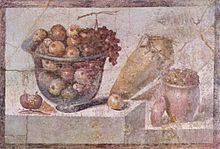 Dessert is an apt conclusion to the series on food. Desserts, including sweetmeats and honey cakes were eaten by the higher classes, including koptoplakous, the ancestor to baklava still eaten in Greece today. It would have certainly been on Theophana’s table: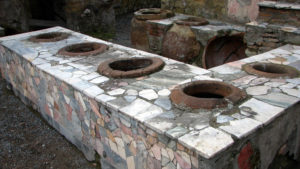
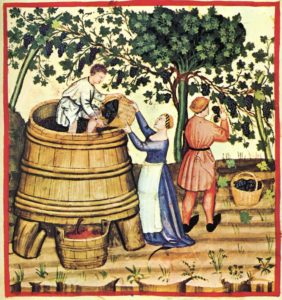 The ambassador, Liutprand of Cremona mentioned in a previous post who objected to garum, also did not care for Byzantine wine which he described as “mixed with pitch, resin, and plaster was to us undrinkable”. Perhaps the ambassador was merely difficult to please. He must have been alone in his assessment, as Byzantine wines were much favored by Western Europeans. He may have been referring to Retsina, a type of wine that got its unique flavor from sealing the wine jars with pine resin.
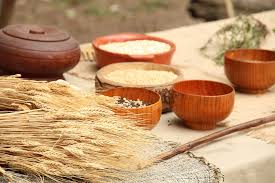 Vegetables were eaten by citizens of the Eastern Roman Empire and in a wide variety. Most of them were well know to the modern diet, such as cabbage, carrots and greens. Artichokes were well known and Antioch was famous for its cucumbers. Melons were cheap and readily available. Lentils were a staple in the diet of the poor. Those that could afford them seasoned their food with spices, some brought in from Asia. These included cinnamon, caraway, cardamom, cumin, ginger, nutmeg, saffron, pepper, clove, coriander, among many others that can still be find in our spice cabinets today, though now far more easily and cheaply obtained. Those with less money would use onions, leeks and garlic for seasoning their food. Eggs were favored by all classes and came from hens, geese and pheasants. The Byzantine omelet known as the sphoungata was stuffed with olives and goat cheese and perhaps chickpeas salted and cooked in olive oil. It would even have been on the table of the Emperor himself as mentioned in The Serpentine Key:
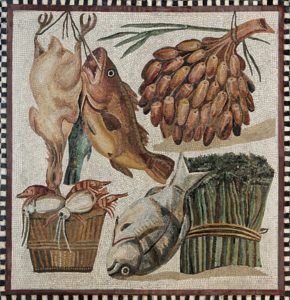 Since I mention food so often in my books, and I have spent so much time researching Byzantine cuisine, I thought the food of the time period would make an interesting article. Eating is a subject is of prime interest to everyone. Not only is it important for sustenance, but it occupies a space in human life that comprises a social aspect. It was no less important to the people of the middle Byzantine period. Food in Byzantium was abundant and of a particular quality few in Western Europe enjoyed at the time. Even the poor often ate better than some better off individuals might have eaten at the same time in say, England. Nevertheless, meat occupied a place of more prominence on the table of the upper middle class than it did the poor, and even then, meat such as beef was not often served. Cattle were more often used for dairy and draft animals. As Constantinople and indeed much of the Empire was in some way close to the sea, one should not be surprised to find that much of the diet was comprised of seafood. All manner of shellfish, mackerel, tuna and mullet were among the general bounty of the Mediterranean. The Eastern Roman Empire, while not as vast as the Roman Empire had been before the split, covered a good piece of real estate and the diets of the inhabitants would be varied according to the culture at that particular time and place. Even in Constantinople, much of the customs regarding food were influenced by Arab cuisine. Constantinople was a cosmopolitan place akin to cities like New York or London today. There were many cultures and languages flowing in and out of her gates daily. From the south and the east came traders bring goods such as spices and dates from India, from Arabia and Africa. Honey was brought in from the Baltic countries, and pickled herring from the North Sea. Figs and pomegranates were brought from the Aegean coast and Anatolia supplied grapes, pears and apples that were much sought after. From the coast of the Euxine Sea (Black Sea) came hyssop, aloes and asafetida as well as fish roe. The rest of the western world was befuddled by the Byzantine predilection for salads. Interestingly, there is no mention of coffee in Byzantine sources, though it seems they would have been familiar with it from close association with the Arabs. Perhaps they did not care for it.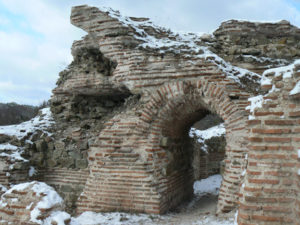
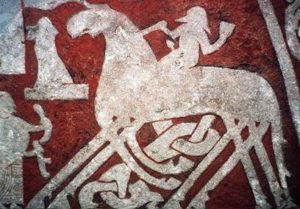 Delving into mythology always brings one to discover interesting archetypes. In The Serpentine Key, Odin plays a minor, yet pivotal role in helping my main character discover something about himself. Odin is a study in contradictions, a multifaceted being who seems to shift and change, perhaps as he is interpreted. But putting such a mythical being in fiction is hardly new.