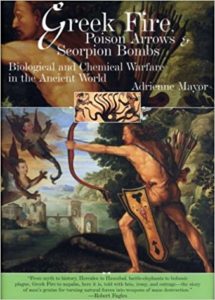
Adrienne Mayor, the author of Greek Fire, Poison Arrows and Scorpion Bombs; Biological and Chemical Warfare in the Ancient World, is a classical folklorist who excels at bringing to life to world of ancient toxicology and biological warfare.
As I have noted in my previous post, Tidbits of War -The Sylogge Tacitorum, warfare on the surface was supposed to be honorable, that is engaging in hand-to-hand combat. However, as we shall see from Ms. Mayor’ enticing book on the subject, rarely, if ever, was this employed solely. In fact, then as now, subterfuge, confusion, poisoning and deception were the tactics readily used.
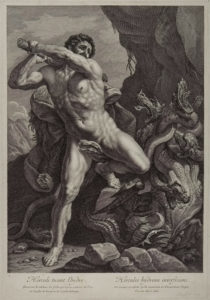
She notes that many of the classical myths have the heroes using poison arrows such as Hercules’ use of the Hydra’s venom which in fact may have been merely been metaphor for commonly used war practices.
Earlier people showed a surprising knowledge of the use of bacteria and poisons. Witness the early English long-bowman who placed his arrows, point first in the ground, knowing full well that the bacteria from the earth thereon, lodged in the flesh of his enemy would reek havoc in the form of a festering infection. Scythian archers went one step further, employing everything from feces to snake venom and toxic plants. As she describes, the Scythians were far fro the only ones to use these methods. In fact she devotes a significant amount of time to the subject of poisoned projectile devices, which is both illuminating and interesting. While much of this indicates a an astute knowledge on the part of the ancients regarding how people are affected by bacterium and disease, some of the recipes for military prowess are laughable, if not outright cringe-worthy, such as the Hindu use of ashes of cremated children and bird sperm to allow a soldier to walk hundred of miles without fatigue. Even today, the U.S. Department of Defense has been involved in the research for the reduction of sleep in American soldiers that includes the use of “magical genes in mice ad fruit flies” which is sure to raise a few eyebrows.
If you are not endeavoring to kill your enemy outright with poison arrows, perhaps another tactic is to poison wells, so that even if he attempts to avoid these poisoned waters, at the very least, he will be overcome by dehydration. This is a good tactic to use when retreating into your own land from a larger, more powerful army. Hellebore was used for this in the siege of Kirrha in about 150 CE. This created such a violent purge, that the men defending Kirrha had to abandon their posts on account of diarrhea.
Perhaps one of the most intriguing points brought up by Ms. Mayor was that of plague caskets. Indeed, I have posited that very idea in my second book of the Varangian Trilogy. Plague in itself was dreaded by all in the classical and medieval world. Short of merely lobbing the corpses of those who have died of the disease over your enemies castle walls, there were other, more nefarious ways of ensuring that your opponents would spread the disease. Bubonic plague, or Yersinia pestis in itself is not very contagious, yet when it morphs into the more deadly pneumonic plague, which can be spread via droplets in the air, that the trouble really begins. Ms. Mayor posits the theory that there were plague temples, particularly to Apollo (who among other things was a god of plague) where jars or caskets of plague were kept. Plague in this instance, could refer to any sot of pathogen, including smallpox. Smallpox infected blankets were handed out to Native Americans during the British Indian wars of the eighteenth century in the hopes of decimating their tribes. It was largely successful. It was no less a weapon in the Old World. She writes “One can imagine that a garment or some other item contaminated with, say. dried smallpox matter, could have been sealed away from heat, light, and air in a golden casket in the temple of Apollo in Babylon until a time of need. The item could maintain ‘weapons-grade’ virulence for many years.”
Religious places of worship were apparently frequently arsenals. Arabic sources reported that Byzantine churches were used to store naphtha, a major ingredient in the manufacture of Greek Fire. Ms. Mayor suggests that the Ark of the Covenant, was in fact, a plague casket, sent to bring down the Philistines. In Babylon, in the temple of Apollo, Roman soldiers burst in and loot, including the plague casket, which perhaps to them looked like an inviting bit of treasure. Soldiers are a perfect vehicle for spreading the plague, given that they march many miles in a day and camp life is ridden with a lack of hygiene and crowded conditions. Spreading contagion, even among your enemy, is always a risky business however, as your own troops and non-combatants may be infected.
The book goes on to describe “poison-maidens” lovely women whose very touch could bring death and poisoned honey, made so because the bees gathered their nectar from the poisonous rhododendron blossoms. This toxic honey proved to be the undoing of the Greek general Xenephon and his hoplites.
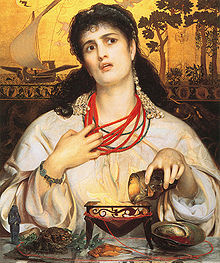
She examines the legend of Medea and her flaming cloak given to an Innocent and unsuspecting rival. Classical combatants utilized animals in warfare, from mice intended to spread plague to beehives and venomous scorpions launched over castle walls. War dogs and war elephants were used in open combat. The Vikings were known to attach incendiaries to sparrows so that when the birds returned at night t their nests in the thatch roofs of the enemy homes, the who town would be set alight. Such a tactic was hardly new to them and was known in the classical world, as noted by Mrs. Mayor.
Speaking of fire, my all time favorite, Greek Fire (also known as liquid fire and Medean Fire) gets plenty of stage time in chapter seven. Incendiary weapons are as old as time. Greek Fire is something special though. Largely a projectile weapon, it was famous for being very hard to put out and in fact water had little effect. Some said that water only served to fuel rather than quench its flames. It was said to have been brought to the Byzantine Empire by a man named Kallinikos and was supposed to have been kept in sacred trust by his descendants, supposedly a family known as Lampros. It has a striking similarity to that which Medea used in her conflagration of her rival Glauce. Another example would be modern napalm.
Altogether, Adrienne Mayor highlights the horror (and our fascination with it) of the many nefarious ways that man has contrived to wage war, bringing in modern examples to compare with the ancient ones. It is a highly readable book, well organized and documented. I recommend it to anyone interested in expanding their understanding of the ancient world.
Have you read this book? Let me know below what you thought about it.