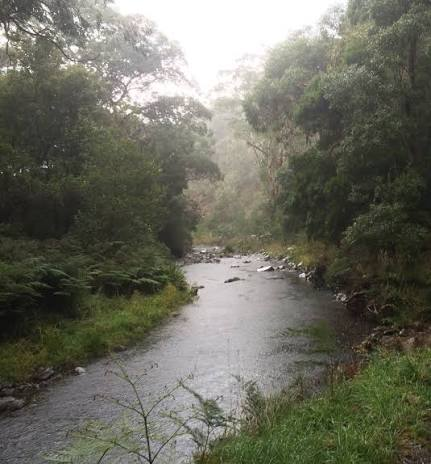
There is a wide river ranging through Appalachia, now known as the Cumberland, named so by a colonial explorer, Thomas Walker in 1758, presumably for the Duke of Cumberland. The river was known as the Wasioto by the Cherokee who hunted and lived in the area. Likely it was a name that continued to be used also by the white men who also hunted along its banks and traversed its treacherous waters. The Cumberland took a long time to take hold as a name.
What there was no uncertainty of was the danger in crossing it. By the time longhunters returned with their horses loaded down with pelts, the late winter snowmelt had swollen the Cumberland and her tributaries and made crossing difficult and fraught with danger.
Snaking its way almost seven hundred miles through limestone bluffs and cliffs of sandstone, three hundred of which flow through what is today Tennessee. Stunningly rich in biological diversity and home to more than three hundred fish species, as well as numerous avian, reptilian and mammalian life, one can only speculate what this rich and wild area looked like to early white and native hunters, long before there were bridges and highways and the Cumberland lay like barrier between the hunting lands and home.
The Lower Crossing of the Wasioto has no bearing in history and is something I created myself. Hunters frequently had shorthand for the geography they frequently navigated and it was just such a plausibility that brought about the name the Lower Crossing. However the crossing itself was no fiction and it did not take much to dramatize such a hazardous affair.
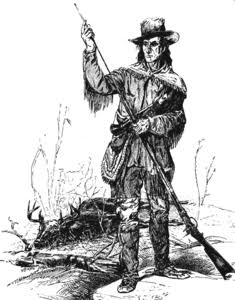
Longhunter Image courtesy of the Missouri State Historical Society (Creative Commons).
Johnnie goes next with the mare carrying Katie and one packhorse. The river is cold, bitingly so. It jolts the breath out of him. It swirls around his waist. The mare steps high, ears flicking. Katie shifts with her, every joint stiff. He glances back at Katie. She has said nothing since he handed her the pistol. Her face is white, making every freckle stand out. The mare whickers softly and Johnnie shushes her. Johnnie’s voice is a low chant—half nonsense, half promise—in that strange tongue of the Shawnee, and the pack horse finally lunges forward, water spilling off its flanks like surrender, they stretch their necks out into the current and begin to swim. The water comes up to Katie’s thighs now. The linen shirt clings to her like a second skin. Johnnie feels the river bottom give way under his feet, and he braces against the current. It’s biting deeper now—into knees, into thought, into the old scar on his ribs that aches like the Deuce. The water is murky. Dark. Treacherous. Logs and debris come their way and Johnnie guides the horses, dodging them. Out of the corner of his eye, he sees the dogs plunge into the water after him. No fear, those dogs. The mare trusts Johnnie. Her eyes are wide, but she pricks her ears in the direction of his voice. The pack horse is floundering. Johnnie keeps an eye on him. He’s one flicker away from panicking. The pack horse makes no sound. Just that floundering twitch—one shoulder dipping, nostrils flaring. Johnnie knows the look: the half-second before a beast forgets how to float. He moves to the pack horse’s halter and strokes the animal’s neck. They dodge a branch that comes out of nowhere. Johnnie can barely think for the cold, but he keeps on crooning to the horses.
The Longhunt by G.S. Brown
Navigating the river’s icy churn was far from their only concern. The newly formed nation was at war with Great Britain and many tribes, especially the Cherokee were mercenaries for the most powerful military on earth at the time. Far from the least of these tribes were the Chickamauga Cherokee led by Dragging Canoe who had no love for the settlers moving into his ancestral lands. Even if the long hunters were to make their way down to a reasonable ford on the river, there was always risk of ambush. And men preoccupied with handling fretful horses and valuable loads of furs were an easy target.
He guides the mare and the remaining pack horse out into the water. Ahead, Sweitzer’s horse falters midstream. Not from fatigue. From scent. The mare snorts once—ears rigid, flank twitching. Something’s changed. He glances behind them. On the bank he has just left, shadows slink from the trees. They melt to the bank like water. Like serpents winding through the grass, startling you before you even know they are there. He urges the mare forward. She is fatigued. She will have to put what she can into this last trip. Out of the corner of his eye, Johnnie sees the bronzy form of a Cherokee warrior. He is raising a musket. And he is pointing it at Johnnie. Johnnie feels the breath of the musket ball near his ear. The horses are too almost fatigued to be spooked from the gunfire. Ahead another ball hits the water in front of Sweitzer. They are still within range of a musket ball. That is too close. The balls slap the water like hail—not random, not wasted. The river hisses back, each impact a punctuation mark. Sweitzer curses. Johnnie leans into the mare, whispering her name like a shield. Something slaps his shoulder—hard. Not a punch. Not a burn.
The Longhunt by G.S. Brown
In The Longhunt, a party of longhunters led by Hoagland are forced to take a less desirable crossing than the Lower Wasioto, as it is guarded by men led by Dragging Canoe. Any such crossing was dangerous, choosing a far less preferable one could mean death. The spring snowmelt covered treacherous shelves of shale and shifting bottoms. Debris swept down from higher elevations threatened themselves and their horses.
The water churns where the horse went under—slick, dark, and silent. The shelf lies inches below the surface. The pack horse lunges left, seeking ground that isn’t there. The river doesn’t roar—it folds him in. Johnnie plunges into the water again, grappling for the halter. He feels himself caught by the undertow like the horse. Water sears his lungs. He feels the shale river bottom and then it is gone from under his feet. He feels the animal’s great body against him, feels himself being pushed further under the water by its thrashing body. This is it, he thinks. He has seen men succumb to the river before. Men with years of experience. The river takes no prisoners. Her teeth are edged with the blood of countless travelers. The pack horse is already gone. Swept into the river’s embrace.
The Longhunt by G.S. Brown
The Wasioto was a liminal threshold. A feral embrace of Mother Nature that signaled one last barrier back to what passed as civilization. While many settlers were led across the famed Cumberland Gap, only the most intrepid actually dared venture the slashing knives her waters bared to the unwary and the defenseless. Once on the other side, the longhunters were in a less contested country, filled with dense hardwoods and a moment to catch their breath and cross the ridge country before the final threshold of the Cumberland Gap. The Wilderness Road took the longhunters through this final leg of their journey, a blazed trail that McWilliams calls “Boone’s damnable Road.”
The journey was not for the faint of heart and the longhunters were often the first to traverse the trails that had been first footpaths of the native Americans. After them came settlers. My five greats grandmother Anne McIntyre was a baby born in 1779 in the worst of the confrontations between native and white settlers in what is today Davidson County, Tennessee, before even Fort Nashborough (now Nashville, Tennessee) was officially organized. Those that chose to come out to a place this wild at that time were the longhunters, the wilderness scouts, those intrepid enough to brave the teeth of the wilderness and the Wasioto.