The American Revolution is frequently framed — especially in modern academic circles — as a political struggle between a colonial bourgeoisie and a distant imperial government that had grown out of touch with the lives and labors of its subjects. In this familiar telling, the Revolution is driven by pamphlets, assemblies, and the grievances of people who — or whose ancestors — had crossed the Atlantic in search of religious liberty, political autonomy, and economic opportunity.
To a degree, that is true. And yet there were many – the children of convicts and Scots and Scots-Irish – who had very little choice in the matter or who had already suffered great discrimination and hardship in their native lands. It is primarily these who ended up in the buffer zone of the colonial frontier and who were looked upon by the British government as a human shield between themselves and the native tribes who pushed back against settler migration. As always, the British government maintained a supposed policy of maintaining political alliances with these tribes and at least outwardly, forbade its own citizens from pushing further into these territories, as outlined in the Proclamation of 1763 following the French and Indian War.
And yet there were many others whose experience of the Revolution looked nothing like this — the children of convicts, transported laborers, Scots, and Scots‑Irish who had endured discrimination and hardship long before the first shots were fired. These were the families who had little choice in their circumstances and who were pushed westward into the buffer zone of the colonial frontier.
To the British government, these frontier settlers served a convenient purpose: a human shield between imperial interests and the Native nations resisting settler expansion. Britain maintained formal alliances with those tribes and, at least on paper, forbade colonial settlement beyond the Appalachian divide. But paper boundaries meant little to families with nowhere else to go — and even less to the native nations who saw their homelands shrinking year by year.
The American Revolution is also frequently framed as beginning with Bunker Hill and “the shot heard ‘round the world,” made popular by Ralph Waldo Emerson. But that is a poetic imagining only. In reality, the American Revolution had begun well before that, in the backwoods and deep hollers of the frontier in Lord Dunmore’s War of 1774. Lord Dunmore was frequently accused of keeping the settlers occupied and distracted as he marched men about in the wilderness while the main theater of the conflict occurred at the battle of Point Pleasant now Point Pleasant, West Virginia. The conflict exposed a widening rift of discontent between backcountry settlers and the Empire. I often say that Lord’ Dunmore’s short-lived war was the true prologue to the real conflict that finally exploded into the American Revolution. It coincided with The Intolerable Acts that came forth as a result of the better known Boston Tea Party, sending over three hundred chests of tea into the Boston Harbor. Yet Point Pleasant showed that the emerging conflict was not isolated to any given area.
The seeds of discontent had clearly been sown not only in the settled farms and valleys of New England but in the far-flung frontier and woods of Virginia and Pennsylvania. Some could argue reasonably that indeed, it had been begun even earlier during the French and Indian War, a conflict that cost the British Empire considerably and for which it taxed colonists harshly, thus leading to the uprising that would be the American Revolution. The pockets of the East India company also were being richly lined at the expense of the colonists. Then as now, corporate interests were given presence over the people. The East India company was protected by Parliament. It had its own diplomats, army, navy and tax system and is not well enough considered in the system that led to the eventual overthrow of the Empire that stood behind it. Yet this is out of the scope of the current article, which is the way the Revolution was experienced on the western theater.
To further widen the division, many of those settlers of Scotsh-Irish origin had been given no reason to love the British Empire. Many of their forbears had been uprooted from lowland Scotland and forcibly settled in Ulster Ireland the century before.
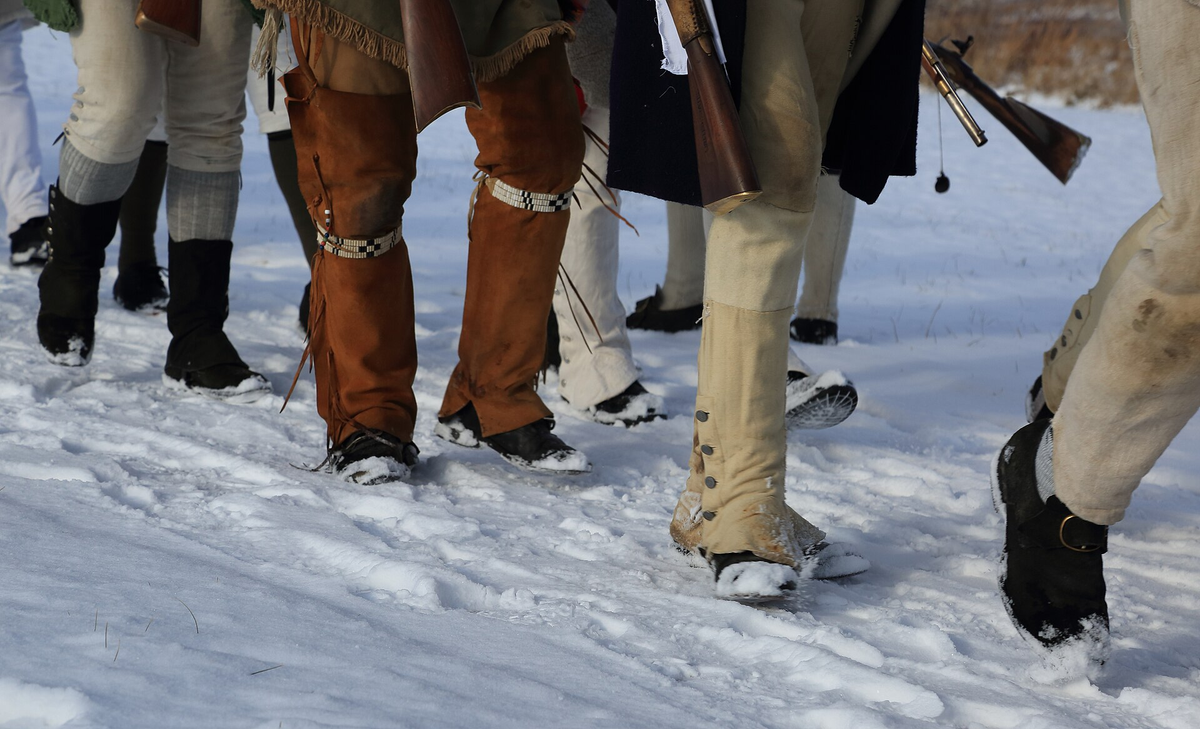
To those who hunted the wild woods beyond civilization and received very little news besides that which was traded over furs and corn flour at far flung trading posts, the war must have seemed very far away indeed. They had little to connect them to far away Boston or Williamsburg. And much of the conflict was driven by interaction with native tribes sent among them as mercenaries by the British. Occasionally they went up against uniformed soldiers such as George Rogers Clark’s campaign against a garrison at Vincennes. Here, Henry Hamilton the “Hair Buyer General” was captured at last by Clark, though he had been coordinating from Fort Detroit which was the British nerve center of the western theater and highly overlooked by most modern Americans trained to remembered Bunker Hill and Valley Forge. Also instrumental on the western theater was Fort Pitt (originally the French Fort Duquesne during the French and Indian War and rebuilt by the British) captured or more generally politically seized by Patriot forces early in the war.
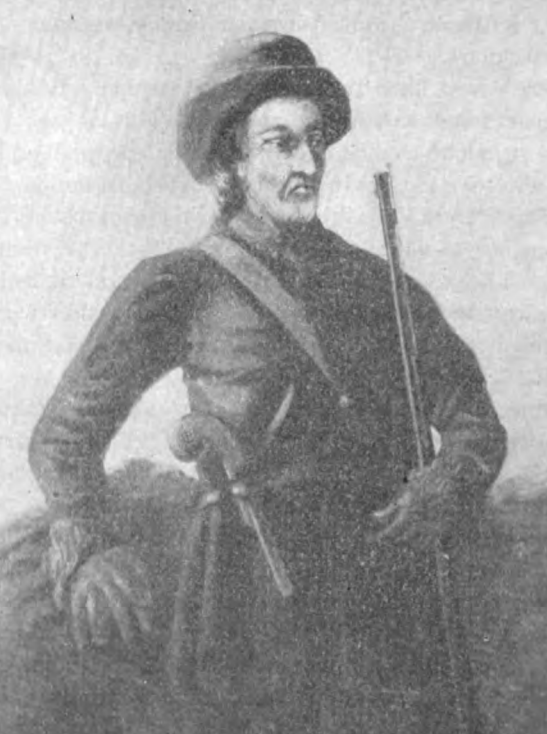
And there were, contrary to popular belief, provincial loyalists on the frontier, the most notorious of which may have been Irishman, Simon Girty, popularly known as “Dirty Girty” for his perceived betrayal of frontier patriots and his alliance with native tribes sent against settlers.
Longunters themselves were mostly apolitical, concerned only with who controlled the forts, the powder supplies and the fur trade. Yet even they could not be immune to the shifting political climate far beyond the Blue Ridge Mountains and extending to the terrain of the buffalo of the Kentucky cane brake, as I portray in this scene from The Longhunt:
“How long will the war go on when even Parliament does not support the King?” Hubbard asks.
“The King does vat he vants,” the taciturn Sweitzer says. He speaks even less than Johnnie if that is possible.
“Fook the King,” Johnnie says solemnly raising the flask of whiskey.
“Fuck the King,” echo the others. A vulgar toast.
“Last I heard,” McWilliams says, “Washington was up near the Hudson. Still holding the line.”
“And the French?” Hubbard asks.
“In Boston, maybe. Or gone. Who knows.”
They fall quiet again. The whiskey warms their bellies, but not enough to forget the cold. Or the war. Or the fact that none of them knows what day it is. Or that the war here is a different war being fought among the trees and shadowed things than what is being waged as far away as Saratoga or the Hudson Highlands.
Current events have a way of bringing all conflict into the open however. The Treaty of Paris officially ending the war in 1783, did nothing for the settlers’ experience and indeed they were only intensified. Whatever was said on paper in 1783 was not experienced by those in the west. We then went on to fight the Northwest Indian Wars that supposedly concluded with the Treaty of Greenville after the disastrous defeat of Saint Clair upon the sordid ashes of which, Fort Recovery was built in open defiance.
To most modern historians, there is a clear delineation between the War for Independence, The Northwest Indian Wars and the War of 1812 (a fresh reopening of old wounds) but for those experiencing them on the frontier, it might be better to frame it as one long continuous conflict stretching from The French and Indian War through the early growing pains of the 19th century. This could be said for settler and native alike. There was no room to breathe. There was no interlude. And this is itself perhaps the most defining difference between the experiences of the western woodsman and the eastern farmer.