Emesa, Golden City on the Orontes
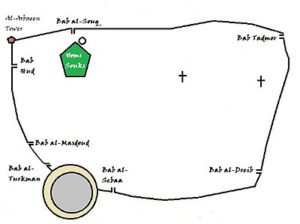
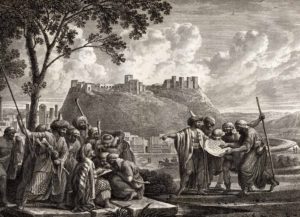
Seen from a distance the Citadel was a sprawling hill, topped by domes and arches, sloping down to the city of Emesa and the desert that encircled it. The entrance was a high face of sand colored stone, flanked by towers and entered by a long narrow bridge that gave way to yet another imposing gate. Bab al-Souq rose up before them, the stone golden in the afternoon sun. Dusk was sifting down into the street, thickening the shadows.
I mention the city of Emesa, Syria in my book The Plague Casket, as a destination by Ulf and Sophia. Today it is known by the Arabic name of Homs, though there is reason to believe that the Byzantines would have continued to refer to it by its Greek name, even after the Muslim conquest and subsequent loss from Byzantine control. It is a city that is no stranger to strife and siege. Homs has long stood as a key center of trade and agriculture going back to at least the Christian era. It was the home of the Roman empress Julia Domna who was a daughter of an hereditary high priest to Elagabal . It had, at one time, a great temple dedicated to this sun god. Currently the Great Mosque of al-Nuri stands on this site. One of the priests of the sun god Elagbal, was the seriously delusional Roman emperor Elagabalus (born Varius Avitus Bassus, also the grand nephew of Julia Domna) named for the god whom he served.
Homs is also referred to with moderate frequency by Usamah ibn Munqidh in his memoirs as published under the title An Arab-Syrian Gentleman in the Period of the Crusades. This venerable Syrian gentleman gave his name to the Citadel there. The tell upon which it was built dates back to at least the Bronze Age. Its strategic position on the Orontes River made it coveted by whomever had military designs in Syria, including the Byzantines. The Hamidids took control in 944 and it was from them that Basil wrested control in 999.
As a city, Emesa may have been founded by the Seleucid kings, following the death of Alexander the Great. It was already a very old city by the time Ulf and Sophia enter its gates in The Plague Casket. It has been identified by some archaeologists as the biblical Zobah which would date it to at least 2100 BCE. The Romans tolerated the worship of the pagan Elagbalus which during the Christian era gave way to churches which were torn down or converted to mosques when the Arabs regained control over the city. The city’s mosques were returned to Christian use when the Byzantines raided Syria in general and Emesa/Homs in particular when Basil II made yet another sweeping foray into Syria in 999 CE. The Arab geographer, Muḥammad ibn Aḥmad Shams al-Dīn al-Maqdis wrote in 985 that Homs was the largest city in all of Syria, but that it had suffered great misfortunes, indicating it had already been the source of much conflict, including the Arab-Byzantine Wars.