The Black Sea, Jewel of Eurasia

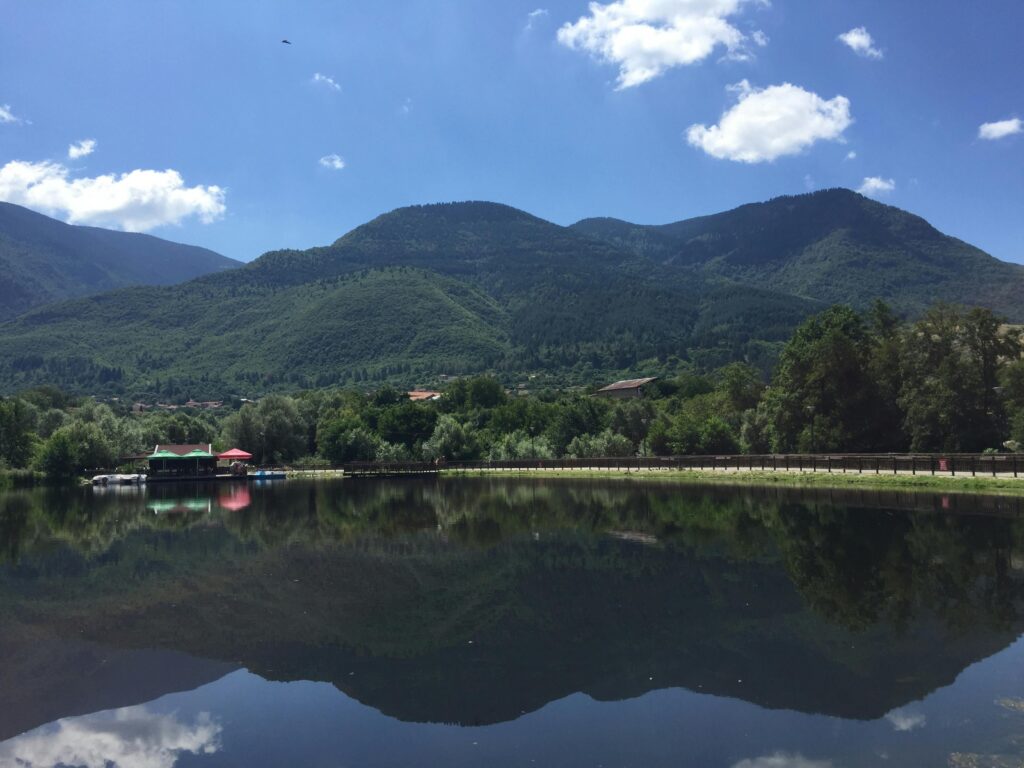
The modern coast of the Black Sea

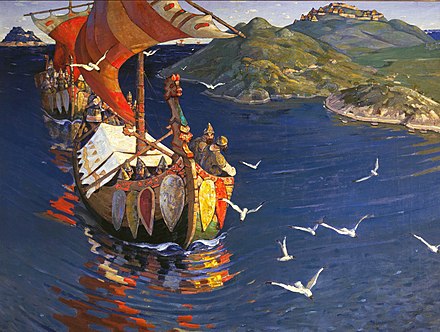
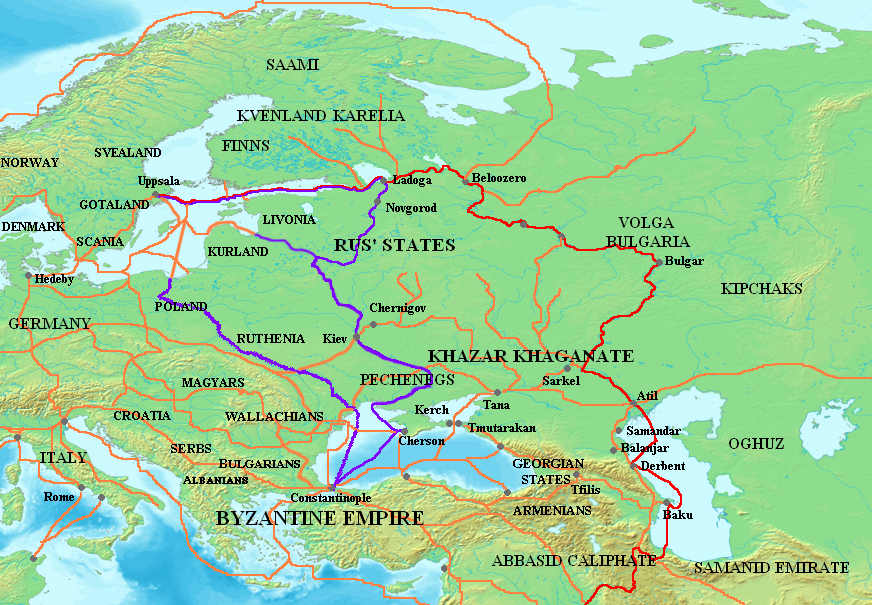
Constantinople lay at the  mouth of  Bosporus, leading to the Black Sea, surely one of her secrets to her expansive hold over commerce. Across from the Black Sea lay what is today Ukraine, but at the time was a constantly shifting arrangement of borders between the Varangian Rus, the nomadic Penchnegs and the ever opportunistic Khazars.  The Byzantine empire did business and war with all of them at one point or another.

Between the Black Sea and home, lay the Dnieper River for the Varangian traders that made their way  to and from the empire with their wares, furs, slaves, honey and many other  things. 

In The Serpentine Key, Sven sets sail across this sea on his mission with Vladimir of Kiev in a small, two-man boat. 

This was to be a clandestine operation. No need to leave from the main shipping area on the Sea. The boat was similar to the rigged faerings he was used to from back home, easily manned by two men, especially if one sailed close to shore. The waters themselves were usually calm, even at this time of the year. The Scythians called these waters Axinos – black. The Greeks called it the Euxine Sea.

The Serpentine Key by G.S. Brown

The Black Sea has not the biodiversity of flora and fauna of an area such as the Mediterranean.  However there are at least three species of dolphins living in the Black Sea as well as jellyfish a small type of shark, crabs, mussels and scallops. There is speculation that because of a lower layer of water saturated with hydrogen sulfide and that beneath this is a completely different world fed by an underwater river originating in the Bosporus. 

in 2018 one of the oldest intact shipwrecks ever found was confirmed at the bottom of the Black Sea. The Bronze age relic was dated to 2,400 years old and found at a depth of 2,000 meters.  It has been likened to the ship on a vase depicting Homer’s Odyssey.  The researchers said they would likely find items such as copper (a hot commodity at this time) and amphorae of wine.

At the height of the Byzantine Empire, the Black Sea continued to be an important avenue for trade and chief among these trades were slaves. As Islam did not allow the enslaving of other Muslims and Christianity did not allow the enslaving of other Christians, the prime victims for enslavement were the pagan Slavs. In fact, the name Slav is commonly cited as the origin of the word “slave” so often were these unfortunate people enslaved by both Christians and Muslims. As the Slavic tribes gradually fell under the sway of Christianity, they became less and less fodder for enslavement with the Christian empires, but many Europeans were still being captured and enslaved by Ottoman Turks as late as the nineteenth century. 

Because of the location of the Black Sea, it was not only an avenue to the Dnieper and Rus’ (now modern day Ukraine and Russia) but also a way to the East, especially the Levant. Commerce was alive and well and thriving throughout the time of the Byzantine Empire and it is safe to say that Black Sea more than helped to facilitate this as maritime travel was cheaper and faster than overland. 

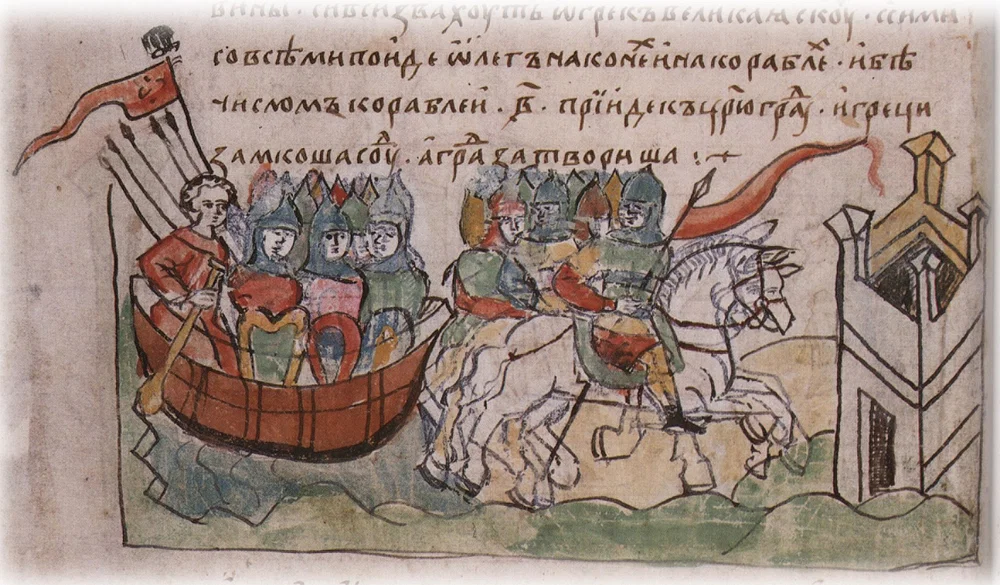
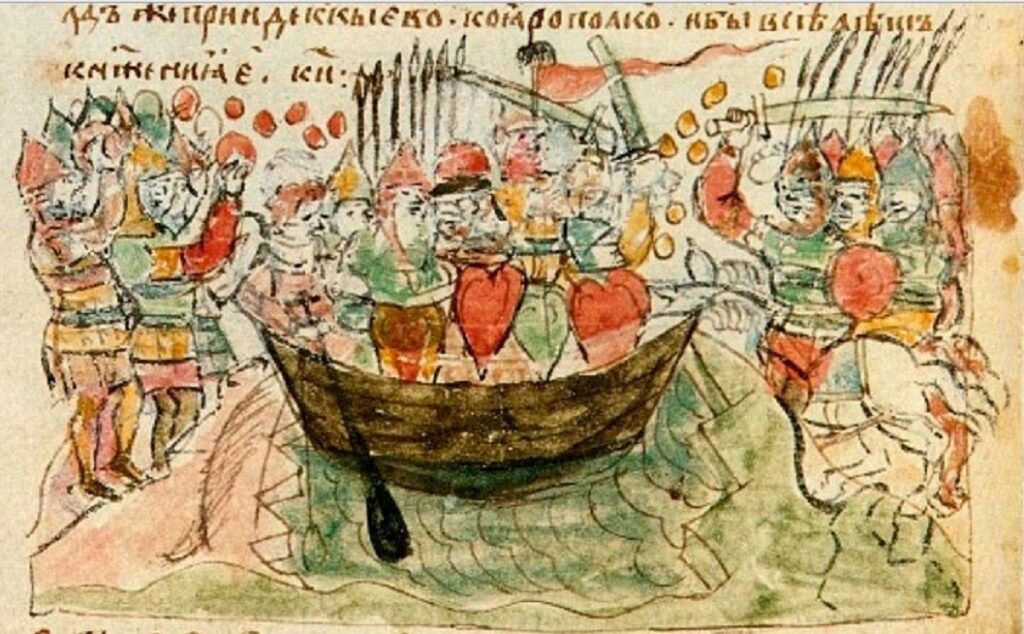
Greek Fire being used against the Rus in 941

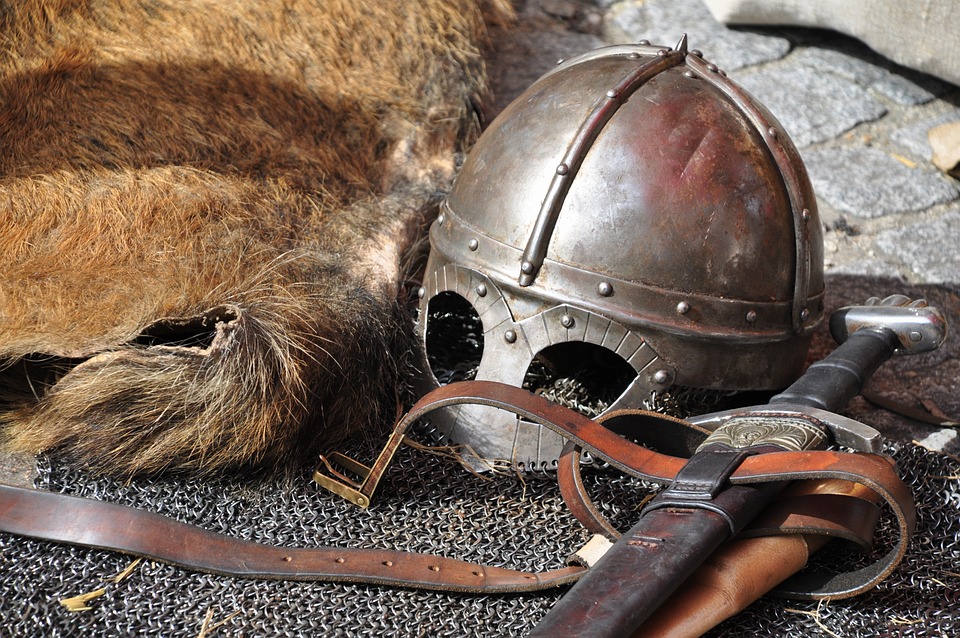
But just as the Black Sea brought silk and spices to the people of Constantinople it also brought violence.  in 941 the Rus, originally immigrants from Scandinavia,  launched a series of attacks with 1,000 ships (which must have been an incredible sight)  upon Constantinople and were only repelled with the aid of Greek Fire.  Though they were defeated, the Rus led another larger force in 944 and this time the Byzantines elected to settle the difference with trade agreements rather than prolonged warfare. The Rus’ were notorious for the brutality of their warfare, nailing the heads of captives and crucifying others. Clearly, the Byzantines felt they would make better trading partners than enemies and in the decades that followed there was a steady stream of commerce down the Dnieper into the Black Sea and the heart of the Empire. However, except for Varangian Guard, they were specifically forbidden from carrying weapons in the city or having too many of them in the city at one time. The Empire was not ready to go toe to toe with these fierce warriors again soon.  In 988, Vladimir the Great of Kiev became a Christian and the Emperor’ brother-in-law, effectively changing the Nordic/Slav culture north of the Black Sea forever. 

The Bold Akritai of the Eastern Frontiers

A little known backstory for Sven Thorvaldson in The Serpentine Key is that before he served in the Balkans with Basil II, he was a member of the Akritai. There is no evidence to suggest that Norsemen served in the Byzantine border patrol, but since the Norse (in particular the Rus) had served in various mercenary positions within the empire since at least 911 and often were deployed against the Arabs to the Empires’ eastern borders, it is not without the realm of possibility. So the backstory remains as Sven having a been a member of the Akritai.

The Akritai were recruited mainly native Byzantine infantrymen and Armenian soldiers, being comprised of both professional soldiers and irregular units. In short, they were a mixed bunch, not just militarily but also ethnically. Being on the border, they might have been from anywhere and may well have included mercenaries. According to Historical Sociology and  World History by Alexander Anievas and Kamran Matin:  “Akritai were exempt from taxation and entitled to full disposition of booty acquired through border raids…” which would have been a very appealing  and lucrative contract for mercenaries if they were not exempt from signing up with the Akritai. 

Their job was to secure the eastern border, but to also combat brigands, but they were just as likely to be brigands themselves. Their tactics seem to have been guerilla warfare, and involved getting the local populace to fortified strongholds, while harassing and shadowing the enemy, and in this way are reminiscent of American frontier warfare. Of course, if they could line their pockets with the gold of a traveling merchant, particularly if he was a Saracen, well who would notice?

The Akritai were reduced in importance in the latter half of the tenth century (about the time the fictional Sven would have left to to join the war in the Balkans and Basil’s continuing struggle against Tsar Samuil.) However they continued in some form until the latter half the of the thirteenth century. They were recalled by Basil to help him in his Balkan wars when manpower was low. This likely explains the distinctly Armenian vanguard that were responsible for getting Basil out of a tight spot at the ambush at Trajan’s Gate in 986. 

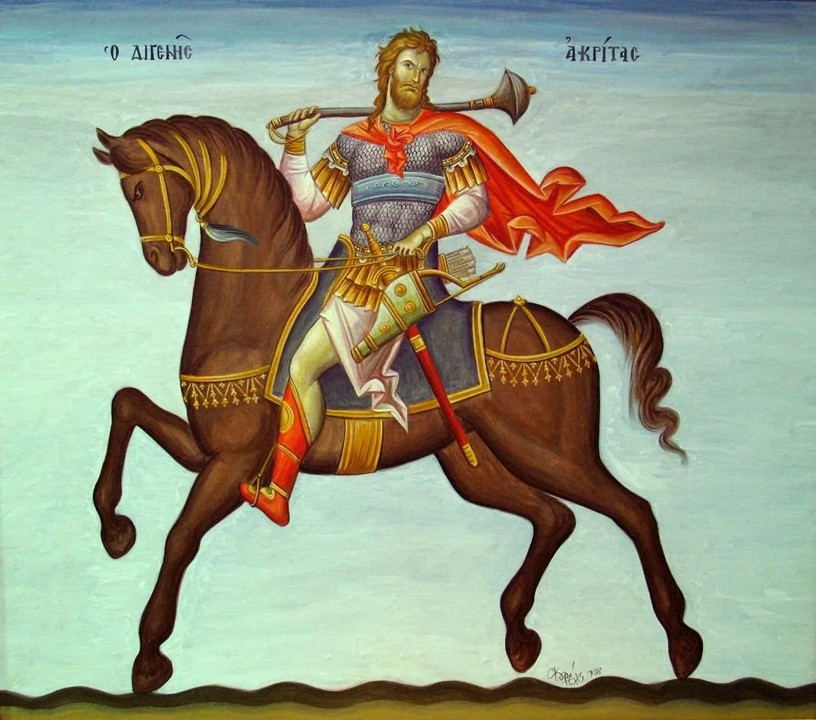
The Akritai are best remembered for the Akritic songs ( literally Ακριτικά τραγούδια “frontiersmen songs) the epic poems that celebrated the life of the guard of the Empire’s easternmost frontiers. Digenes Akritas is the best known of these and this one emerged sometime in the 12th century. The hero of this poem is named Basil, though he is known as Diogenes Akritas (“two-blood border lord”) the son of an Arab father and a Byzantine noblewoman. The original Akritac songs were likely oral and put one in mind of the Frankish Song of Roland, which tells the story of a hero much like Digenes Akritas. The Akritic songs might have even had an influence as far afield as France, as their influence showed up in Arabic and Slavic literature. 

Like the Danish Beowulf, Digenes also came up against a dragon amongst many other heroic exploits. Like Cú Chulainn of Irish myth, he possesses superhuman strength.  Like Cú Chulainn and his Scáthach, he has a love affair with a warrior woman, the Amazon Maximou. Perhaps this only proves how universal the Indo European folk tales really are. 

The Akritic Songs provide far more material than I have time to delve into in the scope of this article, but suffice to say, they provide an intriguing look at life at the time.  It was very popular for centuries and still retains a level of popularity in Greece today. A graphic novel has been made of the exploits of Digenes Akritas. 

In The Red Empress, the courtesan Khatia attempts to read a portion of the Lay of the Emir to a surly Asbjørn, with little success. 

When he only shrugged, she said “Or I can speak to you if you like, so you are not so obliged.” She had plenty of experience with men who had retreated into themselves like a cloak.

When he still didn’t reply, she said, “Shall I read to you?”

“If you like.”

With so little encouragement to go on, she sent one of her girls for a copy of one of the Akritai poems, Lay of the Emir. It was about a great romance of the Akritai border guards. She thought it might amuse and distract him. She searched for a passage most likely to be interesting and when she had, she began to read:

“They hissed like dragons, they roared like lions, they soared like eagles, and the two clashed And then you could see a fight between fine brave youths. In the heat of the battle they struck continuously, and from the great clashing and the cut and thrust the plains grew fearful and the mountains re-echoed, trees were uprooted and the sun was darkened.”

She looked up to see if he was still listening. It was difficult to ascertain.

“Blood flowed down over their horse-trappings and their sweat ran out over their breastplates Constantine’s black horse was speedier, and its rider was a marvelous young man. He charged at the emir and struck him a blow with his stick and then the emir began to tremble and flee. A Saracen addressed the emir –”

“Read instead from the Iliad,” Asbjørn interrupted.

Well that was better. She found she better liked his boorish abruptness to which she was accustomed than this stony silence. Still, she had begun to enjoy reading from the Lay of the Emir.

The Red Empress by G.S. Brown

There are also some elements that remind me of the heroic bogatyr from Slavic myth and perhaps some of the Varangians took these popular tales home to Rus’ with them where they influenced the Slavic folk tales. After all, the Russian bogatyr Dobrynya Nikitich also fought his dragon.

The Many Rebellions of Vidin

In The Secret Testament, Vidin was the home town of Desislava. It was also frequently the source of Bulgarian rebellion and often received the notice of Basil II during his Bulgarian wars. 

It is to Vidin that Desislava returns with her brother Dragan in hopes of finding her other brother Dimitri. They meet someone on the road who informs them of Vidin’s latest rebellion.

A bad business. Vidin has rebelled again. The emperor and his army are there. There is nothing for you there. There were those that fled there following the siege of Kastoria and they have dissolved into rebellion and incurred the emperor’s wrath.”

Desislava searched Dragan’s face. “It would be like Dimitri to be there.”

Then you wish to go on to Vidin to find our brother hanged with the other rebels? You hold out for much, Desi.”

The idea left a hard, gnarled knot in her stomach. She had refused to entertain any notion of Dimitri’s demise. It was as if doing so might give it form and substance. 

“We would have been better off staying among the Bogomils!” he snarled at her. Desislava turned her face away, glad that Dragan could not see how the words tore at her. Guilt swarmed inside her. Would it have been better to have left Dragan and gone on her own to pursue her search for Dimitri? And what if it all came to naught? For the first time, she allowed the thought that always lurked in the periphery of her mind to have a place by the hearth. What if he really was dead? Or even, if not dead at Kleidion, about to meet his end with other rebels at Vidin. The tether of her thoughts began to slip, as if she had once given them their head, they must now run away. On what slender filaments she had based her search for Dimitri! They both became silent. They continued on the road, because neither could break the silence to decide what to do. By midday, the air had become humid and sweltering. 

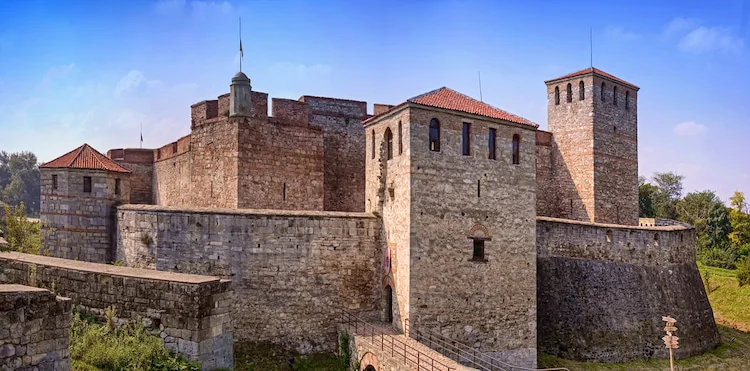
Vidin is still known today for the fortress Baba Vida. Baba Vida is named for a young woman Vida who was given the lands north of the Carpathians, while her tow younger sisters Kula and Gamza  were given Zajecar and the Timok Valley and  the lands west up to the Morava. Her sisters married disreputable men, but Vida remained unmarried and in control of her own lands and buil the fortres in her city of Vidin. The name of the castle means “Granny Vida While the story is a Slavic one, the area was originally a Celtic settlement known as Dunoniaand the site of the fortress was probably originally Roman.  It withstood an eight month siege against Basil II with the Bulgaria rebels finally capitulating to him.  Basil is said to have led an incursion against Vidin in 1002, whereupon Basil is supposed to have negotiated a ten year peace deal with Tsar Samuil. Whether this peace deal was violated and not negotiable for renewal or it was merely agreed upon to resume war upon it expiration is something that seems a little murky in the history books.  During this siege, Samuil attempts diversionary tactics against the Byzantine themata of Strymon and Macedonia and sacks Adrianople. However these failed to draw Basil away and Vidin fell to his army.

A conquered city could expect, in eleventh century terms, fairly humanitarian treatment from Basil. It usually meant mass resettlement in a far off place such as Anatolia. He would then resettle the city with a notably Greek population. This resettlement policy was not altogether successful, as evidently Bulgarians moved back into the city or they may have even had a considerable influence upon the Greek population.  Only sixteen years later, firmly under Byzantine rule, the people of Vidin rebelled again under Petar, a man who claimed to be the son of Tsar Gavril Radomir by his Hungarian wife. Whether he was or not was immaterial. The people rallied around him, in Vidin and the rest of Bulgaria. Basil had died and left the control of his vast empire, first to his useless brother and then to his equally ineffective nieces, in particular Zoe, who had extraordinarily bad luck with her husbands.

When the fictional Desislava and her brother Dragan return to Vidin, it is to the city once again being brought low by Basil II, though it is not clear if the current fortress was in service at the time as it was rebuilt during the time of Ivan Stratsimir in the fourteenth century. The records are scanty at this time for Vidin, but it seems the people were once again resettled. Vidin, for all her rebellious audacity had yet again been brought under the heel of the Eastern Roman Empire. A year later, Ivan Vladislav would be dead and the Bulgarian rebellion would come to a grinding halt. 

The Man in the Mountain

In The Secret Testament, the historical strategos Euthasthios Daphnomeles plays a vital role in the plot. I have chosen to portray him as an atholoulos of the Varangian Guard though there was no actual evidence he ever held this position.

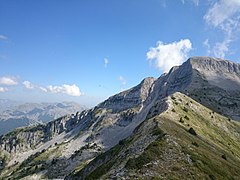
In 1018, the Eastern Roman Empire had brought down Bulgaria. the Bulgarian Tzar Ivan Vladislav was dead, either in battle or by his own hand (or some said, at the hands of a mysterious assassin, maybe even the ghost of Jovan Vladimir whom he had had beheaded). All of the Bulgarian nobles had capitulated to Basil II, save one, Ibatzes who had holed up on Mount Tormor in present-day Albania. Ibatzes held his position in the mountains for fifty-five days before Daphnomeles came up with a devious plan to bring him out. He hiked up to Ibatzes’ fortress Vrohot  with two associates, in this case, my fictional Varangians, Ulf and Þórgil. 

Daphnomeles was a noted general and distinguished himself in the Bulgarian wars. The fact that Basil did not tolerate unauthorized acts of valor and preferred instead obedience in his commanders, is interesting to note that Eustathios Daphnomles apparently took  matters into his own hands in the matter of Ibatzes. Perhaps in the light of his fabulous success in this incident, Basil was willing to over look it. Or perhaps Daphnomles cleared it with the emperor first. It was certainly a bold move and in the hands of a less capable strategist, it might have ended far differently.

The expedition to take out Ibatzes occurred in August during the Eastern Orthodox festival of the Dormition of Virgin, which was the observation of when the Virgin Mary was taken up to heaven. This occurred around August 15, which incidentally, was also the time of a pagan festival at Mount Tormor (named for a giant, Baba Toromor) that went back long before Christianity and observed the Albanian chthonic earth goddess  E Bukura e Dheut.

Ulf looked around him. The people were all carrying small beeswax candles, cupped in their hands to shelter then from the wind. The women carried branches of myrtle and some of them carried wicker cages with white doves. They stood aside on the path to make way for a commotion in the procession. A young girl of perhaps sixteen had been set astride a great he-goat that was being coaxed up the path by two young women. The goat had a rope around its horns and was not going willingly. As they passed Ulf and Þórgil, the girl watched them with large gray eyes. The color of her eyes reminded Ulf of Sophia. She had been Thracian and been born in this part of the world. He felt Þórgil’s hand on his shoulder. “We’ll have to hurry to catch up with Daphnomeles.”

            “If not the Dormition, what festival is this?”

            “Bukura e dheut. The golden-haired earth goddess fought over by the two giants.”

            “The people here are not Christian then.”

            “The people here still worship Father Tomorr,” Þórgil replied. “Very few Christian churches here. Those doves will be sacrificed at the top of the mountain. That girl will likely have her first man there, in the guise of Baba Tomorr.”

            “How is it you know so much about these people?”

            “Þórgil grinned. “The girl I told you about. The one who stuttered? She was from here. When she was younger, it was she who rose astride the goat to the top of the mountain. They do it every year.”

As they approached the opened gates of Vrohot, Daphnomeles muttered. “I had not thought that it would be this easy.” They continued on through the gates. By this time, the people, particularly the women, had ceased their loud, exuberant chatter and had become a great deal more somber. Ulf felt uneasy entering Vrohot without his sword. Even wearing no mail or weapons, he and his companions looked every bit the soldiers. He wondered that they did not stand out prominently in the throng of worshipers, most of whom were women. Some of them had begun to weep openly, dragging their hands through their hair, wailing and slapping their own faces. Ulf stepped over myrtle branches as all around him, the women appeared to be frantic with grief. It reminded him uncomfortably of a story someone had told him of the Greek Maenads of long ago who in their frenzy fell upon unsuspecting men who had the misfortune to happen upon their festivals. They were torn limb from limb, his source informed him gravely. Yet the few men who accompanied these women did not seem afraid of being in their company. Once they passed through the gates of the citadel, the worshipers made their way down a side street. There was a building at the end of it. Ulf assumed that this was their temple, but when Daphomeles swung left to join them, Ulf realized that this had to be the palace of Ibatzes. The doors stood open. The revelers went in and Daphnomeles, Þórgil and Ulf followed.

The Secret Testament by G.S. Brown

Daphnomeles lured Ibatzes into a false sense of security and allowed him to think that Daphnomeles was choosing to act of his own accord independent of the emperor and possibly even turning on him. However, bringing him away from his men, his two associates leaped on him, bound and blinded him.

They had moved a little farther away through the trees and Ulf could not hear Ibatzes’ reply. Per their instructions, they waited in place. Waited for the signal. Then they heard Daphnomeles’ shout from the trees. He had not gone far. Probably only far enough for Ibatzes to let down his guard. The akolouthos had Ibatzes on the ground, a knee set firmly between the unfortunate man’s shoulder blades. He struggled to reach the jeweled knife in in the scabbard in his boot. If it had been at his belt, he might have been successful. He cried aloud for his guards. It was to be hoped they were out of earshot of the palace. Ulf and Þórgil helped to restrain him. Þórgil tore a piece of cloth from Ibatzes linen tunic and stuffed it in his mouth, nearly getting his fingers bitten in the process. Ibatzes was trussed like a pig for the spit. Eustathios staggered to his feet, breathing hard. “You took long enough. You know what to do.”

The Secret Testament by G.S. Brown

The blinded Ibatzes was dragged before his people where he formally surrendered and was brought down the mountain. In this way, the last Bulgarian rebel was subdued and Basil II held complete sway over Bulgaria.

Daphnomeles successful venture earned him great rewards and the governance of the themata of Dyrrhachium. Too bad he could not have left it at that. Little over a decade later, he would try his hand at rebellion himself and was accused of conspiring with other governors in the attempted overthrow of Emperor Romano III Argyros.  Their punishment was to be beaten and paraded in shame on the Mese (the main avenue in Constantinople) where they were banished and never heard from again.

John the Orphanatrophus

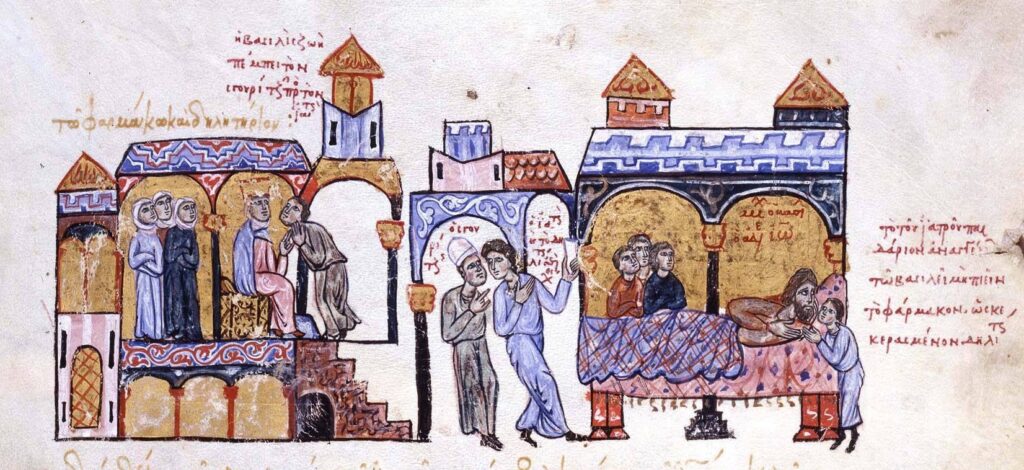
Zoe asks Sgouritzes to poison John the Orphanotrophos – illustration from History of John Skylitzes, 13th century

Anyone who has read the series A Song of Ice and Fire, by George R. R. Martin is acquainted with the fictional character Lord Varys, a prominent eunuch.  Without a doubt, John the Orphantrophus must have been the inspiration for this devious and avaricious character.  If there was ever a man made for the corruption of politics and the greed of empire, it had to be the eunuch, John the Orphanatrophus, the parakoimomenos (imperial chamberlain). He served in some capacity  to at least three emperors in the middle period. 

He began his career under Basil II as a protonotarios which is a clerk of the court. Under Basil’s successor, Romanos, he served as praepositus sacri cubiculiWhile serving under Romanos, he brought his attractive brother Michael to the attention of Romanos’ wife, Zoe, who was possessed of a wandering eye.  It might or might not be too much to say that he almost pushed Zoe into Michael’s arms. Considering the couple seemed to be behind the disturbing and suspicious death if Romanos (they were married one day later, which is not suspicious at all) and many were of the opinion that Zoe had been poisoning Romanos for some time before he succumbed to drowning in the imperial bath. It was certainly advantageous for John to have his brother become the emperor through his wife Zoe. Once Michael IV ascended, John’s own star rose. 


John did not come from money or power, but he certainly was able to readily lay his hands on both. His family was from Paphaloginia (in Anatrolia on the Black Sea coast) was said to in the business of money lending, considered to be disreputable, not withstanding the rumor that the family also dealt in counterfeiting. We have no record how he first came into Basil II’s service, but he quickly managed to garnish power for himself. After his brother was crowned he wasted no time in securing positions for his brothers and other family members. Position was guaranteed based on who you were not how qualified you were for the job. As head of the imperial navy, he appointed his brother-in-law Stephen the Caulker, whose only qualification for commanding a navy was caulking ships and to which he should have preferably left his expertise. He filled the Senate with men bought by himself and every position in government with men who were in some way dependent on the Paphlagonian dynasty.  While holding these offices, he also maintained his position as orphantrophus which basically meant he oversaw the managing of all the orphanages of the city, in particular the imperial orphanage of Constantinople. 

John’s brother was afflicted with epilepsy and often during imperial audiences, curtains had to be quickly drawn around the throne to shield him from public view in the event of a seizure.  Michael was also prone to dropsy and towards the end, he became so ill and infirm, much of the ruling was left to his parakoimemnos. It was clear to many that the empire was in reality in the hands of a despot. John the Eunuch had neither feeling nor a head for the power to which he had become accustomed. Even his own sister, Maria (who was married to the shameless excuse of a naval commander, Stephen) begged him to look upon the suffering of the Roman people. On a pilgrimage to the shrine of Saint John the Evangelist, she was struck with pity at the suffering of the beggars she saw alongside the road and the great need of the people. When she approached her brother, imploring him to have compassion, he replied,  (and here we can almost hear the sneering mockery in his voice) “You reason like a woman, ignorant of the necessities of the imperial treasury.”

John even went to far as to attempt to place himself as patriarch over the church, claiming that the appointment of  Alexios the current patriarch was uncanonical. Alexios, countered this by pointing out that he had overseen the marriage of Michael IV to Zoe and to de-legitimize his position, would also make the current emperor’s position null and void and so by association, that of John the Eunuch. This seemed to hush up the wily old eunuch pretty quickly.

The complexities of a personality like John’s must have been great, as Michael Psellos was able to write about him with both loathing and admiration, perhaps exciting in the historian a sense of displacement in his feelings towards chronicling the eunuch. 

There was surely no love lost between the empress and the oily eunuch as in The Red Empress, as always, he negotiated imperial policy with little regard for the empress’ own feelings, all the while manipulating his often ill brother, Michael IV. Perhaps no stranger to the art of poison, as the title picture illustates, Zoe attempted to have the eunuch poisoned as he was a thorn in her side. John very likely employed a considerable multitude of food tasters and likely took no chances with a woman of Zoe’s reputation.

Michael didn’t seem to be listening to either his wife or the Orphanotrophus. He tapped his fingers on the arm of his chair. “This man, Bourtzes, is he not related to the Macedonian line?”

He is in fact, a cousin to your wife,” John replied.

“Then would not there be an issue with charging him as you so speak? His father is from a powerful noble family. We would be bringing dishonor on them and in fact making enemies with them.”

“If he seek to kill you or your wife, it is because  he seeks recompense for his father and he hopes to ingratiate himself to the line of succession.”

But as the child of a woman not born in the purple, he is not even in line for the succession,” Michael scoffed. “What have we to worry about him.”

“You do not understand, imperator,” John patiently explained. “He is a danger to you, regardless if his claims carry any weight or not. He must be arrested.”

“On what charges?”

“Conspiring assassination.”

“Has he, in fact, attempted to assassinate me or anyone in my family?”

“It doesn’t matter. You must take him out before he does. And as you do not have an heir to the throne, it makes you and your succession vulnerable. There will be those who say, as you have no children, the succession is there for the taking.”

“Oh do go away with all your talk of money and politics,” Zoe moaned from the couch, “I have such an awful headache. How am I ever to bring about a successor if you will never visit my bed?”

“You might consider, kyria, that your time for giving the emperor an heir has expired,” put in the Orphanotrophus. “ You are not,” he searched for the right word. “Youthful any longer.”

“You have a lot of cheek!” she blazed at him. “If I wanted your opinion on the matter, I would have asked for it!”

The Red Empress by G.S. Brown

The Orphantrophus forced Zoe to adopt his nephew Michael V as her son, thus ensuring that power (so he hoped) would remain within his grasp, once his brother Michael IV breathed his last. Ironically and perhaps also karmically, this feat proved to be his undoing.  Once the young man assumed power, he proceeded to reduce the status in one way or another of those around him. Zoe he tonsured and exiled to the Princes Islands. But for his uncle John, he reserved most of his vitriol, even thought it was to him he owed his new status. He was deceived and brought on board a ship and exiled to the very islands to which he had condemned Zoe. Later, he was also blinded. While he was in office, he maintained an iron authority and exacted power that rivaled that of even the emperor. Ultimately, his overreach brought him low, ending his days in exile as so many powerful people did before and after him from Cicero to Napoleon. However, he never achieved such fame and few have read of the machinations of John the Orphantrophus.

Penchenegs and the Dnieper Journey

Þórsteinn strained against the carrying poles, sweat stinging his eyes. The land here was
steep and rocky. He and his companions made their way with their boat, poles placed through the oar holes. It was a small boat and could be transported thus overland. Still, laden down as it was, it was slow going. At their last portage they had paid some Slavs from a nearby village to help them roll it over a road, that could scarcely be called as such. This time, there was no such route by town and anyway, it was likely that few would wish to make such a journey. He wiped the sweat from his forehead and took the flask of water that one of them handed him. He was the only one from the northern isles. These other men were experienced and had made this journey every season from Kiev, some from as far as Novgorod.  He glanced up as the flash of sun off metal caught his eyes. Above them, on the steep embankment beyond the river, came a trilling cry. Gamli gasped and ordered the men to lower the boat and reach for weapons. Further, ahead the trees closed around the road. The boat tilted dangerously on its perch by the river. Þórsteinn grabbed his axe where it hung on the boat within easy reach. Horsemen poured over the slopes. The fringed horse equipment and felted caps, scarcely registered with him before his brain in some fevered way recognized them as Pencheneg tribesmen.

The Secret Testament by G.S. Brown

 A trip down the Dnieper was the most common way to traverse the territory from Rus’ to Constantinople. Waterways in general have been favored through the ages, whether the Dnieper or the Ohio river, as people could transport large amounts of goods on them and often roads were bad or even non existent. However, the Dnieper was not without its perils. Most famous of the dangers were the Dnieper Rapids, which in addition to the shallows of the river, made removing the craft and rolling it on the land necessary. There were seven to nine rapids (depending on whom you asked) and the travelers had to make portage which meant they had to bring their boat up on to shore and move it over land. This was done by rolling it over logs, moving the logs from the back to the front, a laborious and tedious endeavor. It was at this juncture that the travelers were most vulnerable. In the centuries in which travel was at its peak on this waterway during the eighth through the first half of the eleventh century, Penchenegs were a common menace to travelers. Pencenegs were nomadic horsemen of Turkic origin. Not much is known about them or their customs, even thought they were mentioned by many people from Anna Komene to Arabic and Polish sources.  They fomented frequent raids against the Rus for over two centuries,  putting Kiev under siege in 968.

 Basil II came to an agreement with them when they threatened to throw their allegiance in with Ivan Vladislav, tsar of Bulgaria with whom Basil was at war. Basil brought in loaded of carts of wealth, and quietly bought them off.  Whether bought off or fought off, the Penchenegs proved to be a thorn in the side of eastern Europe for a long time. They were known for their ferocity. Not a lot comes down to us about their customs, weapons, and mode of dress but I was able to piece a bit together from other nomadic steppe peoples.

Þórsteinn felt the hard impact of his axe blade as it made contact with the leather helm of the first man who came at him. His blow was poorly aimed and a hit that should have cut through helm, bone and brain, merely glanced aside. Knowing he would not have time to bring it back again for another strike at the man’s face where first he had aimed it, he instead thrust his shield boss into his opponent’s jaw, sending a rain of broken teeth and blood up into his face.
Putting his back into the prow of the boat, he waited for the press of men to advance upon him.
The smell of trammeled moss and soil mixed with blood, seemed a strange thing for him to
notice. The next Pencheneg who came at him wore a tunic of stained ox-hide. He carried a spear the shaft of which was decorated with locks of hair of many different colors. He aimed the spear at Þórsteinn’s belly and Þórsteinn parried his thrust with his axe, moving in close to the Pencheneg so his spear would be of little use, but he had not counted on the man dragging a knife from his belt with which he used to slash at Þórsteinn’s face.

The Secret Testament by G.S. Brown

Psellos tells us that the Penchenegs “wear no breastplates, greaves or helmets, and carry no shields or swords. Their only weapon and means of defense is the spear… in one dense mass , encouraged by sheer desperation , they shout their thunderous war cries and hurl themselves pell-mell upon their adversaries…pursuing them and slaying them without mercy.”

He goes on to relate their manner in the nomadic lifestyle to which they are accustomed: “…If there is no water, each man dismounts his horse and opens its veins with a knife and drinks the blood…after that, they cut up the fattest of the horses, set fire to whatever wood they find ready to hand and, having slightly warmed the chopped limbs of the horse there on the spot, they gorge themselves on the meat, blood and all. Their repast over, they hurry back to their primitive huts, where they lurk like snakes in the deep gullies and precipitous cliffs which constitute their home.”

They are frequently referred to as Scythians, but then so are the Nordic Rus in Byzantine sources, proving time and again that most people don’t know much about other people outside of their own experience. 

Furs, honey, slaves, amber, and beeswax were frequent commodities traded down the Dnieper to Constantinople (or Mikklegard as the Varangians called it). In return, they would carry back the luxuries of Constantinople, such as wine, spices, gold, glass and all manner of expensive things. Over time  the Dnieper carried back the faith and icons of Constantinople and Anna Porphyrogenita, the sister of Basil II, sent to be a bride of Vladimir of the Rus. 

In The Secret Testament, Þórsteinn is the sole survivor of such an attack, and only because the boat they were hauling overland slid down the embankment, pinning him underneath.

The Dnieper Rapids was where Svyatoslav met his end. Svyatoslav was a Rus prince and the father of the Grand Prince of Kiev, Vladimir. After the Penchenegs killed Svyatoslav, they made a drinking cup from his skull. As Svyatoslav was a pretty rowdy pagan himself, he might have approved this ending and might have done the same had the roles been reversed. 

Svyatoslav killed by the Penchenegs on the Dnieper

Constantine Monomachus attempted to use the Penchenegs as mercenaries, but they proved to be untrustworthy and were given to fighting amongst themselves. He then was reduced to fighting them himself, only to have to resort to bribery. But by this time, the Penchnegs were aware of the incredible wealth of the empire and would settle for nothing less  than large tracts of land and honorific titles. 

The journey traversed 1,200 miles to the Black Sea. Once they had reached the Black Sea, if the waters were calm enough, the hardest part of the journey was done.  This journey was estimated to take about six weeks. There is some evidence that winter travel was endeavored with sledges drawn by horses wearing crampons to keep their shod feet from slipping on the ice. 

All in all, the journey was treacherous and not for the faint of heart. IN some ways it reminds me of the journey down the Ohio in the late 18th century, experienced by intrepid ancestors. This too was fraught with rapids and attacks from the shore. However, in the case of the Rus, many did not intend to settle, but would make the return homeward again at the end of the season, intending to return in the spring. However many did settle and their descendants occupy many of the surrounding areas to this day.

Sumela, Pinnacle of Paradise

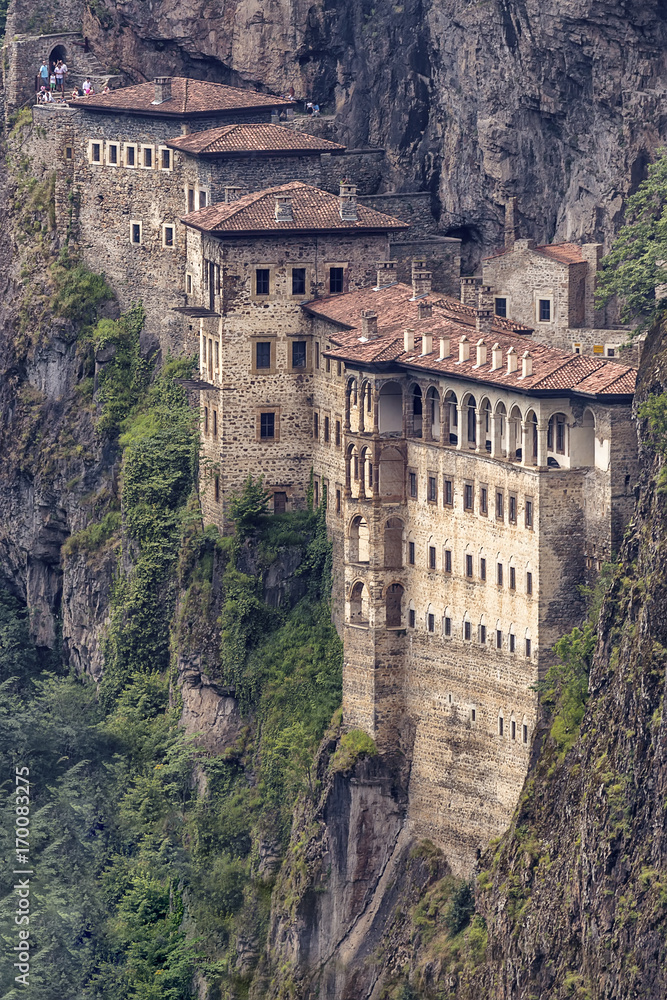
Sometimes an incredible setting is what gives impetus to my writing. It is said that “setting is a sexy character” and certainly some have a seductive quality to them. This could be said about the 1600 year old monastery of Sumela in present day Turkey. Carved impossibly high in the rocky face of a cliff, it has silently observed the comings and goings of mankind for over a millennium and a half.

Sumela is a Greek Orthodox monastery dedicated to the Virgin Mary. The name comes from the Greek for “black mountain.”

Basil II was known to be quite generous in his donations to Sumela. This was perhaps what first led to my interest in this UNESCO World Heritage site that was founded possibly as early as 386 CE in the Black Sea region of Turkey (near modern day Trazbon), then part of the Eastern Roman Empire.

Describing this marvel from the point of view of someone who was seeing it for the first time (in this case Ulf Svensson) was intriguing as I myself have never been here. Reconstructing it from travel videos, personal accounts and photos brought me hopefully to a somewhat accurate rendering as Ulf and his men accompany the emperor and the archimandrite (Greek Orthodox abbot) up the steep steps that wind their way to the monastery. In this context, Basil II and his Varangians are head to Kartli (modern day Georgia) to negotiate terms and head off a possible alliance with the youthful king of Kartli Giorgi I and the Fatamid caliph al-Hakim. Sumela was a stop off point for Basil and worked itself beautifully into the plot of the story.

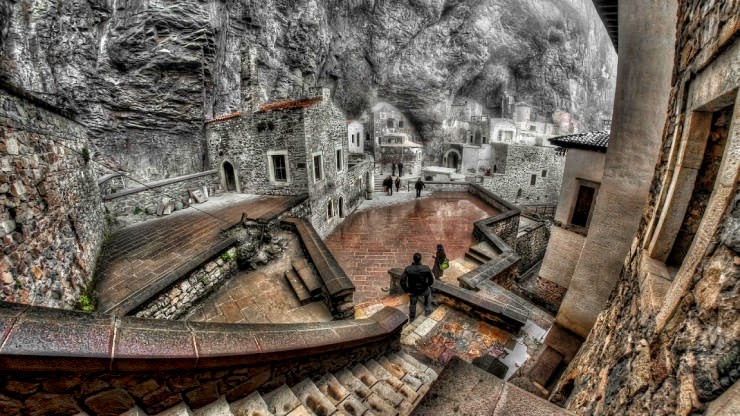
The emperor had sent word ahead to the archimandrite of the Sumela Monastery to expect him. From what Ulf had heard, Basil had gifted the religious establishment handsomely. He expected the monastery to be lavish, like a palace, to be so fortunate as to receive the special notice of the emperor. Now they stood at the foot of the mountains and looked up at the craggy pinnacle. Nestled in the rocks and swathed in a shroud of fog that was beginning to settle over the valley lay the face of a monastery, looking out upon the forests and valleys like a sentinel. It appeared more of a fortress than a sacred place. The archimandrite appeared like a specter at the base of the winding trail that disappeared into the forest. He held up one hand in silent benediction. The emperor likewise nodded to him without speaking a word. They left their horses with the grooms at the foot of the mountain and began their ascent. The heat of the day had become oppressive. The sun long ago had burned off the fog, but a sticky humidity lay in the air. The men shed their cloaks. Ring mail and shields had been left with the horses. The trail was fraught with rocks and roots from the trees that clung to the mountain like a suckling child to its mother. It twisted and writhed around the rock face and then suddenly, there were stairs, cut into the rock, merciful only in the evenness they provided, but no less steep than the trail had been. Ulf felt his hair stick to his neck. The archimandrite, though seemingly a frail man, did not slacken his step in the slightest or even pause. The emperor was the oldest among them and his Varangians adjusted their pace for him, till soon it seemed to Ulf that they might lose the archimandrite around the twisting stairs hugging the ancient mountain. He paused momentarily, looking down at the expanse of trees in the valley below. It seemed incredible to him that such a building could be so constructed as if it were a part of the mountain itself. And then suddenly, the rock face opened up and they stood before a courtyard over which the mountain loomed. Ulf now saw that they were behind the face of stone that they had seen from the bottom of the mountain. The buildings were squat and angular and seemed to emerge from the mountain itself as if the rock had given them birth. In the center – a part of the cave itself – was a large church, covered in frescoes of brilliant colors, all depicting religious figures. Ulf had done much traveling all his life, but he took a moment to marvel at the sight before him. He had never seen anything like it.  All at once, he seemed to forget his weariness from the weeks of travel. Beside him, his companions’ sudden stillness indicated that the view had much the same effect on them. There was nothing palatial in the edifice, as Ulf might have supposed but the place had a quiet, and reserved dignity, almost, he thought, a touch of aloofness.

The Secret Testament by G.S. Brown

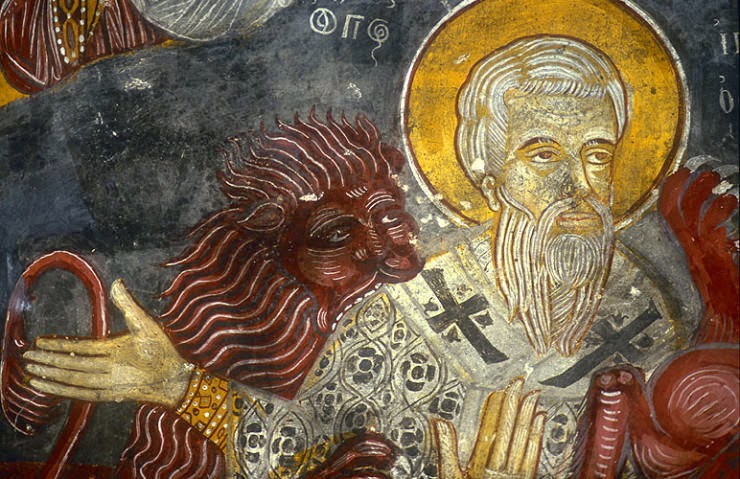
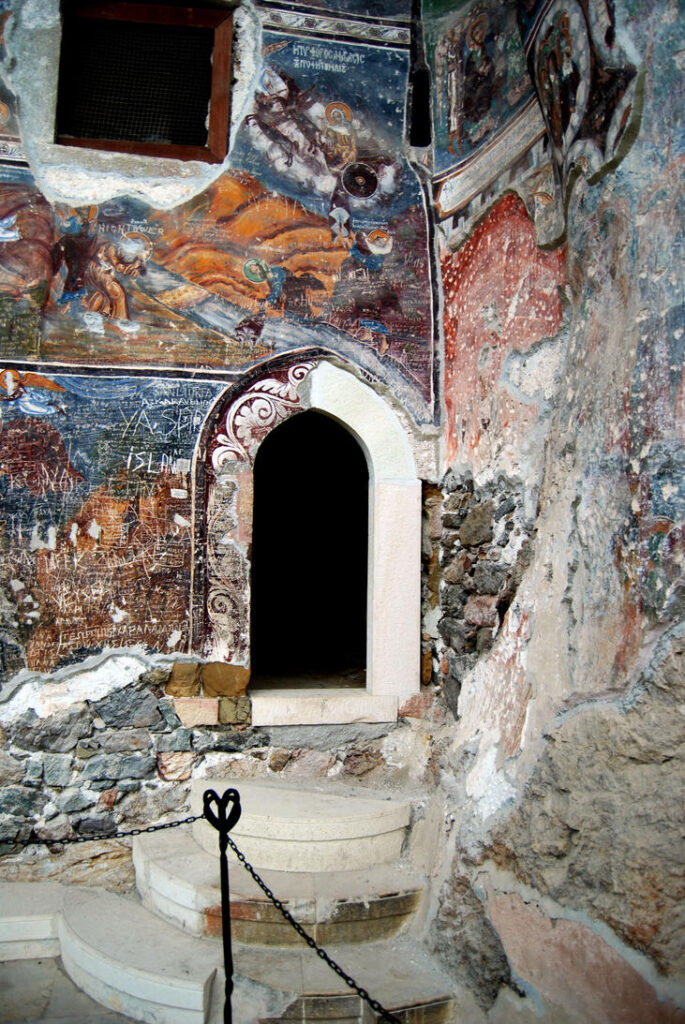
Many visitors come to it every year (though it was closed for three years for restoration work as the structure had become unsafe). The attraction lies not only in its incredible design, but the frescoes on the walls. Many have unfortunately been touched by vandalism, yet the brilliant colors with which they were imbued is still evident today. The monastery is supplied with its own aqueduct and has numerous rooms and buildings including a library and a kitchen. It appears that, for at least the standards of its time, it was quite comfortable.

A secret tunnel was discovered at one point and even more frescoes were found. As described in The Secret Testament, visitors to the monastery must first make their way up a steep trail and then a series of steep stairs before they emerge in the aerie that is the monastery. The long flights of stairs, wend this way and that before they emerge at the monastery. The engineering genius to build an edifice of this size into the sheer cliff of a mountain is astounding.

Furthermore, that the paint on the frescoes has lasted as long as it has, albeit with vandalism, shows the knowledge in their materials. In modern times we struggle to keep our surfaces painted without peeling completely in a few years. The incredible detail and magnificent designs show us the the monks put their time in their lofty isolation into good use. This site is yet another example of how those who came before us were far from regressive or backward.

Michael Psellos, Philosopher and Instigator

In my fourth book, The Red Empress, Michael Psellos, is a viewpoint character, not least of which is because he seemed to be in so many places, have so many opinions and write on such a plethora of subjects. He is best known for his Chonographia, a history covering at least a century leading up to the time of Psellos himself, in which in his contemporary writings, he maintains those opinions for which he himself was an eyewitness.  In addition to his historical writings, he was also known for bringing Plato back into serious study in Constantinople and was a disciple of music theory and philosophy.

In my last post, I mentioned his observations on the strategos Georgios Maniakes, including his prodigious height. He was also witness to the evacuation from Constantinople of the emperor Michael V and his uncle the nobilissimus when things began to take a dangerous turn for those two gentlemen of dubious character. From what Psellos leads us to understand, he was coerced by them, but given his position as an imperial secretary, it is likely that he went along because, after all, it was part of his job. In the tumult of the riots in Constantinople following the reinstatement of the empress Zoe (the erstwhile emperor Michael’s adoptive mother), when Michael and his uncle were forced to flee to the Studikon monastery, they clung to the alter of the monastery. When this proved to be fruitless in averting their fate, Psellos witnessed their eventual blinding at the hands of the Varangian Guard (some say by Harald Sigurdsson personally, who probably also had an axe to grind with Emperor Michael). 

Psellos was actually born Constantine (arguably one of those most popular names for men at this time and place) and chose the name Michael when he entered a monastery later in life. Psellos, as a last name was probably more of a nickname and meant “stammerer”, an ironic appellation given that he was known for his copious writings, but perhaps, he was, like most writers, better at expressing himself through the pen than the voice.

When my story opens, he is a young man who has just been able to return to his studies under the venerable Ioannes Mouropous. His studies had been interrupted by the need to earn a dowry for his sister, and so at the age of ten, he was sent outside the city where he was employed as a secretary to a provincial judge. When his sister passed away, he was allowed to return to study under Mouropous. The latter was undoubtedly responsible for the social climb of the young Psellos, who, under his influence, would meet and rub elbows with many who would later be notable such as the emperor Constantine X. As John Julius Norwich says in his book Byzantium – The Apogee, “[Psellos] thus writes of events in which he not only experienced but frequently himself helped to shape and control.”

As he was a personal friend of Constantine X, it is hardly surprising that some of his writings regarding that man were rather prejudiced in his favor.  Yes he spared no gushing rhetoric on the aforementioned Stephen who fancied himself a naval commander. We see some of the true Psellos in his snide assertion that “I saw him after the metamorphosis. It was as if a pygmy wanted to play Hercules and was wanting to make himself look like the demi-god. The more such a person tries, the more his person belies him – clothed in the lion’s skin but weighed down by his club.”

I find such scathing assertions make Psellos one of the more readable biographers of his time.  He is witty and opinionated. Perhaps not the best attributes of an impartial historian, but without a doubt, he gives us a peek into politics as only politics in Constantinople could truly be.  We are given a hint of the real Michael Psellos who was known to write a taunting letter to the disgraced emperor Romanos Diogenes as he lay in exile, dying of the infection in his blinded and bleeding eyes. Here he congratulated him on his martyrdom and the loss of his eyes as God had found him worthy of a “higher light”. It should not be lost on the reader that it was Psellos himself who had engineered the emperor’s downfall.

As such, Psellos was a product of his environment and the times, equally avaricious and opportunistic, once given a taste for power, he was not likely to let it go. The term “byzantine politics” comes to mind when speaking of Psellos here. In all the chaos of the riots in Constantinople following the reinstating of the empress Zoe, Psellos’ greatest concern was that the empress Zoe see that he was not personally affiliated with Michael V and this his loyalty was instead reserved for her. Yet he did not spare her, acerbically commenting on the “transformation of a gynaeconitis [women’s quarters] into an emperor’s council chamber.”

He was even more blunt later on the Chronographia as he wrote on their political blundering (diplomatically after both the sisters had passed on of course):

“For those who did not know them it may be instructive if I give here some description of the two sisters. The elder, Zoe, was the quicker to understand ideas, but slower to give them utterance. With Theodora, on the other hand, it was just the reverse in both respects, for she did not readily show her inmost thoughts, but once she had embarked on a conversation, she would chatter away with an expert and lively tongue. Zoe was a woman of passionate interests,

prepared with equal enthusiasm for both alternatives—death or life, I mean. In that she reminded me of sea-waves, now lifting a ship on high and then again plunging it down to the depths. Such characteristics were certainly not found in Theodora: in fact, she had a calm disposition, and in one way, if I may put it so, a dull one. Zoe was open-handed, the sort of woman who could exhaust a sea teeming with gold-dust in one day; the other counted her staters when she gave away money, partly, no doubt, because her limited resources forbade any reckless spending, and partly because inherently she was more self-controlled in this matter.

 To put it quite candidly (for my present purpose is not to compose a eulogy, but to write an accurate history) neither of them was fitted by temperament to govern. They neither knew how to administer nor were they capable of serious argument on the subject of politics. For the most part they confused the trifles of the harem with important matters of state. Even the very trait in the elder sister which is commended among many folk today, namely, her ungrudging liberality, dispensed very widely over a long period of time, even this trait, although it was no doubt satisfactory to those who enjoyed it because of the benefits they received from her, was after all the sole cause, in the first place, of the universal corruption and of the reduction of Roman fortunes to their lowest ebb. The virtue of well-doing is most characteristic of those who govern, and where discrimination is made, where the particular circumstances and the fortune of the recipients and their differing personal qualities are taken into account, there the distribution of largess is to be commended. On the contrary, where no real discernment is exercised in these questions, the spending of money is wasted.”

Michael Psellos, Chonographia

Whether this was the misogynistic temperament of the times that influenced Psellos’ writing or an actual candid observation, it may be noted that many of the failings in a male ruler might have been forgiven him would be called into greater scrutiny on the part of a woman. However, as a contemporary biographer, within the confines of the imperial residence, he was certainly closer to the facts that we are today.

A Giant of His Time – Georgios Maniakes

“I have seen this man myself, and I wondered at him, for nature had bestowed on him all the attributes of a man destined to command. He stood ten feet high and men who saw him had to look up as if at a hill or the summit of a mountain.”

Thus the 11th century historian and writer Michael Psellos described Georgios Maniakes in his Chronorgraphia.  Maniakes was an 11th century Byzantine strategos (general) and catepan of Italy.

It is telling in the work of modern researchers  that they cherry pick which of Psellos’ writing to take seriously and dismiss out of hand his claim that the notorious general stood as tall as Psellos described him. Yet, it was not uncommon to describe gigantic human beings and indeed there are numerous archaeological examples of humans ten feet and taller. Armenian warriors are described elsewhere as ten feet tall.  I am inclined to believe that the Armenian strategos really was this tall.

In any case, he was a giant of his time, as he had a reputation for numerous military accomplishments. It is a shame, that as a brilliant military strategist, he had not the control necessary over himself and his temper as he did over his troops, or he might have been truly great. The element in his army that author and historian John Julius Norwich describes as “heterogeneous” was largely Varangian. Yet this was also an element that as an almost general rule, had a strong independent streak and did not take well to coercion, which as we will see, worked to undermine Maniace’s control in the Mediterranean.  In addition to the Varangian, were the Lombards, led by a man named Arduin and a contingent of Normans led by William de Hauteville. The Normans were largely mercenaries and were hard to control without coin,

Psellos went on to speak of Maniakes: “There was nothing soft or agreeable about the appearance of Maniakes but put one in the mind of a tempest; his voice was like thunder and his hands seemed to be made for tearing down walls or smashing doors of bronze. He could spring like a lion and his frown was terrible. And everything else about him was in proportion. Those who saw him for the first time discovered that every description they had heard of him was an understatement.”

Given this, admittedly rather epically written description of the famous strategos, one can only imagine the effect he had on the emperor’s brother-in-law, Stephen the Caulker. Stephen was a completely unremarkable man who, due to his favorable juxtaposition by marriage and happenstance, found himself appointed to naval commander, a position to which he was in no way suited or qualified.  In short, he was an idiot and was better suited at caulking ships rather than commanding them. Maniakes was not a man to suffer fools gladly, so it was only a matter of time before these two would clash.  As it turns out, Maniakes did not get along with very many of his men and there was an inevitable clash with the Varangian leader Haraldr Hardrada, a man who was not a fool, but did not get on well with the bullying Maniakes. He certainly made enough of an impression on Haraldr, for Maniakes was mentioned in the Norse sagas where he was known as Gyrgir.

He did manage to get a nice fortress named after him. Castle Maniakes in Sicily.

The campaign in question was Sicily and the enemy was the Saracens who had long held the island.  Maniakes and his men took Messina and Rometta almost, it seems, without trying. The problem began at Syracuse. The Byzantines had won much booty from the Saracens, gold, jewels, precious fabric military equipment and horses. Given that the Varangians had a long standing agreement as part of their service, that they would receive a lion’s share of the booty. It is only reasonable to assume that there were stipulations made for booty on the part of the other commanders, such as, in this case Arduin the Lombard. For his part, he chose a magnificent Arab stallion.  It was a shame that Maniakes also had his eye on the same stallion. He demanded that Arduin relinquish it. Arduin refused. He was soon relieved of the horse anyway and stripped and beaten for his audacity. This humiliation seated within Arduin a deep and abiding hatred that would eventually lead him to switch sides and rebel against the Byzantines. As for the other troops, the Normans led by William de Hauteville and the Varangians looked upon this treatment of their fellow Germanic warrior and turned and walked out. The Normans would go on to revolt against the Byzantines and continue the Sicilian campaign independently and solely for their own gains. The Varangians returned to Constantinople. Maniakes was left with a reduced army with a depleted morale.

Once again Maniakes’ overbearing ego and his enormous temper, got him into trouble. However the real conflict between Stephen and Maniakes did not truly come to a head until the Battle of Dranginai, which according to all accounts, was a win for the Byzantines. They used special metal cases on their horses feet to protect them from the devastating caltrops that the Saracens had left to cripple and disable them. With the unexpected development, that they faced a cavalry charge that they thought they had completely incapacitated, the Saracens were left surprised and bewildered.

In addition, a dust storm rose up on the plain and left them blinded and disoriented. In the midst of all this, Stephen the caulker had one job and one only. As the naval commander, he was supposed to guard the cost with his fleet and prevent the escape of Wallah Abdullah, the Saracen commander. There is no record on what exactly happened here. Was Stephen sleeping? Was there a fog that enabled Abdullah to escape? Whatever happened, the Saracen commander slipped through the Byzantine network of ships sitting off the coast. The result was a furious Maniakes when he discovered what he supposed was Stephen’s brash ineptitude. When he confronted Stephen, reportedly with the handle of a whip. And while he is said to have beaten him, he must have, for all his size, used a modicum of restraint, as Stephen was able to escape alive and send word to the emperor, his brother-in-law. The result was that Maniakes was recalled to Constantinople. He was not given a chance to defend himself and found himself in prison, where he languished until the throne again received a new imperial behind in the person of Michael V.  The command of the Sicily expedition went by default to Stephen, a most unwise choice, as the campaign deteriorated under his inexpert leadership. Two years later Michael V released Maniakes from prison and he was sent back to Sicily which is found in a shambles, much of what he had won for the empire had been lost once again to the Saracens. Perhaps his name would have been remembered with more fondness had he been able to restrain his ego and his ambition. Yet the very things that had made him great were also his downfall.

An Update After an Extended Time Away…

I have come back to my blog after an extended time away. It has not been for a lack of writing as I have begun on my fourth book The Red Empress. The Red Empress is set around the events that led up to the dethroning and eventual restoration of the Empress Zoe and the exploits of the Haraldr Sigurdsson, who would later be known as Haraldr Hardrada – “the Hard Ruler” and king of Norway. Haraldr is accompanied by a fictional character from Rus, Asbjørn Ulfsson. It certainly leads one down some fascinating historical avenues, not least of which is the role Haraldr Sigurdsson played as a Varangian Guardsman and part of the armed escort to the pilgrimage of the Imperial family to Jerusalem as stonemasons were sent there to rebuild the Church of the Holy Sepulcher.

In the early eleventh century, the son of the “mad caliph” al-Ḥākim bi-Amr Allāh had the church completely destroyed, but his successor, Al-Zahir li-i’zaz Din Allāh, was the son of a Byzantine woman and had no such compunctions against the Christians and graciously allowed them to begin rebuilding the church in 1027. During this time, around 1034, a great procession made its way to Jerusalem not only of the builders and stonemasons who would commit to the work, but some of the imperial family, to whom the Varangians were tasked with guarding on the possibly treacherous journey from Jaffa to Jerusalem.

It has been an interesting journey for myself to commit to the research surrounding such an event. A pilgrimage, even from Constantinople was no small task. To disembark in Jaffa was perhaps not to the liking of those who were used to finery and luxuries within the Imperial City. Jaffa was the only way at the time to get to Jerusalem by sea. However there was no harbor and one had to be rowed to shore, navigating the choppy open water and hazardous rocks. Here the travelers and their baggage would be loaded ashore and transported up narrow stone steps, through the crowded narrow streets. To decide upon the itinerary has been interesting, because I have found that pilgrimages, even if they were for the purpose of the forgiveness of sins, had within them something of a touristy affair. And while seeing such sights as the the Church of the Holy Sepulcher, believed to be the site of Jesus’ tomb; the Church of the Nativity, the supposed site of the birth of Jesus; Mount Zion and the Sea of Galilee might have been held with great reverence by the Christian pilgrims, how might these same sights been viewed by men such as Haraldr or Asbjørn to whom the Biblical stories were foreign. As a non-religious person myself, I get to view these things with much the same lens as they might have and see them for the strange and foreign wonders that they were without the subjectivity of religion attached to them. Or perhaps Haraldr Sigurdsson had recently taken up Christianity, the religion, after all, of his new employers and also got to see these things with same mystic awe. We may never know.

Church of the Holy Sepulcher in Jerusalem. Wikimedia commons

One thing for sure, the pilgrims were certainly a gold mine for those who preyed upon them, whether they were bandits, or those, who in the spirit of all who have ever made a quick buck upon holidaymakers everywhere, sold them everything from fragments of “the true cross” to – in earlier centuries – small flasks known as monz ampulae containing either holy water or soil from the ground where Jesus walked. Later, small badges, often in the shape of a palm leaf, were popular mementos to bring back from the Holy Land.  There have been many such mementos found all over Europe, Some things just never change.

Bronze monz ampulae from 7th century. Wikimedia Commons