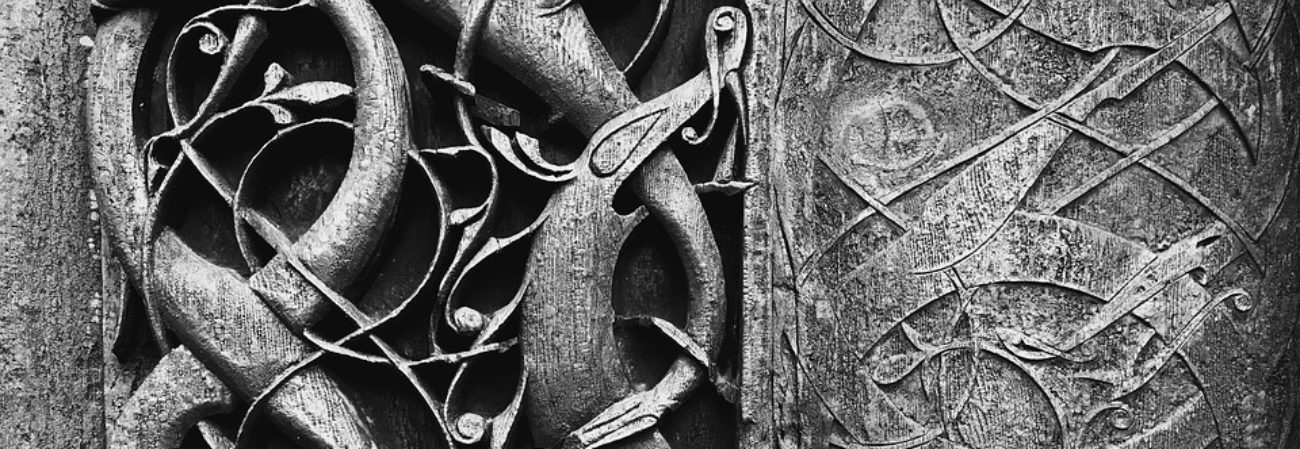
The Year 536

The Jotuns were notorious frost giants of Norse myth. Could the
Fimbulvetr of 536 been thought to have been their doing?

I have not had much time to write blog articles lately due to family concerns, though I have made progress on the second book of the Varangian Chronicles and with only about sixty more pages to go, there is an end in sight. With winter battering the area where I live, and snow and ice making the roads all but impassable, one thinks of the year of 536 and the darkness that settled over Europe for at least three years. George R. R. Martin writes of winters that last years in his Song of Ice and Fire series. In reality, there is an historical basis for just such a winter.

There is indication that a volcanic eruption from a super volcano that occurred in the tropics (possibly in El Salvador) caused this devastation. Recent studies from Harvard are looking into the eruption of a super volcano in Iceland early that year as well. Two other eruptions in Iceland were reported to have occurred in 540 and 547. Volcanic ash and sulfuric particles called aerosols released into the the atmosphere resulted in eighteen months of virtually no sunlight. Crops failed, it grew abnormally cold and may even have led to the events a few years later that caused Justinian’s Plague. The effects of the plague in 541 were felt as far west as Ireland, a country already staggering under the effects of the volcanic eruption. The Byzantine historian Procopious writes of the time:

It came about that a most dread portent took place. For the sun gave forth its light without brightness, like the moon, during this whole year, and it seemed exceedingly like the sun in eclipse, for the beams it shed were not clear nor such as it is accustomed to shed. And from this time when this thing happened men were free neither from war nor pestilence nor any other thing leading to death. And it was the time when Justinian was in the tenth year of his reign.

The early Germanic people believed that Fimbulvetr or in English Fimblewinter (a harsh winter) would occur prior to Ragnarok which would herald three years of no summer. Indeed, the Irish Annals of Innisfallen mention a time “without bread” from the years 536 to 539. Europe was very nearly brought ti its knees by this catastrophe and was n no shape to face the near annihilation of the known world a few years later when Justinian’s Plague broke out, killing an estimayed fifty million people. It was was supposed to have broken out in Constantinople, brought on grain ships from Egypt. Furthermore, it has been speculated that the eruption may have been responsible for the plague as the changing climate drove the rodents carrying the Yersinia pestis laden fleas into contact with the rats that would ultimately carry them to the grain ships bound for Constantinople.

There is ample archaeological and historical evidence to show a near agricultural and societal collapse on a massive scale in Northern Europe. Ice cores from Greenland and Antarctica show residue from sulfuric deposits indicating a volcanic eruption (of not several) of great magnitude. Tree ring dating shows drastically slowed growth in trees of this time. Scientific data extracted from tree rings in Scandinavia and Ireland and historic sources that mention a “failure of bread” have given us a bleak picture of the year 536.

The hardship during these years forced the Great Migration which saw Germanic tribes making their way westward and doubtlessly effected the Germanic invasion of England. It is simple logic that peole began to move about hoping to survive as their crops failed and their livestock and children died or failed to thrive. Rome had already pulled out of Britain, looking to secure its home defense as the Goths and Visigoths moved in. Britain was ripe for the taking though certainly faring no better than anywhere else in Europe.

The Völuspá (Prophesy of the Volva), a poem from the Norse Poetic Edda tells us:

The sun turns black, | earth sinks in the sea,
The hot stars down | from heaven are whirled;
Fierce grows the steam | and the life-feeding flame,
Till fire leaps high | about heaven itself.

In fact it has several references to the long darkness that was to come to Europe:

The giantess old | in Ironwood sat,
In the east, and bore | the brood of Fenrir;
Among these one | in monster’s guise
Was soon to steal | the sun from the sky.

There feeds he full | on the flesh of the dead,
And the home of the gods | he reddens with gore;
Dark grows the sun, | and in summer soon
Come mighty storms: | would you know yet more?

It goes on to speak of the battle of Ragnarok

Brothers will fight
and kill each other,
sisters’ children
will defile kinship.
It is harsh in the world,
whoredom rife
—an axe age, a sword age
—shields are riven—
a wind age, a wolf age—
before the world goes headlong.
No man will have
mercy on another.

History tells us of wars and raids initiated by such people as the Avars and and the Lombards as well as the Huns during this period. It truly was a “wolf-age”. Was Ragnarok based on an actual event that had already occurred and not some far off event like the biblical myth of Armageddon?

Perhaps the most startling thing to come out of all of this was how it effected the mostly Germanic languages spoken in Europe. The proto-Norse language died about this time, giving way to an early form of Old Norse. Runic inscriptions release clues that tell us language was developing so rapidly at tis time that a younger generation to survive the near annihilation of Europeans at this time would have spoken a different language than their grandparents! The crisis caused a startling shift in demographics. With this shift, this was quite possibly caused the Elder Futhark runes to gave way to the Younger Futhark with far fewer runes, indicating much knowledge had been lost. There was no older generation to pass down such knowledge. We may never know the full scale of such an event and how it effected our ancestors and to what effect this may have had even on us in the present day. One thing is for certain, climate change is nothing new, happening again and again in cyclical fashion. Scientists tell us that super volcanoes like Yellowstone are overdue for eruption. How we would fare again in the face of such a disaster, we can only speculate.

Hel’s Wintry Breath

With Yuletide come and gone, I can hopefully finally settle back to a reasonable writing routine. Winter is a time of stillness and repose, or at least to my mind, it should be. True, there are always family obligations and a never-ending litany of things that must be done, but it invites the mind to turn inward. As I looked out upon the – as yet- – snowless landscape it struck me that winter, like Hel, the old Norse goddess of the underworld, strips away all illusions. Once the trees lay bare of their garment of leaves and the grass lies dormant, beaten down and dead, you can see the landscape for what it truly is. The trees stand against a winter sky like bones. There is no greenery to give them flesh as mother earth lies dormant for another season. Would that all could be so simple, with illusions stripped away and lies seen for what they are. Death is like that. Like winter it gives no illusions and like winter it gives dormancy and a much- needed rest to the earth. We are reminded of Hel’s lessons. Impermanence. Fate. Sacrifice. Happiness is nothing without pain. Summer is made more brilliant because of winter. Life more beautiful because of death.

Such is the developing theme in my novel the working title of which thus far is The Bone Goddess. The Bone Goddess has many themes in many cultures. In the Slavic culture which is the more prevalent one in my third book of the Varangian Chronicles, she is Mara, a deity much like the Norse Hel. She later became the folk character Baba Yaga, best known as a witch tho lives on a house with stilts of gigantic chicken legs and reminds us of the witch in the German folk tale, Hansel and Gretel. We are afraid of characters like Baba Yaga or Hel, because they remind us of our own mortality. We shy away from the lessons she teaches us, even the one that in spite of our own mortality, there is really no death. All things cycle into new life. The animal that dies in the forest decays and becomes part of the soil, feeding the insects and the crows in the process. If all life is energy and energy is a never ending recycling process and constant refeeding upon itself, then nothing every truly dies that does not become new energy.

Hermod appeals to Hel

This concept was well understood by our pre-Christian ancestors as the time of the solstice or Yule was a celebration of the death of the sun and the eventual return of longer days and rebirth. One of the few stories told of Hel embodies this. When jealous Loki sought the destruction of Odin’s son Baldur (a representation of the sun) he came upon a means of trickery to do so. Baldur began to have dreams of his impending death and so his mother, Frigg went throughout the earth to make all things living and inanimate swear not to hurt her son. Only the mistletoe had failed to swear an oath but Frigg thought it too small and of little consequence to swear an oath. Delighted that to find that he was impervious to all weapons and poisons, the gods began to throw darts and weapons at him and he was unharmed by all. But Loki, dark-souled and jealous, convinced Baldur’s blind brother Hod to throw a dart made of mistletoe at Baldur and so caused his death. The legend is that Friggs’ tears turned to the white berries of the mistletoe as a symbol of her love for him. She forgave the plant and decreed it should be a symbol of love and friendship, which is why we have the tradition of kissing under the mistletoe to this day at Christmastime. When Baldur was consigned to the realm of Hel, Helheim, Hermod, another son of Odin made the journey down to the roots of the world Tree to implore his release. It is a mark of the respect that Hel held for Odin that she was willing to concede on the condition that all things in the world must weep for him. All agreed, except for a giantess named Þökk , really Loki in disguise. And so Hel kept her prestigious guest. The story has a ring of similarity to it with the Greek story of Hades and his capture of Demeter’s daughter Persephone who was obliged to stay in the underworld a month for every pomegranate seed she had eaten. Both stories epitomize the dark days of winter and the release of the deity who brings back the sun. How much this story must have resonated with our early ancestors who longed for the return of the sun as we do today. Only then it also meant an ending to days of winter famine and freezing. We cannot truly appreciate in our time of modern heating and grocery stores the hard bitterness of winter for our Northern ancestors. And no time was more bitter and freezing for the Europeans than 536 CE, which will be the subject of my next blog post.

In the meantime, my friends, keep warm, wherever you are and be sure to ring in the new year with joy and friendship!

Seed of Yggdrasil — a review

Of any book in my personal library, Maria Kvilhaug’s Seed of Yggdrasil is the most breathtaking in its depth, scope and insight. A graduate of the University of Oslo and a long time scholar of Germanic culture and myths as well as a scholar of the Norse language, Ms. Kvilhaug presents a  fascinating foray into the Norse myths as you have never seen them. I found myself murmuring as I read this book “Well that makes sense!” as she explored the myths from the perspective of an open-minded scientist and historian. When you see the myths, not as stories but as allegories, things begin to click into place. When you begin to see evolutionary flow in the stories, you then realize that all of it was intended to be allegory, as any religion founded in Nature, is.

She also writes of spiritual allegory. “When one realizes that a Viking prince has to fight a giant called Hatred, another called Rage and must be reborn in order to win a battle he lost in his previous life, the Battle of the Rock of Greed, in order to restore the Peace of Wisdom and gain entry into the divine afterlife, what at first sight appears to be just another heroic legend of a tough guy who fights giants, become s a spiritual parable. In fact, the moment I started to apply my translated names to the old texts, a whole new world unraveled itself, a world of spiritual concerns, ageless wisdom and metaphysical and philosophical speculation; speculation that is sometimes almost compatible with modern scientific theories.”

Even if you have only a casual interest in the subject of Norse mythology, The Seed of Yggdrasil makes the myths much easier to understand. Furthermore, since the author is a Norse scholar, she is qualified to make judgement calls on translations of certain words, to which she adds her explanation as to why she does. Not only did I gain greater insight into the stories and the all probable likelihood of their place on, I gained greater insight into how the people of the Norse Culture saw their world.

Easy to read and understand, The Seed of Yggdrasil takes on an almost meditative, spiritual experience. Her deeply delving understanding of the Old Norse texts and her unwillingness to take anything previous scholars have written at mere face value without holding it up to the light of in-depth research, her a highly qualified writer on the subject. Because of her extensive studies in Old Norse, she is not simply regurgitating anything that has already been written. She writes about translating a passage from Konungsbók (The Book of the King, written around 1200 CE) while at the University of Oslo and remembers doing a double take at a passage that read “The Earth is as round as a globe.” Clearly the early medieval people comprehended much more than we give them credit for. As any reader of this book will see, Kvilhaug delves extensively into the cosmic myths of the Norse and when seen under her lens, they are seen with fresh insight. It is truly a remarkable experience.

My only pique with this book was not the price, though it was considerable. I paid over fifty dollars for it on Amazon, yet considered it immensely worth it. My issue stems from the fact it does not contain an index. I bought it for research purposes and I found the lack of an index somewhat debilitating. However, I was not adverse to reading such a book cover to cover merely for enjoyment. At well over six hundred pages, it is not a quick read, but certainly a memorable one.

Go back

Your message has been sent

Warning
Warning
Warning
Warning

Warning.

Keeping Steamy in the Banya

Russian Banya by Janelop

There is a custom in medieval Slavic culture that still survives today in modern Russia and the Ukraine and that is the banya or bathhouse. The bathhouse was and is akin to the Native American sweat lodge, the Scandinavian badstu or the Finnish sauna. All of these produced heat and steam, encouraging sweating and a general detoxing. Likewise, all of these were at one time used for a spiritual experience. In medieval Russia and Ukraine, the banya was also a place where women went to have their babies. Icons were forbidden there, as was laughing, singing or any sort of boisterous behavior. It was regarded as “a habitation for witches and ghosts of the dead.” As Kenneth Johnson further writes in his book Slavic Sorcery – Shamanic Journey of Initiation, “In short, the bathhouse was a Pagan temple, and in fact, was called the “temple of the Mothers”, the Three Fates who represented the ancestors of the clan and whom we shall meet later on. Its association with “witchcraft” reminds us that the bathhouse was often the setting for esoteric rites of sorcery. A sorcerer might heat himself up in the bathhouse, then dive into ice-cold water and, through his own shamanic inner heat, warm the water and change its polarity.

The “Mothers” Johnson mentions are the Rozhenitsa who can be likened to the Greek Fates or the Norse Norns. There are usually three of them and they spin the destiny of every newborn child just as do the Norns.

In my WIP The Bone Goddess, Sigga takes Þórsteinn out to the banya to divine for him what he wants to know.

Sigga said nothing as she poured water over the hot stones. The steam soon enveloped the banya, wreathing both of them in its density. “Will you help me or no?” Þórsteinn’s voice came to her over the hiss of steam.

You speak of the Norns and of Óðinn, yet I thought the people here had abandoned the Northern ways and Slavic gods only were followed here. Are you from the North?”

He could not contain his curiosity. She allowed silence again to fall between them. She pounded the herbs on the stone, their pungent fragrance filling her nose. She threw them onto the hot rocks and soon the entire banya reeked of wild chicory and hempr. She sat back, and laid her head back against the pine planks of the banya.

“No, my father’s people came from Norvegr. My mother was Thracian and a Christian. She died when I was young and my father thought it best that my sister and I be brought back to the north country to be raised among his people and learn the old ways. He gave to me and my sister Northern names and he tried, for the sake of my mother, to follow her Christian god, but it was not in his heart to do so.”

“I hear that your Rus prince has forbidden the oak pillars, both Norse and Slav and dragged the idols in the streets when he married the Roman princess.”

She gave him only the barest glimmer of a smile. The banya was not the place for laughter if one did not wish to anger the spirits. She probably should have warned him.

Historically, the banya has also had its use for revenge. The Radzivill Chronicle tells us how the Rus Princess Olga got revenge on the Drevalian (a Slavic tribe) murderers of her husband Prince Igor. When the Drevalian leader sent word of his interest in marrying Olga, she sent word back that she would entertain the idea.

“When the Drevlians arrived, Olga commanded that a bath should be made ready for them and said, ‘Wash yourselves and come to me.’ The bath-house was heated and the unsuspecting Drevlians entered and began to wash themselves. [Olga’s] men closed the bath-house behind them and Olga gave orders to set it on fire from the doors, so that the Drevlians were all burned to death.

Slavic Bannik by Ivan Billibin

Perhaps one of the most interesting and persistent things about the banya, was one of its spooky inhabitants, the Bannick. Like most Slavic folk spirits, he has a dark side. The Bannik was variously described as being small and having hairy legs. He could be very malicious and great lengths were gone to propitiate him. It was because of the Bannik that icons were not allowed in the banya for fear of offending him. He is supremely a creature of the old pre-Christian forest gods. If offended he could pour boiling water on you or even strangle you, or at the very least invite a whole host of forest spirits in with him. The banya may have been a place where a volkhvy (Slavic shaman) would work his magic. In the tradition of the Native American sweat lodge, the banya was a place to transcend yourself, perhaps to go into trance.

The banya was not just a place to maintain good hygiene or to bring young children into the world, but a place to commune with the old gods, long after Russia and the Ukraine had officially accepted Christianity. Even the 1917 revolution could not crush the indomitable spirit of of the native Slavs and today Rodnovery or the Slavic Native Faith has made great leaps in popularity in eastern Europe, especially with younger Slavs as they seek to reconnect with their ethnic identity in an increasingly global, multicultural world that pays no homage to distinct ethnic identity.

Go back

Your message has been sent

Warning
Warning
Warning
Warning

Warning.


Like Pulling Teeth

Today I’d like to address a few commonly held myths that, whenever I come across them, never fail to annoy me. One of them is the myth that medieval peasants were all walking around with a mouthful of rotten teeth and stinking breath. Nothing could be further from the truth. Honestly, he probably had a better set than you do. The main reason for this was a lack of sugar. Your average peasant wasn’t attached with a diehard addiction to a bottle of carbonated sugar water such as the average modern in western civilization. In fact, aside from honey (a rare delicacy) or the occasional apple or wild berries, he may never have even tasted sugar. Sugar was so rare, it was used only in very sparing amounts by the wealthiest individuals.  In fact it was not widely distributed in Europe until the late medieval era and even then it was prohibitively expensive. You might live your entire life and never taste a gram of the stuff. The main problem with medieval teeth was the consumption of stone ground bread. The grit that found its way from stone querns used for grinding grain into bread, could be problematic and would eventually wear down even the best set of teeth over time. However, dental caries affected less that twenty percent of the population of medieval western Europe (and perhaps even less in earlier Europe, if skeletons of early Anglo Saxons in Britain have anything to say on the matter), compared to nearly ninety percent at the turn of the twentieth century and the estimate that dental caries affect over half of America’s teen population today. Also, halitosis was not considered something that must be born with patience. Mouthwashes did exist, containing such herbs as  sage, rosemary, pepper, mint, and parsley, many of which also have significant antibacterial properties, in addition to making the breath smell sweeter. Used enough over time, they may have also been very beneficial for oral health.  While they may not have used toothbrushes, it was common enough to clean the teeth with a piece of linen and some burnt rosemary

Now that we have cleared that up, the next myth to debunk would the question of medieval people being significantly shorter that they are today. This myth is supposed to have arisen due to the poor health and conditions in cities during the Industrial Revolution. Stephen Nicholas and Richard H, Steckel have this to say in Heights and Living Standards of English Workers During the Early Years of Industrialization 1775-1815:

“Falling height of urban- and rural- born males after 1780 and delayed growth spurt for 13- to 23-year olds, revealed declining living standards among English workers after the Industrial Revolution.”

According to Sebastian Payne, chief scientist for English Heritage, this myth may arise from the shorter doorways of the period that were designed to be heat efficient in winter. Also, children took longer to reach puberty then and continued growing for a longer span of time than they do today. Furthermore, researchers were astonished to discover relatively few skeletons who in life had suffered from polio or tuberculosis. In fact most of the people of this period would have been far hardier, not to mention more wiry and fit than those of modern western civilization today.

While I am about it, I should probably point out that a lack of bathing is another commonly held belief about the middle ages. Public baths, just as in the Roman era, were quite common. In fact, most brothels in London required their patrons to wash before doing the deed with their girls. Not everyone could afford to immerse themselves in a full bath, but even the very poor would wash themselves spit-bath style. Baths were so important to the Norse Rus’ under Prince Oleg in the early tenth century, access to the the city’s baths was one of their requirements for leaving Constantinople unscathed, as well a good supply of food and wine. In fact, the Rus’ were known to be fastidious, utilizing bathhouses and saunas (as they had in Scandinavia) and the Slavic banya, which is very similar and which I may be discussing soon in another article.

So there you have it. While medieval people may not have had standards up the the modern Scope-swishing, Febreze-spraying, germophobic modern, neither were they the beastly smelling, rotten-mouthed, not to mention short-statured people that popular culture has led us to believe.


Landvættir — Guardians of the Land


Modern Icelandic coin showing the four landvaettir such as drove away the warlock

The landvættir in Norse belief were guardians of the land. Among the Anglo Saxons they were called landwights. In Iceland they were the hulduófolk (the hidden people). Among the Irish and Scots they were the pixies, brownies and fairies, who like the landvættir inhabited barrows, mounds and stone circles. They were universally venerated among the Norse and the dragon prows on Viking ships were designed to frighten the landvættir on foreign shores where ever they might approach. The prows were removed when approaching their home shore however, so as not frighten their own vættir. Many a housewife would place a bowl of milk or porridge out for these land spirits as an offering, both for protection and as a thank you. Many still continue this tradition, both those who identify as heathen or neo-pagan or those older folk in the old country who still identify with their ancestral beliefs.

There is a story told in the Icelandic Saga of King Olaf Tryggvason of a warlock who was sent from Denmark to spy out the defenses of the coast of Iceland. The warlock took the shape of a whale and encountered many landvættir:

King Harald told a warlock to hie to Iceland in some altered
shape, and to try what he could learn there to tell him: and he
set out in the shape of a whale. And when he came near to the
land he went to the west side of Iceland, north around the land,
where he saw all the mountains and hills full of guardian-
spirits, some great, some small. When he came to Vapnafjord he
went in towards the land, intending to go on shore; but a huge
dragon rushed down the dale against him with a train of serpents,
paddocks, and toads, that blew poison towards him. Then he
turned to go westward around the land as far as Eyjafjord, and he
went into the fjord. Then a bird flew against him, which was so
great that its wings stretched over the mountains on either side
of the fjord, and many birds, great and small, with it. Then he
swam farther west, and then south into Breidafjord. When he came
into the fjord a large grey bull ran against him, wading into the
sea, and bellowing fearfully, and he was followed by a crowd of
land-spirits. From thence he went round by Reykjanes, and wanted
to land at Vikarsskeid, but there came down a hill-giant against
him with an iron staff in his hands. He was a head higher than
the mountains, and many other giants followed him.

The warlock soon discovered that Iceland was well fortified with landvættir! According to a poll taken in the recently, as many as fifty percent of Icelanders still believe in the possibility of the landvættir! Iceland, is one of the few nations that still holds to a fairly homogeneous way of thinking and relating to their ancestral land. Much of this has been lost in her sister Scandinavian countries and in countries such as England, Germany, the Netherlands, et al, areas where the old beliefs of the land spirits once held sway.

In Iceland the huldufólk are sometimes attributed as alfar (elves) and are said to dwell in mounds. The concept of them is so strong, that in 2004 the international aluminum producer Alcoa had to have a government official certify that the area in which they desired to build a smelting plant was free of archaeological mounds and artifacts, particularly those pertaining to the huldufólk . In addition, roads have had to be rerouted so as not to offend these landvættir.

In The Plague Casket, Ulf and Sophia have a conversation about the Norse-descended Ulf who is an Úlfhéðinn. and mistaken by a band of Bedouins for a djinn. Ulf compares the desert djinn to the land spirits of his own ancestral homelands.

Finally he said, “Among my people I am called Úlfhéðinn. Yet I am nothing ghostly like a djinn. I am flesh and blood like you.” He glanced sideways at her. “You who even questioned your own icons, are you superstitious like the Bedouin and the Sabians?”
“Even the churchmen in Constantinople might question if you are possessed of evil spirits.”
He laughed. “So I am possessed by an evil spirit now? Among my people, the being the Hagarenes call ‘al-jinn’ would be called the Huldufólk – the hidden people.”
“Why are they hidden?”
“They are landvættir. They are part of the land, the rocks, the trees. They are only hidden from those who do not know what they are seeing.”

Many cultures have traditions of various spirits. As I have already discussed, these spirits have evolved with the time. The hulduófolk still maintain their presence among their people, shunning Christian crosses and modern conventions such as electricity. In an age where our planet is under constant assault from pollution, trash and a general sense of wastefulness, perhaps we would all do better to honor the traditions of the hulduófolk.

Theophano — Murderess or Victim?

Did Theophano, empress of Romanos II and mother to the young emperors Basil II and Constantine VIII,  kill her husband as was popularly believed? The evidence is thin on the ground for the death of her first husband, Romanos and father to her children Basil, Constantine and Anna, yet she seems to be implicated in the death her her second husband Nikeophoros Phokas. When Romanos II died, Theophano was still in childbed, having delivered her baby daughter Anna not four days before. This does not preclude her from having a hand in his death, that is to say ordering an assassin to do so, but it does not seem likely as in that time, a woman’s children were considered orphans if they did not have a father, not counting the status of the mother. Also, with her husband dead, it would put her own status in a very precarious situation. Theophano ( not to be confused with my character Theophana, the fictionalized bastard sister of Basil II), the empress Theophano was said to be very beautiful, but her lowborn status as the daughter of a common innkeeper made her unpopular.

She has less an alibi in the regicide of Nikephoros however. While Theophano was still considered a great beauty, Nikephoros was certainly not. The Bishop Liutprand described him thus:

…a monstrosity of a man, a pygmy, fat-headed and like a mole as to the smallness of his eyes; disgusting with his short, broad, thick, and half hoary beard; disgraced by a neck an inch long; very bristly through the length and thickness of his hair; in color an Ethiopian; one whom it would not be pleasant to meet in the middle of the night; with extensive belly, lean of loin, very long of hip considering his short stature, small of shank, proportionate as to his heels and feet; clad in a garment costly but too old, and foul-smelling and faded through age; shod with Scythian shoes; bold of tongue, a fox by nature, in perjury, and lying a Ulysses.”

Nikephoros II Phokas, though admittedly nothing like Bishop Liutprand’s unflattering description

Their marriage was likely a business arrangement, with Nikephoros playing the role of the regent for the young emperors till they should come of age. Who can say what schemes Theophano may have played, or what favors she owed Nikephoros, or for that matter, any of the Phokades? In any case, the marriage was to be celibate as per their agreement. He busied himself on the battlefield and his wife busied herself in the bedroom… with his nephew John Tzmiskes.

On the night of the murder, Theophano left the imperial bedchamber unguarded and unbolted, ostensibly to visit the young Bulgarian princesses who were to be betrothed to her sons. In reality they were hostages, but in those days this was a fine line. The conspirators then came up the stairs and attacked Nikephoros where he lay on a leopard skin (he was a notorious ascetic) and proceeded to attack him. One of these men was Michael Bourtzes, with a personal grudge against Nikephoros. He would later betray Basil as well.

For all Theophano’s scheming, it came to naught. After the murder of her second husband, Tzmiskes completely abandoned her. The patriarch Polyeuktos refused to perform the coronation unless Tzmiskes removed “the scarlet empress.” Power comes before love in the world of Byzantine politics and Tzmiskes had her exiled to Prinkipio one of the Prince Islands in the Sea of Mamara. (The Prince Islands were so called because they were a favorite place to exile disgraced nobility.)

After Theophano’s exile, a play mocking the event took place in the streets of the city. The actress playing the part of Theophano would sing this raunchy little ditty:

The blacksmith strikes his anvil, and he strikes his neighbor’s too

For the matchmaker and the princeling are standing at the door.

Theophano wanted her pie and the beauty ate it.

He who wore the coronation robe now donned a leather hide,

And if wintry weather comes upon him, he will wear his fur coat too

For men with shriveled cock and hand-sized arseholes

parade the murdering adulteress on the saddle of a mule.

The matchmaker appears to be the chamberlain, the princeling, Tzmiskes and the “beauty” reportedly no beauty, but the middle-aged princess Theodora, who got to eat the “pie”, the wealth and power as Tzmiskes’ consort, a position Theophano had reserved for herself. The last two lines take a swipe at the purported sexual proclivities of the patriarch Polyeuktos and the imperial chamberlain Basil Lakapenos, both of whom were eunuchs.

Nothing is known of how this murder affected the young emperors Basil and Constantine. In my third book, the working title of which is The Bone Goddess, I imagine a conversation between the emperor Basil and one of his Varangian Guard, Ulf Svensson who has been set to guard his tent for the night. In this piece, I pull back the veil of how Basil may have viewed the event as the child he would have been when his stepfather was assassinated. I draw upon Leo the Deacon’s description of the assassination:

Ulf turned his face back to the wind, feeling it burn his skin raw. The normally taciturn emperor did not usually speak so much about himself. It made Ulf uncomfortable. He was not one to speak much about himself either. Basil was silent again. When he spoke, it was as if he had delved into some inner corner of himself and forgotten that Ulf was even standing there. “I was scarcely eleven summers old that night. It comes to mind because it was a night much like this one. My mother had gone from the imperial chambers to the gynaikonitis for the evening She had given word that she was going to visit the two Bulgarian princesses. They were more hostages than guests who were to be given in marriage to my brother and I.

“He laughed again. “Perhaps if those marriages had gone through as arranged, we should not be standing here in the snow talking to one another now.” Basil flashed Ulf half a smile at the irony. “My stepfather stayed in his chambers. The light from his candles showed under his door till late in the night. He had not been allowed me to ride with him on a hunt that day. I was angry. I felt I should be treated as a man. It was I who had been born to be emperor. I went to his door several times, to give voice to my indignation, yet turned away again. I remembered the night being so cold, that even under all the blankets, I could not get warm. The snow fell outside as is not often seen in Constantinople. After the vespers hour, I finally approached the door again. I heard my stepfather screaming. He was crying aloud for the protection of the Virgin Theotokos. I pushed open his door. The candles were not at his desk any longer. They had been moved by the bed. My stepfather lay on the floor on a panther skin. He was unrecognizable. His assassins ranged themselves around him. One had kicked in his jaw. He had no teeth. They had been knocked out with the hilt of a sword thrust in his mouth. One eye had been gouged out. They had kicked him numerous times in the groin. John Tzmiskes himself sat on the bed and watched as his accomplices kicked and pummeled my stepfather. I stood there in the door. I could not move. Finally one ran him through.

“I closed the door and tiptoed away. Later, as dawn broke through the winter clouds, they paraded his head in the streets. John was proclaimed emperor. He and his men had killed Nikephoros. But it was my mother who had let them in. Had he guards posted properly at the door, he would never had been murdered. He trusted my mother. I think in his own way he loved her. She did not receive such gracious treatment from the new emperor. He in turn, then betrayed her. As soon as he had been crowned, he had her exiled. She deserved little better. Nikephoros they buried and placed an inscription on his tomb. ‘You conquered all but a woman.’” Basil scoffed and drained the last of his wine, now cold.

Indeed, it may have been his own mother’s supposed licentiousness and her devious desire to gain power that turned Basil against marriage. We have no record of his marriage or of any progeny, unusual for a man who was expected to bring a male heir to the throne of such a powerful realm. Instead he left it up to his brother and (nominally) co-emperor Constantine, who produced only three daughters. Constantine himself, gave little heed to the running of the empire and had more interest in pursuits such as hunting, dancing, partying and a general lavish lifestyle. It was far easier to leave the dull work of war and ruling to big brother.

In the meantime, Basil ruled a golden age of the Eastern Roman Empire, throwing off the dark sordid cloak of his predecessors, unencumbered by marriage or women like his mother.


Emesa, Golden City on the Orontes

18th century original drawing of the castle of Hims by Cassas

Seen from a distance the Citadel was a sprawling hill, topped by domes and arches, sloping down to the city of Emesa and the desert that encircled it. The entrance was a high face of sand colored stone, flanked by towers and entered by a long narrow bridge that gave way to yet another imposing gate. Bab al-Souq rose up before them, the stone golden in the afternoon sun. Dusk was sifting down into the street, thickening the shadows.

I mention the city of Emesa, Syria in my book The Plague Casket, as a destination by Ulf and Sophia. Today it is known by the Arabic name of Homs, though there is reason to believe that the Byzantines would have continued to refer to it by its Greek name, even after the Muslim conquest and subsequent loss from Byzantine control. It is a city that is no stranger to strife and siege. Homs has long stood as a key center of trade and agriculture going back to at least the Christian era. It was the home of the Roman empress Julia Domna who was a daughter of an hereditary high priest to Elagabal . It had, at one time, a great temple dedicated to this sun god. Currently the Great Mosque of al-Nuri stands on this site. One of the priests of the sun god Elagbal, was the seriously delusional Roman emperor Elagabalus (born Varius Avitus Bassus, also the grand nephew of Julia Domna) named for the god whom he served.

Homs is also referred to with moderate frequency by Usamah ibn Munqidh in his memoirs as published under the title An Arab-Syrian Gentleman in the Period of the Crusades. This venerable Syrian gentleman gave his name to the Citadel there. The tell upon which it was built dates back to at least the Bronze Age. Its strategic position on the Orontes River made it coveted by whomever had military designs in Syria, including the Byzantines. The Hamidids took control in 944 and it was from them that Basil wrested control in 999.

As a city, Emesa may have been founded by the Seleucid kings, following the death of Alexander the Great. It was already a very old city by the time Ulf and Sophia enter its gates in The Plague Casket. It has been identified by some archaeologists as the biblical Zobah which would date it to at least 2100 BCE. The Romans tolerated the worship of the pagan Elagbalus which during the Christian era gave way to churches which were torn down or converted to mosques when the Arabs regained control over the city. The city’s mosques were returned to Christian use when the Byzantines raided Syria in general and Emesa/Homs in particular when Basil II made yet another sweeping foray into Syria in 999 CE. The Arab geographer, Muḥammad ibn Aḥmad Shams al-Dīn al-Maqdis wrote in 985 that Homs was the largest city in all of Syria, but that it had suffered great misfortunes, indicating it had already been the source of much conflict, including the Arab-Byzantine Wars.

Gates of Old Emesa Aemilius Wikimedia Commons

When Basil entered the city, he may have ridden through any number of her historic gates. They were Bab al-Souq (Gate of the Market), Bab Tadmur,  Bab al-Sebaa (Gate of the Lions),  Bab al-Dirayb, Bab al-Turkman,  Bab al-Masdoud (Closed Door) and  Bab Hud.

Many Arab tribes came to settle near Homs, among whom were the Banu Kilab who also receive mention in my book. A proud Bedouin people, the Banu Kilab tended to support the Fatimid regime, though in the late tenth century it was the Hamidids who tried to maintain control over the city. Often the Hamidid cities were vassals to the Byzantines and paid suzerainty to the Byzantine Emperors or their representatives as did Sa’id al-Dawla , emir of Beroea (now Aleppo). Throughout the early eleventh century it was the Banu Kilab who maintained control over Homs, as Basil concluded a ten year peace with the Fatimids so he could continue his Bulgarian wars.

Today the original city and its citadel lie in ruins outside the modern city of Homs, which has had its own insurrections to deal with. Before the Syrian Civil War it was a major center of industry for Syria. The area is home to many cultural and historical landmarks such as the Crusader castle Krak des Cheveliers and it is to be hoped it does not meet fate of so many icons of the area as did the Roman theater in Palmyra at the hands of ISIS insurgents. War has often been responsible for the destruction of things that give us a window into the past. Perhaps this wanton and tragic demolition can be halted, by those who care to preserve the past to better our understanding of the future.

Resources:

A Brief History of the Roman Empire

By Stephen P. Kershaw

Cities of the Middle East and North Africa: A Historical Encyclopedia

edited by Michael Dumper, Bruce E. Stanley

An Arab-Syrian Gentleman in the Period of the Crusades

by Usamah ibn Munqidh


Death of a Doux

Byzantine fresca from St-Lucas
Wikimedia commons

Several Bedouin horse archers, seeing the men separated from the main ranks, bore down on them. One leaned out from the saddle and grasped the reins of Dalassenos’ horse. Dalassenos jammed the hilt of his sword into the face of the rider. Another of the Banu Kilab took firm hold of his horse’s reins from the other side. A third pulled Dalassenos from the saddle. They set upon the unfortunate doux. They kicked him, and beat him with their fists. Both Constantine and Theophylact Dalassenos were also pulled from the saddle, but they offered much less resistance and were tied hand and foot. The sons of Dalassenos were pushed over to the baggage wagons and leather sacks placed over their heads. Both were made to sit and tied securely to the wagon wheels. Dalassenos was no longer moving. One of the Banu Kilab leaned over and with a slick, wet slicing motion, cut the throat of the doux.  From where he stood, Ulf watched with a sinking heart as the body of Damian Dalassanos thrashed about on the ground. Their standard gone and their doux dead, the tide of the battle began to turn for the Roman forces.

The horsemen came upon them in a wave like a hot desert wind, with a rush of trampling feet. Somewhere in the chaos Ulf thought he heard his father’s voice to stand firm, but then all was drowned out by the shrill ki-yiing of the Bedouin. He was enveloped in thick choking dust stirred up by the horses’ feet, the clash of metal on metal, the screams of dying men, the smell of blood, coppery on the back of his tongue, making his gorge rise.

A hoarse cry rose up in the throats of the Fatimids. “The enemy of Allah is dead! The enemy of Allah is dead. May Allah be praised!” It was repeated over and over like a chant. A war cry. The heavy war drums, stretched with elephant hide, sounded deep and hollow, a steady thrum that set the rhythm of the swordplay on the plain. The gates of Apamea were opening. Now a stillness had taken over, so even at this distance they could hear the grind of the pulleys as they brought up the massive iron portcullis. The soldiers of Apamea rushed forward. First quietly. Then with a great cry, as their numbers swelled into the ranks of ibn Samsama’s soldiers. Someone had separated the head of Damian Dalassenos from his body and placed it on a spear where it waved, a grotesque battle standard over the now recaptured Fatimid baggage wagons.

from The Plague Casket

Thus was the gruesome end of Damian Dalassenoss, Doux of Antioch on July 19, 998. Apamea must have seemed like an easy victory to him. He had the numbers, though no longer the element of surprise as messengers were dispatched to the Fatimids who came to the rescue of the besieged Apameans who had been purportedly been living on dogs and cadavers as the siege dragged on.

Apamea is not a famous battle and only those who are students of the history of medieval Byzantine-occupied Syria will have ever heard of it. Damian Dalassenos learned of a fire in the city of Apamea early in June of 998. He set out to take advantage of the city and once he arrived was surprised and dismayed to discover that the Hamadid hajib Lu’lu’ al-Kabir of the Emir of Beroea (now Aleppo) had arrived before him. He must surely have attempted to treat with the Hamidid forces. They eventually left, but not before leaving supplies at the walls of Apamea for the inhabitants. Beroea was supposed to be a vassal state to the Byzantines, so al-Kabir’s actions must certainly have appeared treasonous. The Hamidids did retreat and Dalassenos set up a siege. Even once the Fatimid forces appeared, the Byzantines might have had an easy victory if ego had not gotten in the way. Al-hakim’s Bedouin forces (perhaps numbering 1,000 men by some accounts) took possession of the Byzantine baggage carts. Incensed by this, Dalassenos pursued them, accompanied by two of his sons. I have not read in any of the records I have thus far perused how many other accompanied him, as he pursued the Bedouin contingent. It was a staggeringly bad move on his part. Cut off from the rest of his men, Dalassenos found himself beset by the Bedouin tribesmen. For some reason he wore neither cuirass or helmet which made him all the more vulnerable. He was killed and his head was paraded so that all might see that the doux of Antioch had been slain. His two sons were taken captive, where they remained in Cairo as hostages for the next ten years, reportedly ransomed for six thousand dinari. The death of the doux disheartened the Byzantines and they fell back before the Fatimid forces who claimed victory for the day.

The battle was the instigation for the emperor Basil II breaking off his affairs in Bulgaria to ride with his Varangian Guard to Syria the following year, where he besieged Emesa (modern Homs, Syria) garrisoned Shaizar and burned several smaller forts. Basil spent three months in Syria personally campaigning there before he set his most trusted man Nikephoros Ouranos as doux over Antioch, replacing the unfortunate Dalassenos. He then turned his attention to Georgia where his former Kouropalatēs had just died (presumably at the hands of his angry nobles with poisoned communion wine) with the purpose of taking over the lands that the Kouropalatēs had been forced to hand over to Basil as his legatee upon the former’s death. (This was his punishment for backing the losing rebels against Basil earlier in the latter’s reign, but that is a story for another time.) Basil was able to conclude a ten year truce with the Fatimids, which gave him time to continue his ongoing wars in Bulgaria. A blip as it were on the timeline of the Byzantine Empire, the battle of Apamea was yet another marker in the ongoing turmoil that has marred the history of Syria.

Go back

Your message has been sent

Warning
Warning
Warning
Warning

Warning.


Al-Hakim bi-Amr Allah — the mad caliph

Al-Hakim bi-Amr Allah
Wikipedia

Abū ʿAlī Manṣūr was one of the most interesting and yet controversial figures of his time. He was popularly known even in his day as “the mad caliph” though it is often difficult to separate fact from fiction and what stories about him were actually true. We do know that he rose to power while still a child when his father died. It was written he was up in a sycamore tree when his tutor, vizier and regent came to tel him that he was no caliph. The young caliph refused. His regent and wasīta (vizier) was a Slavic eunuch name Barjawan, whom al-Hakim may have had murdered later in life when Barjawan’s quest for power became too over-reaching. While he does not occupy a very large part of my second book, he cannot be overlooked as he had a part in the Fatimid Byzantine wars that occupied Emperor Basil II’s time when he was not trying to make the lives of the Bulgarians miserable. In spite of what has been written about the young al-Hakim, I had to piece together a picture of him as he might have been when young. I imagined a precocious child, calculating and suspicious, perhaps raised that way out of necessity for a boy brought up in his position. This was how Ahmed saw him when he met him rather unexpectedly in The Plague Casket:

After some time, Ahmed was ushered into an ornate room, decorated rather garishly with much gold plate. His eyes, having been outside in the blazing sun, took some time to adjust to the cool dimness here. He was left alone and the door pulled closed behind him. It was quiet. Too quiet. For a moment all he could hear was his own heart. From the lavishly piled cushions he heard a voice in careful, formal Arabic say, “Come.” Startled, he peered into the cushions and was surprised to see a boy of no more than ten or twelve years.

Looking back at him with an old man’s eyes in a small boy’s face, the child replied, “Why are you stunned to see your caliph, the son of my revered father, al-Hazziz? Did you expect a monkey on a chain? Come, give me your message.”

Ahmed hesitated. Amid the splendor and the gently bubbling fountains, he detected a hum of menace. It made his skin crawl. “I am sent by Damian Dalassenos, himself a representative of the autokrator, Basil Porphyrogenitus in Constantinople. He sends you respectful greetings, but bids that you not seek any of the lands north of Emesa for your own, lest you make him your bitterest enemy.”

The boy’s faced creased as if did not often form in more than one expression and he laughed. “You have been sent by that puppet in Antioch. Yes, he is a representative of an emperor so far away, the leagues I have forgotten. The Emperor does not even reside in the imperial city, but is occupied by his wars with the barbarian khan Samuil in far-off Bulgaria. His influence bothers me not. I am al-hakim bi-Amr Allah, son of al-Hazziz, a descendant of Fatimah, revered daughter of the holy Muhammad. I do not take orders from the Christian barbarian dogs!” His voice had turned to a spittle flecked snarl and the laughter was gone from his face. “And nor should you.”

As the boy grew to be a man, he had a reputation of killing those who displeased him on a whim and making absurd laws that no one could follow. His subjects both hated and feared him. He was said to walk through the streets of Cairo disguised as a commoner and notice which merchants were using illegally weighted scales. He meted out a terrible punishment  on them publicly right there in the market.

It was Barjawan who referred to the young caliph as “the gecko” a name he detested. It was said, that when al-Hakim grew displeased with Barjawan, he sent for his vizier saying, “Tell Barjawan that the gecko has grown into a large dragon.”

Whether true or not, one of the most infamous storiess about al-Hakim is the one in which he invite d number of rebels to a feast in his baths (lavish buildings which were used for dining as well as bathing). When all were assembled, he his his personal Berber guards slaughter them all. We don’t know if this story is true or not or merely propaganda promulgated by his enemies. It makes for an interesting story however and one I utilized for my book:

The heavy scent of myrrh was mixed with another scent Ahmed could not immediately identify. As heavy as the myrrh, but with a lingering sickly stench. Ahmed stood in the stone corridor, letting the sun scorch his skin. Columns too big for a man to put his arms around, stretched like an endless line of soldiers. Beyond them gleamed cool marble floors. He hesitated a moment and then set his foot on the floor. Now he heard only his footsteps. They seemed far too loud for the silence. Out of the intense burn of the sun, the shade was refreshing, but the cloying scent of myrrh grew stronger. Almost…almost as if it was being used to cover a stronger scent. One less pleasant. It was a familiar one to him. Even to him, Ahmed, who had once been a merchant of pepper. One to whom scent should have been everything, but which pepper had destroyed much of long ago.

The torches on either side gleamed dully from the black iron curlicues. It was odd even in the dim corridors that they should be lit at this time of day. They seemed to lead the way for him. Under the torches were great shields, hung like beads in a necklace on the walls.

He stopped. He had heard something else. A low hum. The kind of sound that makes horses shake their heads with irritation. The great doors, covered with silver beaten in ornate designs, lay closed before him. In the right circumstances, these opened to the sounds of laughter, the delicately rich scent of food.

He laid a hand on the doors and pushed them open. In this room the torches bloomed like fierce flowers. The light glanced off the gleaming marble, splashed off the copper bowls, danced on the silver, reflected off the still water in center of the great bath. Amid the spilled food and tumbled fruit, the flies droned. They tasted the sweetmeats, rested on the cups. They whined in the blood that caked blackly on the stone floors. They crawled like black clouds over the corpses stretched among the mess of food and wine on the table. His attention was held by men with empty eyes, mouths full of food only barely tasted. The high whine of flies. And the stench of myrrh.

There is too much for the scope of a blog article to write about al-Hakim. His end was fittingly colorful. He went out one night for a ride in the desert and he never returned. He was only thirty-six. All that was found of hm was his horse and his blood stained garments. His most admiring followers said that he had merely been taken up to heaven. Scholar John Esposito writes that the caliph believed that “he was not only the divinely appointed religio-political leader but also the cosmic intellect linking God with creation” He became a central figure in the Druze religious movement of that time. His disappearance only cemented this  idea in the minds of the Druze followers, though it was likely that he was assassinated.

Propaganda or a real life Joffrey of House Barathion, Game of Thrones style? Let me know what you think below.

See Paul Earnest Walker’s Caliph of Cairo: Al-Hakim Bi-Amir Allah, 996 -1021 for more about this fascinating historical figure

Go back

Your message has been sent

Warning
Warning
Warning
Warning

Warning.