Death of a Doux

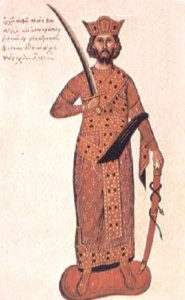
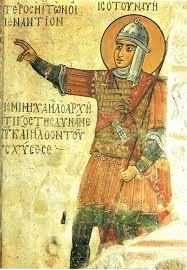
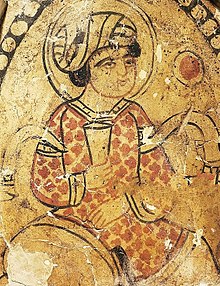
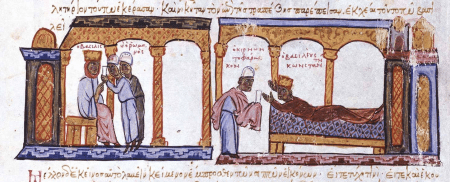
Byzantine fresca from St-Lucas
Wikimedia commons

Several Bedouin horse archers, seeing the men separated from the main ranks, bore down on them. One leaned out from the saddle and grasped the reins of Dalassenos’ horse. Dalassenos jammed the hilt of his sword into the face of the rider. Another of the Banu Kilab took firm hold of his horse’s reins from the other side. A third pulled Dalassenos from the saddle. They set upon the unfortunate doux. They kicked him, and beat him with their fists. Both Constantine and Theophylact Dalassenos were also pulled from the saddle, but they offered much less resistance and were tied hand and foot. The sons of Dalassenos were pushed over to the baggage wagons and leather sacks placed over their heads. Both were made to sit and tied securely to the wagon wheels. Dalassenos was no longer moving. One of the Banu Kilab leaned over and with a slick, wet slicing motion, cut the throat of the doux.  From where he stood, Ulf watched with a sinking heart as the body of Damian Dalassanos thrashed about on the ground. Their standard gone and their doux dead, the tide of the battle began to turn for the Roman forces.

The horsemen came upon them in a wave like a hot desert wind, with a rush of trampling feet. Somewhere in the chaos Ulf thought he heard his father’s voice to stand firm, but then all was drowned out by the shrill ki-yiing of the Bedouin. He was enveloped in thick choking dust stirred up by the horses’ feet, the clash of metal on metal, the screams of dying men, the smell of blood, coppery on the back of his tongue, making his gorge rise.

A hoarse cry rose up in the throats of the Fatimids. “The enemy of Allah is dead! The enemy of Allah is dead. May Allah be praised!” It was repeated over and over like a chant. A war cry. The heavy war drums, stretched with elephant hide, sounded deep and hollow, a steady thrum that set the rhythm of the swordplay on the plain. The gates of Apamea were opening. Now a stillness had taken over, so even at this distance they could hear the grind of the pulleys as they brought up the massive iron portcullis. The soldiers of Apamea rushed forward. First quietly. Then with a great cry, as their numbers swelled into the ranks of ibn Samsama’s soldiers. Someone had separated the head of Damian Dalassenos from his body and placed it on a spear where it waved, a grotesque battle standard over the now recaptured Fatimid baggage wagons.

from The Plague Casket

Thus was the gruesome end of Damian Dalassenoss, Doux of Antioch on July 19, 998. Apamea must have seemed like an easy victory to him. He had the numbers, though no longer the element of surprise as messengers were dispatched to the Fatimids who came to the rescue of the besieged Apameans who had been purportedly been living on dogs and cadavers as the siege dragged on.

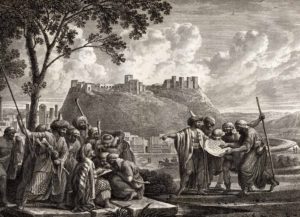
Apamea is not a famous battle and only those who are students of the history of medieval Byzantine-occupied Syria will have ever heard of it. Damian Dalassenos learned of a fire in the city of Apamea early in June of 998. He set out to take advantage of the city and once he arrived was surprised and dismayed to discover that the Hamadid hajib Lu’lu’ al-Kabir of the Emir of Beroea (now Aleppo) had arrived before him. He must surely have attempted to treat with the Hamidid forces. They eventually left, but not before leaving supplies at the walls of Apamea for the inhabitants. Beroea was supposed to be a vassal state to the Byzantines, so al-Kabir’s actions must certainly have appeared treasonous. The Hamidids did retreat and Dalassenos set up a siege. Even once the Fatimid forces appeared, the Byzantines might have had an easy victory if ego had not gotten in the way. Al-hakim’s Bedouin forces (perhaps numbering 1,000 men by some accounts) took possession of the Byzantine baggage carts. Incensed by this, Dalassenos pursued them, accompanied by two of his sons. I have not read in any of the records I have thus far perused how many other accompanied him, as he pursued the Bedouin contingent. It was a staggeringly bad move on his part. Cut off from the rest of his men, Dalassenos found himself beset by the Bedouin tribesmen. For some reason he wore neither cuirass or helmet which made him all the more vulnerable. He was killed and his head was paraded so that all might see that the doux of Antioch had been slain. His two sons were taken captive, where they remained in Cairo as hostages for the next ten years, reportedly ransomed for six thousand dinari. The death of the doux disheartened the Byzantines and they fell back before the Fatimid forces who claimed victory for the day.

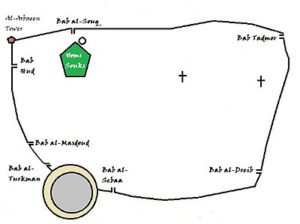
The battle was the instigation for the emperor Basil II breaking off his affairs in Bulgaria to ride with his Varangian Guard to Syria the following year, where he besieged Emesa (modern Homs, Syria) garrisoned Shaizar and burned several smaller forts. Basil spent three months in Syria personally campaigning there before he set his most trusted man Nikephoros Ouranos as doux over Antioch, replacing the unfortunate Dalassenos. He then turned his attention to Georgia where his former Kouropalatēs had just died (presumably at the hands of his angry nobles with poisoned communion wine) with the purpose of taking over the lands that the Kouropalatēs had been forced to hand over to Basil as his legatee upon the former’s death. (This was his punishment for backing the losing rebels against Basil earlier in the latter’s reign, but that is a story for another time.) Basil was able to conclude a ten year truce with the Fatimids, which gave him time to continue his ongoing wars in Bulgaria. A blip as it were on the timeline of the Byzantine Empire, the battle of Apamea was yet another marker in the ongoing turmoil that has marred the history of Syria.

← Back

Thank you for your response. ✨


Al-Hakim bi-Amr Allah — the mad caliph

Al-Hakim bi-Amr Allah
Wikipedia

Abū ʿAlī Manṣūr was one of the most interesting and yet controversial figures of his time. He was popularly known even in his day as “the mad caliph” though it is often difficult to separate fact from fiction and what stories about him were actually true. We do know that he rose to power while still a child when his father died. It was written he was up in a sycamore tree when his tutor, vizier and regent came to tel him that he was no caliph. The young caliph refused. His regent and wasīta (vizier) was a Slavic eunuch name Barjawan, whom al-Hakim may have had murdered later in life when Barjawan’s quest for power became too over-reaching. While he does not occupy a very large part of my second book, he cannot be overlooked as he had a part in the Fatimid Byzantine wars that occupied Emperor Basil II’s time when he was not trying to make the lives of the Bulgarians miserable. In spite of what has been written about the young al-Hakim, I had to piece together a picture of him as he might have been when young. I imagined a precocious child, calculating and suspicious, perhaps raised that way out of necessity for a boy brought up in his position. This was how Ahmed saw him when he met him rather unexpectedly in The Plague Casket:

After some time, Ahmed was ushered into an ornate room, decorated rather garishly with much gold plate. His eyes, having been outside in the blazing sun, took some time to adjust to the cool dimness here. He was left alone and the door pulled closed behind him. It was quiet. Too quiet. For a moment all he could hear was his own heart. From the lavishly piled cushions he heard a voice in careful, formal Arabic say, “Come.” Startled, he peered into the cushions and was surprised to see a boy of no more than ten or twelve years.

Looking back at him with an old man’s eyes in a small boy’s face, the child replied, “Why are you stunned to see your caliph, the son of my revered father, al-Hazziz? Did you expect a monkey on a chain? Come, give me your message.”

Ahmed hesitated. Amid the splendor and the gently bubbling fountains, he detected a hum of menace. It made his skin crawl. “I am sent by Damian Dalassenos, himself a representative of the autokrator, Basil Porphyrogenitus in Constantinople. He sends you respectful greetings, but bids that you not seek any of the lands north of Emesa for your own, lest you make him your bitterest enemy.”

The boy’s faced creased as if did not often form in more than one expression and he laughed. “You have been sent by that puppet in Antioch. Yes, he is a representative of an emperor so far away, the leagues I have forgotten. The Emperor does not even reside in the imperial city, but is occupied by his wars with the barbarian khan Samuil in far-off Bulgaria. His influence bothers me not. I am al-hakim bi-Amr Allah, son of al-Hazziz, a descendant of Fatimah, revered daughter of the holy Muhammad. I do not take orders from the Christian barbarian dogs!” His voice had turned to a spittle flecked snarl and the laughter was gone from his face. “And nor should you.”

As the boy grew to be a man, he had a reputation of killing those who displeased him on a whim and making absurd laws that no one could follow. His subjects both hated and feared him. He was said to walk through the streets of Cairo disguised as a commoner and notice which merchants were using illegally weighted scales. He meted out a terrible punishment  on them publicly right there in the market.

It was Barjawan who referred to the young caliph as “the gecko” a name he detested. It was said, that when al-Hakim grew displeased with Barjawan, he sent for his vizier saying, “Tell Barjawan that the gecko has grown into a large dragon.”

Whether true or not, one of the most infamous storiess about al-Hakim is the one in which he invite d number of rebels to a feast in his baths (lavish buildings which were used for dining as well as bathing). When all were assembled, he his his personal Berber guards slaughter them all. We don’t know if this story is true or not or merely propaganda promulgated by his enemies. It makes for an interesting story however and one I utilized for my book:

The heavy scent of myrrh was mixed with another scent Ahmed could not immediately identify. As heavy as the myrrh, but with a lingering sickly stench. Ahmed stood in the stone corridor, letting the sun scorch his skin. Columns too big for a man to put his arms around, stretched like an endless line of soldiers. Beyond them gleamed cool marble floors. He hesitated a moment and then set his foot on the floor. Now he heard only his footsteps. They seemed far too loud for the silence. Out of the intense burn of the sun, the shade was refreshing, but the cloying scent of myrrh grew stronger. Almost…almost as if it was being used to cover a stronger scent. One less pleasant. It was a familiar one to him. Even to him, Ahmed, who had once been a merchant of pepper. One to whom scent should have been everything, but which pepper had destroyed much of long ago.

The torches on either side gleamed dully from the black iron curlicues. It was odd even in the dim corridors that they should be lit at this time of day. They seemed to lead the way for him. Under the torches were great shields, hung like beads in a necklace on the walls.

He stopped. He had heard something else. A low hum. The kind of sound that makes horses shake their heads with irritation. The great doors, covered with silver beaten in ornate designs, lay closed before him. In the right circumstances, these opened to the sounds of laughter, the delicately rich scent of food.

He laid a hand on the doors and pushed them open. In this room the torches bloomed like fierce flowers. The light glanced off the gleaming marble, splashed off the copper bowls, danced on the silver, reflected off the still water in center of the great bath. Amid the spilled food and tumbled fruit, the flies droned. They tasted the sweetmeats, rested on the cups. They whined in the blood that caked blackly on the stone floors. They crawled like black clouds over the corpses stretched among the mess of food and wine on the table. His attention was held by men with empty eyes, mouths full of food only barely tasted. The high whine of flies. And the stench of myrrh.

There is too much for the scope of a blog article to write about al-Hakim. His end was fittingly colorful. He went out one night for a ride in the desert and he never returned. He was only thirty-six. All that was found of hm was his horse and his blood stained garments. His most admiring followers said that he had merely been taken up to heaven. Scholar John Esposito writes that the caliph believed that “he was not only the divinely appointed religio-political leader but also the cosmic intellect linking God with creation” He became a central figure in the Druze religious movement of that time. His disappearance only cemented this  idea in the minds of the Druze followers, though it was likely that he was assassinated.

Propaganda or a real life Joffrey of House Barathion, Game of Thrones style? Let me know what you think below.

See Paul Earnest Walker’s Caliph of Cairo: Al-Hakim Bi-Amir Allah, 996 -1021 for more about this fascinating historical figure

← Back

Thank you for your response. ✨


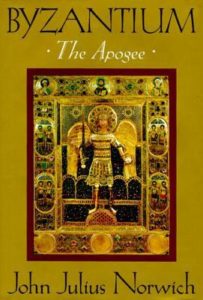
Byzantium, The Apogee — a review by Gretchen Brown

British historian, John Julius Norwich’s three part series on Byzantium is probably the most comprehensive work on the subject that I have ever read. It is easily readable, while being scholarly. This particular review is on the second one, following Byzantium: The Early Centuries and preceding the third which is Byzantium,:The Decline and Fall. This one is called Byzantium: The Apogee and covers the period from 800 CE to 1059 CE. His works are thoroughly researched and are given the very necessary addendum of maps and genealogies, in this case, the line of the Armorian Dynasty, Macedonian Dynasty as well as the Rus and Bulgarian rulers as pertains to his timeline.For fans of George R. R. Martin’s fictional fantasy series, A Song of Ice and Fire, there is much recognizable in the fabric and scope of the middle period of Byzantine history. It is not hard to see King’s Landing in Constantinople in Martin’s fictional world, not to mention the parallels with the various people and cultures surrounding the Byzantine Empire and the then known world.

I found it refreshing that he did not treat the Byzantine Empire in isolation, but recognized, very rightly, that her history must be considered in tandem with her neighbors, namely the Bulgarians to the west, the Rus to the North and the Muslims to the east and south.

Norwich dos not shy from recounting stories that are told by various contemporary historians, even the more gruesome ones. He is neither an apologist for the Byzantine emperors, not a detractor, giving all aspects the the history its due. He begins, interestingly, in Bulgaria, the source of so much dissension for the Macedonian Emperors. Khan Krum was likely just as much a thorn in the side of the Eastern Roman Empire as the Khan Samuil centuries later, if not more so. It was said he made a silver-lined drinking cup from the skull of the Nikephoros I, just as a later Pencheneg king did centuries later of the Rus prince Sviatoslav.

Norwich then delves into iconoclasm and the eventual restoration of the images. Perhaps with the same relish he recounted the gruesome death of Nikephoros I, he also goes into the strikingly dysfunctional family of the Macedonian Dynasty, peppered with the doubt of pahternity and betrayal. Michael I rose to the throne, the son-in-law of the ill-fated donor of the cranial drinking cup. Michael’s successor was neither of imperial blood (indeed the Byzantines seemed fond of having the line taken over by common soldiers, gutsy enough to take the reins of state) nor was he even Greek. Indeed, he was not even Macedonian, but was an illiterate, uneducated an Armenian peasant. This man would be come Basil I, by dint of his association with Michael who unwisely elevated the common peasant ( who may have been only a stable groom) to a position of power. To be honest, as Norwich points out, there is far too much speculation, both on Basil’s ethnic origins and his station in life. These stories may have been crafted by his detractors to cast aspersion on the name of what was to become the Macedonian Dynasty. And let’s not even get started on the unusual marriage arrangements or the menage a quatre they engaged in. There was speculation of who was the father of the baby given birth to by Michael’s mistress, the Norse Eudocia Ingerina. Basil was forced to divorce his own wife and marry Eudocia.  However, the lad was intended to remain “imperial property” which begs the question, who was the father of her son Leo? However the marriage arrangements were to work themselves out, Basil was promoted to junior emperor. When Michael began to favor another courtier, Basil arranged his murder. Basil I was now sole emperor.

Norwich weaves us pictures of murder, corruption and betrayal in the manner of a gifted storyteller, giving us every reason to see the origins of the term “Byzantine politics.” He excels at the story of perhaps this era’s greatest and perhaps most surprising emperor, Basil II, the descendant of Basil I or Michael II, we know not which and perhaps it matters very little. He was sadly underestimated by his generals who fomented a rebellion against him, thinking of him no more than a young, untried pup. He was soon to prove them all wrong. Breaking free of first his step father who served as regent to himself and his brother and co-Emperor, Constantine and then of his great-uncle, he eunuch and Imperial Chamberlain, Basil Lakepenos. deciding to prove himself by marching into Bulgaria. It was ill-advised, his general were inexperienced or perhaps even downright treasonous. His siege of Serdica (now Sofia, Bulgaria) was a disaster. Concerned about the possibility of a coup back home, he made his way back across the mountains, only to stumble into a disastrous ambush, now known as the Battle of Trajan’s Gate. It was a turning point in the reign of the young Emperor. His rule brought the Eastern Roman Empire into a golden age, vast powerful and wealthy. It was not to last. Basil left no heirs and his throne passed to his younger brother who had not the ruling capability of Basil. Constantine VIII left only daughters who in turn had no children. The great Empire which for five decades Basil II had forged, began to crumble, a long slow descent that culminated in 1453 with the conquest of the Ottoman Turks. That is a story that Norwich continues in his third book, Byzantium: The Decline and Fall.

Readable, broad in scope, yet infinite in detail and information, John Julius Norwich’s work is a must for any serious researcher as well the the armchair historian.

Get it on Amazon here. It’s on sale right now!

← Back

Thank you for your response. ✨


Byzantine Glass – a shattering short history

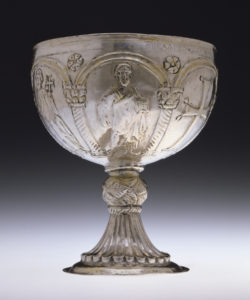
Byzantine chalice with relief of the Apostles venerating the cross Wikimedia commons

Glass is something that we take for granted today. We have glass in windows of our homes and cars, bullet proof glass and mirrors, jars sealed with all manner of food items and also many decorative items as well. In the earlier days of glass, almost every item, no matter how utilitarian, was given at least a pleasing form and sometimes could be very elaborate.

While originally glass was a luxury item, it seems that by the middle Byzantine period, it was relatively cheap and plentiful, with even the middle class easily purchasing glass drink ware and the commonly used shallow oil lamp with a free-floating wick was just as likely to made of glass as clay. In fact, it was so much more efficient for this purpose, they may have eventually phased out clay lamps, The sand along the coast of the Mediterranean was a good source for early glass making and sites both in Constantinople and Emesa (modern Homs, Syria) have been established.

Vases have been recovered from archaeological sites in areas the Empire encompassed. There has been such a plethora of glass from these periods found, that archaeologists have had to revise their earlier assessment that glass was only for the wealthy. The wealthy, however, could probably afford much more of the highly adorned, decorative objects such as vases and goblets, though perhaps even the lower classes might find in their possession an object with threads of different colored glass wound around it and pressed into the surface such as Sigga Úlfsdóttir remembers from her childhood in my still in progress novel, The Bone Goddess

Her fingers now thoroughly numb, she headed back with her meager collection. The faint twinkle of flame served as a beacon to her, as she made her way back to the village, rising up, it seemed, straight from the snow-covered marsh. Every reed was etched in sharp relief by frost, as if it had been made of pure spun glass. It reminded her of a small glass vase her father had brought home when she was very young. It had come from the markets of Constantinople. The vase itself was milky, but it was threaded with strands of blue crystalline glass, blown delicately around its neck and base, like a spiders web. The vase was gone now, she didn’t know where, no doubt shattered into a multitude of fragments. Its memory was reminiscent of a happier time.

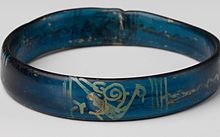
Byzantine glass bracelet with silver-staining Wikimedia commons

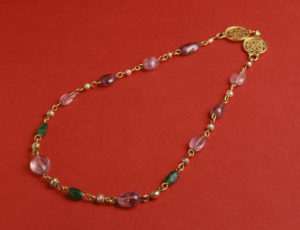
Glass was frequently used for windows not only in churches, but also well-off homes and public buildings. It was rolled in sheets for this purpose. It was also cut into pieces known as tesserae and used for mosaics and icons. Sometimes bracelets were made of glass decorated with the silver-staining method that the Byzantines adopted from the Arabs. For color, minerals were to the flux, the silica and sand that was heated in hot iron furnaces. This was especially useful for making glass beads of many different colors.

Byzantine glass bead necklace
Wikimedia commons

The Byzantines also recycled their glass! During a period when material for glass became more difficult to find, glass makers relied on cullet or scrap glass to be melted down and used again. An eleventh-century ship was found sunk off the Lycian coast and its main cargo was cullet.

Byzantines glass was used throughout the empire and frequently exported all over the known world. Now please recycle that salsa jar!

← Back

Thank you for your response. ✨


Ready, set, go! Equestrian games in the tenth century.

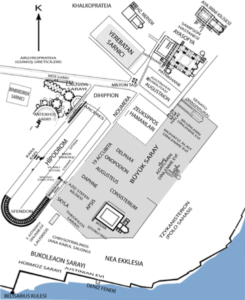
A map of early Constantinople showing the prominent position of the Hippodrome

In my last article I talked about indoor games such as shantranj, a precursor to modern chess. While the Byzantines were famous for court intrigue and naturally such a game would have immediate appeal, they also enjoyed more physical games. They too had their place, continuing the legacy of the Western Roman Empire. The gladiatorial games had long since ceased when the Eastern Roman Empire turned to Christianity. The races however, did not die so easily. In the early centuries there were originally four factions backed by various political entities – the Blues, Greens, Whites and Reds, that eventually were condensed down to the Blues and Greens. In any case, the races in the Hippodrome at the beginning of the Empire were very much a political function as much or more so than true entertainment. By the medieval period, much of the political function of the factions had disappeared, yet the races at the Hippodrome in Constantinople were still a venue for the workings of political and religious rivalries within the city. Constantinople was far from the only city to host such a monstrosity, though it is surely the more famous. The Circus of Antioch was a fairly well known one. The famous chariot race in Ben Hur was supposed to have taken place here. We can assume it remained in use to at least the Muslim conquest of Antioch in the seventh century. It is a prominent feature of the Antiochene archaeology and seems a safe guess that its use resumed after the Byzantine reconquest in 969 CE.

The horses race around the track counterclockwise a length of perhaps two to three miles. Such events were used to entertain visiting dignitaries. In The Plague Casket I created a fictional visit to Antioch by the historic Kartovelian prince and Kouropalates, Davit of Tao who came from what is now the republic of Georgia.

Sophia was escorted through passages reserved for the Doux and his family beneath the Murus Tiberii from the paláti to the Doux’s kathisma, a spectator’s box with the best view, overlooking the oval Circus of Antioch. From here, she received a view of Antioch she often did not get to see. Antioch rose around the hippodrome like a decaying, crumbling giant. It had been reduced to dust and rubble by earthquakes and war, only to rise again, indefatigable and unflagging.

The kathisma is a term that carried over to the Eastern Catholic and Eastern Orthodox religious terminology to indicate a division of the Psalter. It translates to “seat”, but in the case of the Byzantine racing tracks, it literally was a seat, or a spectator box reserved for the aristocracy, whether that was the Emperor and his family or the ruling governor of Doux of a city. It was a place to entertain state visitors in the manner to which they were accustomed and sometimes very lavish proceedings took place here. Between events, spectators could view acrobats, wild animals, dancers and musicians, as Sophia witnesses in The Plague Casket:

She turned her attention back to the acrobats to hide her anger. They twirled and leaped. The female acrobat, lithe and slim and clad only in a scanty chiton leaped on the back of her male companion, wrapping her bare legs around his middle as he balanced on a small block of wood and juggled some leather balls filled with barley. She climbed up his back and soon was standing on his shoulders. Another acrobat produced a wooden hoop as tall as he was and began to spin it rapidly. Leaping to the floor, the girl stepped through the hoop and then, grasping the top with both hands and curling her bare toes over the bottom, began to spin with it. She was poor, no doubt earning only a few copper coins for her performances, perhaps earning more by spreading her legs in the streets. But she had a wide smile on her face and her skin, dusted with mica, shone in the light from the low winter sun. She radiated life and Sophia could not take her eyes off her. For a moment she forgot all about the Kuropalates, about Constantine and the far off windy Caucus mountains. There was only the graceful movements as the girl acrobat moved like water in and out of the hoop. The tune the musicians played on the reedy syrinx was not one familiar to her, but it seemed ethereal, like the dance of the girl herself.

The Hippodrome was also used as a place to punish prisoners and humiliate political rivals, a carryover from Pagan Rome as was the Circus of Antioch and any other major city in the bounds of the Empire.

Andros Kouranos was seated on the donkey, facing the animal’s tail his hands bound before him. His head and beard had been shaved, so she scarcely recognized him. There was something buzzing with flies on his head and it took Sophia a moment to realize that his head was crowned in mockery with coiled animal entrails. The crowd jeered and threw rubbish and excrement. He bowed his head against their missiles. His clothes were coated with filth.

By the twelfth century, races were primarily held at religious occasions such as Easter. The race called chryson hippodromion took place the week after Easter. The races came under heavy criticism from the Church, yet continued to be hugely popular with the public as they had been for centuries. To further infuriate the leaders of the Church, often warring teams would inflicted curses upon one another with lead curse tablets. The charioteers were credited with sorcery and and condemned for the popularity of various athletes with the public who could be unruly in their support of their favored charioteer, fights sometimes breaking out in the stands. The spectators would often indulge in riotous and even lewd and drunken behavior, However, efforts to shut down the races were met with resistance. They were ingrained as it were, in the soul of the people It seems that not much changes with time.

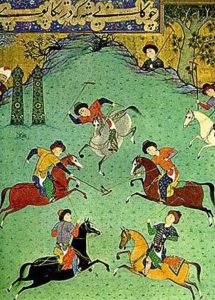
A more genteel sport that to this day continues to be a sport of the elite was tzykanion, a form of polo played by the Byzantine emperors and their nobles. It was played in a stadium called the Tzykanisterion. The sport came to the Byzantines from Sassanid Persia. Anna Komene, Byzantine, princess and historian, daughter of Emperor Alexios I Komnenos mentions an injury due to this sport, in her history, The Alexiad:

One day for the sake of exercise, he [her father, the Emperor] was playing polo with Tatcius, of whom I have often spoken. Tatcius was caused to swerve by his horse and fell against the king, whose kneecap was injured by the wight of the impact and the pain extended right down the leg.

It was played by two mounted teams, using a small leather ball, perhaps the size of a modern baseball. They pursued the ball with netted sticks. The exact rules of the game have not come down to us, but it can be assumed that it was similar to modern polo. The Emperor had his own private Tzykanisterion where he might entertain nobles and visiting dignitaries. The sport became popular in the twelfth century with mercenaries from western Europe. It can be assumed that it was in this way the game was transported to western Europe. It may have also originiated from Persia where it was known as Chovgan.

Persian miniature depicting Chovgan

It could be argued that sport serves a wider function to society as a whole. Perhaps it no longer has a religious function as it has had in many societies in times past as in the Easter celebrations of the Byzantines races in the Hippodrome or the pagan functions of the gladiatorial games of the western Roman Empire. Yet also, the Roman emperors knew that to keep the games going was to keep the empire functioning even when there was not enough bread. Games are, with their rules and systems of play, perhaps a mirror on a smaller scale of how societies work. We work within rules and perhaps games are a way of keeping a handle on those rules. In the end, then as now, most people agree that a good competition is just plain fun.

Let me know your thoughts below!

← Back

Thank you for your response. ✨


Checkmate! Games and Gaming in Tenth Century Byzantium and Beyond

I have had to take a break from the blog because of family obligations. Now I am back with a series about games and entertainment.

In the second book of The Varangian Chronicles, the courtesan Cyra is rescued by an Antiochene court eunuch named Arpad after she has her tongue cut out. To alleviate the interminable boredom from which she suffers while hidden away in his quarters in the deepest part of the paláti (the palace in the center of Antioch) he brings her a game that he calls shantranj. She is both puzzled and delighted by this game.

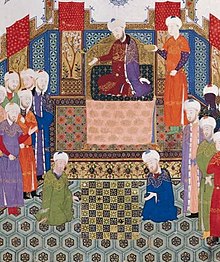
From a Persian miniature depicting two shantranj players circa 1430

Over the past few days, Arpad had come and gone, each time bringing her things, usually flagons of broth. On the fifth day, he judged her mouth healed well enough that he brought her millet porridge, sweetened with honey and cardamom. She could only eat it in the tiniest spoonfuls, leaving her hungry and unsatisfied. With it, he had brought her an elegantly carved game. Each piece was made out of either ivory or ebony. The board was square and consisted of a pattern of dark and light wood blocks, arranged in an alternating pattern. She had seen one before. Once an official from Baghdad had brought such a marvel. He had called it shatranj al-muddawara. Arpad taught her how to play, moving the various pieces across the board. She was a lousy player and he won every time. She failed to see how a lowly pawn could prove the undoing of a king. Were not kings always more powerful than common soldiers? When had she gained anything from whispering simmering lust in the ear of a lowly spearman? It had been a marvelous distraction at first. She moved people across her board in a far different manner. Often Arpad’s duties kept him away all day and shantranj proved to be a welcome diversion when he returned.

Shatranj is a game from which our modern chess is derived. The rules and board have not changed drastically,though Arab manuscripts describe numerous variations and the roles and moves of the Queen and Bishop were different than they are today. Nancy Marie Brown in her book Ivory Vikings tells us that “The Arabic word for chess, shantranj, comes from the Persian chantrang, itself from the Sanskrit chanturanga. Chess seems to have arrived in Persia from India in the mid-500s. By 728 an Arabic poet wrote, ‘I keep you from your inheritance and from the holy crown so that, hindered by my arm, you remain a pawn among the pawns.’”

Nikephoros I, a ninth century Byzantine Emperor, sent word to the Abbasid Caliph, Hurun al-Rashid refusing to pay tribute according to a treaty agreed to by his predecessor Irene of Athens. He writes of Irene, that she must have “considered you as a rook and herself as a pawn.” This tells us that not only was shantranj very well known among the Byzantines at this time, but that the rules of the game had made its way into the vernacular.

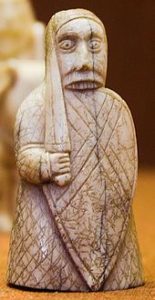
 Some say that the game spread to Europe through the Islamic conquest of Spain, but there is a legend that Harun al-Rashid sent a set as a gift to Charlemagne. A set survives at the National Library of Paris that is Norman in origin. An incredibly valuable and beautiful version survives, though the collection is split between the National Museum of Scotland and the British Museum in London. They were found on the Scottish island of Lewis. Archaeologists think they were made in Trondheim, Norway. For more about the history behind these pieces, please read Nancy Maria Brown’s wonderful book, Ivory Vikings. However it got to Europe, it proved to be very popular and is now our most well known board game with chess champions the world over competing against one another.

Berserker from the Lewis Chessmen British Museum

The Arabs and the Byzantines in the East were not the only ones to have board games, nor are the chess pieces carved at Trondheim the only surviving example of gaming in Iron Age Scandinavia. Among the artifacts discovered on the Gokstad ship in Sweden was a taflborð with markings on it played like Nine Men’s Morris.

Dice have also played in almost every culture imaginable, though sometimes the knuckle bones of pigs were used. They were sometimes used for divination purposes, as even the runes are to this day.

Next time we will have a look at some of the more physical forms of games and entertainment that would have been enjoyed by the people in The Varangian Chronicles.

For further reading see:

Ivory Vikings by Nancy Marie Brown

A World of Chess; Its Development and Variations through Centuries and Civilization by Jean-Louis Cazaux, Rick Knowlton

Give me our thoughts below. I love hearing from you!

← Back

Thank you for your response. ✨


Tidbits of War -The Sylogge Tacitorum

There have been several military handbooks written by Byzantine authors, most notably the Strategikon by Emperor Maurice. But Sylogge Tacitorum stands out in my mind, perhaps because it is  a surprisingly easy and even titillating read, divided as it is into short treatises on sundry subjects of interest to any properly educated military man of the time and gives interesting insight on military philosophy. While it is far less well-organized that the Strategikon, it poses some real human interest. It shows the intelligence and organization of the Byzantine army perhaps contrasted more favorably against western Europe of the time.

I will not go into detail surrounding all the literary significance of the piece, nor the so-called Macedonian Renaissance and subsequent literary revival that supposedly spurred on the creation of the Sylogge in the first half of the tenth century, presumably penned by the Emperor Leo VI. The average reader would much rather hear the more scintillating bits from the piece. So here it goes.

The Sylogge is divided into portions with such titles as “How the soldiers are overpowered by the enemy with wine” or “How horses will not neigh.” (That is, how to keep them quiet in times of ambush.) These are interspersed with gems of wisdom concerning the conduct of generals, as it is expected these or the sorts of people who will be reading this in the first place. Generals are advised to be patient and be able to bear hardship as well as the belief that in urgent matters, the general should be the first one to act in person.

A few cunning methods for gaining the upper hand against the enemy have been used since pre-history, including poisoning the water supple, destroying the land (this might include salting the fields to make them unusable for agriculture) and using sea turtle bile to incapacitate the horses.

The  Sylloge Tacticorum gives instruction on how to make enemy equipment spontaneously ignite with the application of a mysterious brew. The recipe called to: “Put equal portions of of native sulphur, rock salt, ashes, cedar-tree, and pyrite stone in a black mortar, when the sun is at its peak. Mix together with black mulberry sap and free-flowing Zakynthian liquid asphalt, each in equal portions. You should grind it until it becomes sooty coloured. Then you should add the smallest amount of quicklime to the asphalt. However, as the sun is at its peak, you ought to pound it with diligence and to protect your face entirely. Then, it should be sealed in a copper vessel, so as for it never to see the rays of the sun. The wagons of the enemy should coated while it is still night. All will be suddenly burned, when the sun shines on them moderately.” (This is not be confused with Greek Fire, though there is a chapter entitled “How the so-called liquid fire may be put out and how it might not burn wood or walls when it is cast upon them”.)

Of course, there is always the age old tactic of poisoning your enemies which seems surprising considering that the Byzantines deemed poison the weapon of women and eunuchs. Nevertheless, instructions were given to poison wine with monkshood, hemlock and boxwood. Then abandon your wine, leaving for your eager opponents to find and  “and drink their fill and thereby endanger themselves.” These instructions were given also that a general may be alert to the danger of their being used upon his own troops by the enemy. One could never be too cautious when drawing water from wells in enemy territory. He cautions his reader that the enemy may endeavor to add plague to bread and send back prisoners of war infected with plague. This was done by placing a toad or viper in a vessel and sealing it till both are dead. Then they are ground up and boiled and the water thereby obtained used to make plague bread. Naturally, those employed to make the bread would also end up dead. It leaves us to wonder if perhaps an elemental step was left out of the procedure and the infusion of viper was meant merely to be the vehicle by which infected buboes were carried into the bread. 

At the same time, the author of the Sylloge Tacticorum admonishes the reader to behave humanely to cities that surrender. This in itself has tactical benefits. The inhabitants of a city, believing themselves to be in danger of brutality once they open their gates, will be all the more inclined to fight with their last breath. A commander’s reputation in warfare, as in everything else, was paramount.

The Sylogge carefully details how ranks of soldiers and cavalry should be arranged, discipline of soldiers, how to build a fort near enemy borders, how to take in traitors and defectors from the other side (while never completely giving them your trust). He advises soldiers to eat many small meals a day rather than twice as was customary so as to avoid fatigue from the sun. Instruction is given to boil water before drinking and to use an infusion of rue and wild marshmallow for digestive health.

The author sprinkles his adages and advice throughout with references to historical military leaders, such as Alexander the Great, Pompey, Dionysius and Themosticles, all names familiar to the Byzantine ear. If it was good enough for Alexander, it was good enough for the reader of the Sylogge!

In short, the Sylogge makes clear that while honorable battle is sought above all, as is fair treatment towards soldiers and humanity towards the enemy and prisoners of war, there is absolutely nothing standing in the way of a Byzantine military leader in the way of cunning and deceit. In fact, the majority of the military manual seems devoted to ways to deceive the enemy, from giving the impression that one has a larger army or horses than in reality to causing suspicion among enemy allies. The rest is divided largely between general tactics and ways to make the camp and military life safer, healthier and more efficient for your soldiers.

The Sylogge Tactitorum is a fascinating read, for the casual historian or one seeking more insight into Byzantine military life.

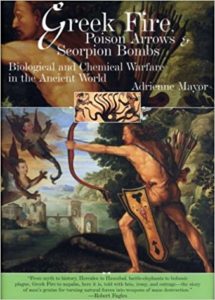
Greek Fire, Poison Arrows and Scorpion Bombs – a review

Adrienne Mayor, the author of Greek Fire, Poison Arrows and Scorpion Bombs; Biological and Chemical Warfare in the Ancient World, is a classical folklorist who excels at bringing to life to world of ancient toxicology and biological warfare.
As I have noted in my previous post, Tidbits of War -The Sylogge Tacitorum, warfare on the surface was supposed to be honorable, that is engaging in hand-to-hand combat. However, as we shall see from Ms. Mayor’ enticing book on the subject, rarely, if ever, was this employed solely. In fact, then as now, subterfuge, confusion, poisoning and deception were the tactics readily used.

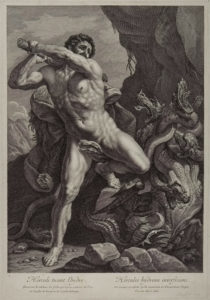
Hercules and the Hydra

She notes that many of the classical myths have the heroes using poison arrows such as Hercules’ use of the Hydra’s venom which in fact may have been merely been metaphor for commonly used war practices.

Earlier people showed a surprising knowledge of the use of bacteria and poisons. Witness the early English long-bowman who placed his arrows, point first in the ground, knowing full well that the bacteria from the earth thereon, lodged in the flesh of his enemy would reek havoc in the form of a festering infection. Scythian archers went one step further, employing everything from feces to snake venom and toxic plants.  As she describes, the Scythians were far fro the only ones to use these methods. In fact she devotes a significant amount of time to the subject of poisoned projectile devices, which is both illuminating and interesting.  While much of this indicates a an astute knowledge on the part of the ancients regarding how people are affected by bacterium and disease, some of the recipes for military prowess are laughable, if not outright cringe-worthy, such as the Hindu use of ashes of cremated children and bird sperm to allow a soldier to walk hundred of miles without fatigue. Even today, the U.S. Department of Defense has been involved in the research for the reduction of sleep in American soldiers that includes the use of “magical genes in mice ad fruit flies” which is sure to raise a few eyebrows.

If you are not endeavoring to kill your enemy outright with poison arrows, perhaps another tactic is to poison wells, so that even if he attempts to avoid these poisoned waters, at the very least, he will be overcome by dehydration. This is a good tactic to use when retreating into your own land from a larger, more powerful army. Hellebore was used for this in the siege of Kirrha in about 150 CE.  This created such a violent purge, that the men defending Kirrha had to abandon their posts on account of diarrhea.

Perhaps one of the most intriguing points brought up by Ms. Mayor was that of plague caskets. Indeed, I have posited that very idea in my second book of the Varangian Trilogy.  Plague in itself was dreaded by all in the classical and medieval world. Short of merely lobbing the corpses of those who have died of the disease over your enemies castle walls, there were other, more nefarious ways of ensuring that your opponents would spread the disease. Bubonic plague, or Yersinia pestis in itself is not very contagious, yet when it morphs into the more deadly pneumonic plague, which can be spread via droplets in the air, that the trouble really begins. Ms. Mayor posits the theory that there were plague temples, particularly to Apollo (who among other things was a god of plague) where jars or caskets of plague were kept. Plague in this instance, could refer to any sot of pathogen, including smallpox. Smallpox infected blankets were handed out to Native Americans during the British Indian wars of the eighteenth century in the hopes of decimating their tribes. It was largely successful. It was no less a weapon in the Old World. She writes “One can imagine that a garment or some other item contaminated with, say. dried smallpox matter, could have been sealed away from heat, light, and air in a golden casket in the temple of Apollo in Babylon until a time of need. The item could maintain ‘weapons-grade’ virulence for many years.”

Religious places of worship were apparently frequently arsenals. Arabic sources reported that Byzantine churches were used to store naphtha, a major ingredient in the manufacture of Greek Fire.  Ms. Mayor suggests that the Ark of the Covenant, was in fact, a plague casket, sent to bring down the Philistines.  In Babylon, in the temple of Apollo, Roman soldiers burst in and loot, including the plague casket, which perhaps to them looked like an inviting bit of treasure. Soldiers are a perfect vehicle for spreading the plague, given that they march many miles in a day and camp life is ridden with a lack of hygiene and crowded conditions. Spreading contagion, even among your enemy, is always a risky business however, as your own troops and non-combatants may be infected.

The book goes on to describe “poison-maidens” lovely women whose very touch could bring death and poisoned honey, made so because the bees gathered their nectar from the poisonous rhododendron blossoms. This toxic honey proved to be the undoing of the Greek general Xenephon and his hoplites.

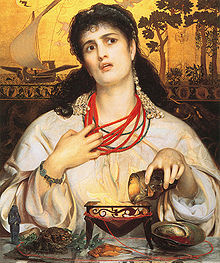
The witch Medea

She examines the legend of Medea and her flaming cloak given to an Innocent and unsuspecting rival. Classical combatants utilized animals in warfare, from mice intended to spread plague to beehives and venomous scorpions launched over castle walls. War dogs and war elephants were used in open combat.  The Vikings were known to attach incendiaries to sparrows so that when the birds returned at night t their nests in the thatch roofs of the enemy homes, the who town would be set alight. Such a tactic was hardly new to them and was known in the classical world, as noted by Mrs. Mayor.

Speaking of fire, my all time favorite, Greek Fire (also known as liquid fire and Medean Fire) gets plenty of stage time in chapter seven.  Incendiary weapons are as old as time. Greek Fire is something special though. Largely a projectile weapon, it was famous for being very hard to put out and in fact water had little effect. Some said that water only served to fuel rather than quench its flames. It was said to have been brought to the Byzantine Empire by a man named Kallinikos and was supposed to have been kept in sacred trust by his descendants, supposedly a family known as Lampros.  It has a striking similarity to that which Medea used  in her conflagration of her rival Glauce. Another example would be modern napalm.

Altogether, Adrienne Mayor highlights the horror (and our fascination with it) of the many nefarious ways that man has contrived to wage war, bringing in modern examples to compare with the ancient ones. It is a highly readable book, well organized and documented.  I recommend it to anyone interested in expanding their understanding of the ancient world.

Have you read this book? Let me know below what you thought about it.

You can purchase this book here:

← Back

Thank you for your response. ✨

A Gathering of Ravens by Scott Oden: a review by Gretchen Brown

As the ways of the old gods fades to twilight and the religion of the White Christ sweeps Britain, we are brought into the dark cold world of A Gathering of Ravens, a beautiful compilation of both historical fiction and fantasy genres. Scott Oden’s writing is easily readable, yet hauntingly poetic and evocative in style of the Eddas or even the Anglo-Saxon Beowulf itself. The author gives us a theme with characters sharing a little of each side of the yawning chasm of morality with themselves and the readers. Ultimately, morality is defined for us as honor, to oneself and to those to whom one has sworn allegiance, a basic and ancient code integral to the Norse culture.

We follow a young Christian Anglo-Saxon monastic Etain who travels in the company of a Christian Dane, Njall. After the apparent death of Njall, she becomes the unwilling travel companion of the monstrous Grimnir, a creature who can best be described as kinsman to Grendel an orcneas, or orc. Grimnir is Corpse-maker and Life-quencher, the Bringer of Night, the Son of the Wolf and Brother of the Serpent. Like his namesake the Norse god Odin, Grimnir comes with many names, is complex, not always easily understandable and hardly predictable. Bent on cold revenge for an ancient slight, Grimnir is an unlikely protagonist, not at all likable, yet we are always rooting for him. His reasons for doing things are not always clear, perhaps not even to himself. He is a faithful follower of Odin, while spewing contempt on the humans, particularly any who follow the White Christ. Etain must walk in his world while remaining true to her own beliefs.  While doing so, it gives her an opportunity to feel compassion and loyalty for the prickly-natured Grimnir.

Their journey takes us from Anglo Saxon England and culminates in Ireland with a lineup of Irish kings and sorcerers, Norse warlords and Danish refugees who clash outside the walls of Norse-occupied Dubhlinn. They become separated, face many dangers, together and apart, yet curiously, Etain continues to be loyal to her captor, to see something in him others cannot.

Some readers more used to a modern writing style may find the Edda-like poetic passages that the author interspersed into the main body of the narrative, off-putting. I thoroughly enjoyed them for the authentic mood they conveyed. It may also be an easier read to those who more familiar with the historical period and the manner of speaking. He includes many italicized words perhaps not familiar to the average reader, though this is not meant to be a criticism as I felt he placed them in enough context, which the “uninitiated” as it were, could keep up. That said, this is not “fluff” fiction.

The only thing that confused me and took me out of the story was the strange time travel via the World Tree Yggdrasil.

Ultimately, A Gathering of Ravens will have you turning the pages, surprised by the twists and captivated by the moving quality of the author’s use of language. His characters are neither flat, nor one-dimensional, but will stay with you long after you have reached the end, hungering for more.

Click here to be taken to the details page on Amazon.com

← Back

Thank you for your response. ✨

Cleanliness and Hygiene Among the Norse

Ibrahim Al-Tartushi, a tenth-century Arab traveler and merchant visited the Norse town of Hedeby in 950AD. He wrote “there is also an artificial make-up for the eyes, when they use it beauty never fades, on the contrary it increases in men and women as well.” One might well question whether this liner might not have been used in the manner of a football player’s eye black to shield the eyes from the intense sun especially seeing that Hedeby was a coastal town and many of them spent time on the water. Ibrahim ibn Yacoub seems insistent on the idea that it was used for cosmetic purposes, leaving us with an image of tenth century Viking men à la Johnny Depp in Pirates of the Caribbean. They are depicted using kohl in this way in History Channel’s Vikings.

Constantinople had a very cosmopolitan environment, with people of many nations passing through and living there. Among those more exotic to the native Byzantines were the Varangians, people of Scandinavian or Scandinavian-descended Russian heritage. They brought many trade goods, including amber, honey and furs. According to The Russian Primary Chronicle, the Rus invaded Constantinople in 907 and as part of the payoff agreement, the use of the public baths was agreed upon.

The Norse made extensive use of saunas. Among the Rus, their bathhouses were called banyas. An Old East Slavic illuminated manuscript, the Radzivill Chronicle mentions the banya in the in the story of Princess Olga’s revenge for the murder of her husband, Prince Igor, by the Drevlians in 945 AD. When an emissary from the Drevlians came to Olga with an offer of marriage, “… Olga commanded that a bath should be made ready for them and said, ‘Wash yourselves and come to me.’ The bath-house was heated and the unsuspecting Drevlians entered and began to wash themselves. [Olga’s] men closed the bath-house behind them and Olga gave orders to set it on fire from the doors, so that the Drevlians were all burned to death” Incidentally, Olga was the grandmother of the Prince Vladimir who was given Basil II’s sister Ann in marriage in exchange for six thousand Varangian troops and a promise of conversion to Christianity. While the Varangian inhabitants of Constantinople and indeed most of the common native people as well, were unlikely to make use of the extensive cosmetics that highborn women such as Theophana would use, cleanliness was nevertheless highly valued, weakening the popular image of the medieval Scandinavian as dirty and unwashed.

The Abbot of St. Albans write with no little chagrin of the Danes who settled in England that “thanks to their habit of combing their hair every day, of bathing every Saturday and regularly changing their clothes, were able to undermine the virtue of married women and even seduce the daughters of nobles to be their mistresses.” Apparently even Anglo-Saxon women were crazy about a sharp dressed (Danish) man.

In The Serpentine Key, Freydis washes her hair in water scented with lavender flowers and this is a scent that Sven always associates with her:

Freydis placed the basket she had been carrying on the table. It was filled with meadow rue. There was almost little enough room for them both in the small space and she pushed past him, her hair smelling of lavender. If he had not known better, he might have thought he had never left Rodnya. A feeling like longing overcame him, drowning his senses in memories, threatening to make him forget why he was here.

Then as now, cleanliness was appreciated and enjoyed and we see that those who came before us, were perhaps not as smelly as we may have supposed.

Northmen: The Viking Saga AD 794-1241 by John Haywood

Face Paint: The Story of Makeup by Lisa Elridge

← Back

Thank you for your response. ✨