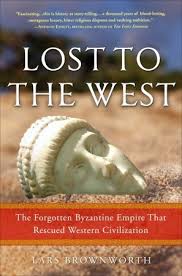
We often define the Byzantine Empire beginning where the Western Roman Empire left off. As Brownsworth aptly illustrates there was no abrupt handover. Rome did not even “fall” in the strictest sense. Yes, the Goths and Visigoths took down her great city, but Rome in the West had been declining gradually for some time, while in the East, the Empire had been experiencing something the West would not see for many more centuries – a Renaissance. Constantine places the new capital between the Black Sea and the Mediterranean, and in a stroke of typical egotism, names it after himself.
Brownsworth covers the next several centuries in a whirl of emperors, Hunnic invasions and Christian heresies. He does so through a series of vignettes, graphic tales and titillating tidbits. He covers Justinian, the Muslim threat from the east, the institution of the Varangian Guard and the Bulgarian wars under the reign of Basil II and the golden age of Byzantium. He spends much more time in the earlier centuries and fewer pages on the golden age of the empire, Constantinople’s tragic role in the Crusades and the downfall of the Byzantine Empire.
For readers of Alan W. Eckart’s works on American frontier history, Brownsworth’s approach is similar, condensing otherwise dry academia into a readable work for the average armchair historian. The strength of this book is that the author has a genuine passion for the history of the Eastern Roman Empire and it shows in his enthusiasm for his subject in these pages while showing a real flair for the dramatic. The major drawback is that he may have sacrificed some academic accuracy for dramatic flair.
The main weakness to this book is that it is attempting to deal a broad stroke at a very broad subject within three hundred or so pages. Brownsworth faces a monumental task in condensing over a thousand years of Byzantine history in a few hundred pages. The Byzantine Empire is a subject that is too expansive a scope to handle in one book. Yet he does a good job of catching the highlights and making them readable. While certainly not for the serious academic, who will need a more in depth approach with more primary sources cited, it is an excellent and entertaining introduction written for the casual reader. Have you read this book? What did you think? Let me know your thoughts below.
You can get the book here:

