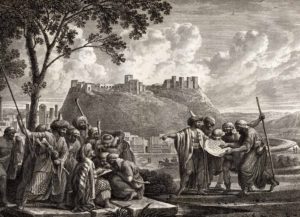
Seen from a distance the Citadel was a sprawling hill, topped by domes and arches, sloping down to the city of Emesa and the desert that encircled it. The entrance was a high face of sand colored stone, flanked by towers and entered by a long narrow bridge that gave way to yet another imposing gate. Bab al-Souq rose up before them, the stone golden in the afternoon sun. Dusk was sifting down into the street, thickening the shadows.
I mention the city of Emesa, Syria in my book The Plague Casket, as a destination by Ulf and Sophia. Today it is known by the Arabic name of Homs, though there is reason to believe that the Byzantines would have continued to refer to it by its Greek name, even after the Muslim conquest and subsequent loss from Byzantine control. It is a city that is no stranger to strife and siege. Homs has long stood as a key center of trade and agriculture going back to at least the Christian era. It was the home of the Roman empress Julia Domna who was a daughter of an hereditary high priest to Elagabal . It had, at one time, a great temple dedicated to this sun god. Currently the Great Mosque of al-Nuri stands on this site. One of the priests of the sun god Elagbal, was the seriously delusional Roman emperor Elagabalus (born Varius Avitus Bassus, also the grand nephew of Julia Domna) named for the god whom he served.
Homs is also referred to with moderate frequency by Usamah ibn Munqidh in his memoirs as published under the title An Arab-Syrian Gentleman in the Period of the Crusades. This venerable Syrian gentleman gave his name to the Citadel there. The tell upon which it was built dates back to at least the Bronze Age. Its strategic position on the Orontes River made it coveted by whomever had military designs in Syria, including the Byzantines. The Hamidids took control in 944 and it was from them that Basil wrested control in 999.
As a city, Emesa may have been founded by the Seleucid kings, following the death of Alexander the Great. It was already a very old city by the time Ulf and Sophia enter its gates in The Plague Casket. It has been identified by some archaeologists as the biblical Zobah which would date it to at least 2100 BCE. The Romans tolerated the worship of the pagan Elagbalus which during the Christian era gave way to churches which were torn down or converted to mosques when the Arabs regained control over the city. The city’s mosques were returned to Christian use when the Byzantines raided Syria in general and Emesa/Homs in particular when Basil II made yet another sweeping foray into Syria in 999 CE. The Arab geographer, Muḥammad ibn Aḥmad Shams al-Dīn al-Maqdis wrote in 985 that Homs was the largest city in all of Syria, but that it had suffered great misfortunes, indicating it had already been the source of much conflict, including the Arab-Byzantine Wars.
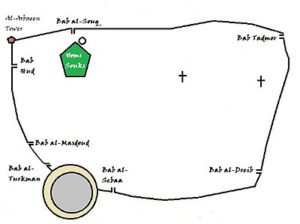
When Basil entered the city, he may have ridden through any number of her historic gates. They were Bab al-Souq (Gate of the Market), Bab Tadmur, Bab al-Sebaa (Gate of the Lions), Bab al-Dirayb, Bab al-Turkman, Bab al-Masdoud (Closed Door) and Bab Hud.
Many Arab tribes came to settle near Homs, among whom were the Banu Kilab who also receive mention in my book. A proud Bedouin people, the Banu Kilab tended to support the Fatimid regime, though in the late tenth century it was the Hamidids who tried to maintain control over the city. Often the Hamidid cities were vassals to the Byzantines and paid suzerainty to the Byzantine Emperors or their representatives as did Sa’id al-Dawla , emir of Beroea (now Aleppo). Throughout the early eleventh century it was the Banu Kilab who maintained control over Homs, as Basil concluded a ten year peace with the Fatimids so he could continue his Bulgarian wars.
Today the original city and its citadel lie in ruins outside the modern city of Homs, which has had its own insurrections to deal with. Before the Syrian Civil War it was a major center of industry for Syria. The area is home to many cultural and historical landmarks such as the Crusader castle Krak des Cheveliers and it is to be hoped it does not meet fate of so many icons of the area as did the Roman theater in Palmyra at the hands of ISIS insurgents. War has often been responsible for the destruction of things that give us a window into the past. Perhaps this wanton and tragic demolition can be halted, by those who care to preserve the past to better our understanding of the future.
Resources:
A Brief History of the Roman Empire
By Stephen P. Kershaw
Cities of the Middle East and North Africa: A Historical Encyclopedia
edited by Michael Dumper, Bruce E. Stanley
An Arab-Syrian Gentleman in the Period of the Crusades
by Usamah ibn Munqidh
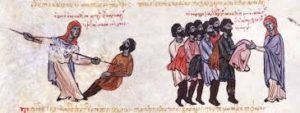 It didn’t happen any too soon. Bardas Phokas, the chief of the rebels and a one time trusted general of Basils’ was closing in on the imperial city. Or rather, one of his next in command, Kalyokyros Delphinas, who took charge of storming Chrysopolis, a city across the Golden Horn from Constantinople. It took a quite a long time for negotiations to take place, but once they did, either in late 988 or early 999, numerous long ships could be seen on the horizon and with them six thousand Norsemen. They soundly defeated Delphinas’ men. Delphinas himself went on to meet a nasty death of impalement. The Varangians then went on to Abydos where they were again victorious, albeit helped out some by Bardas Phokas inexplicably keeling over on the battlefield. Stroke? Heart attack? Poison? We can’t be sure.

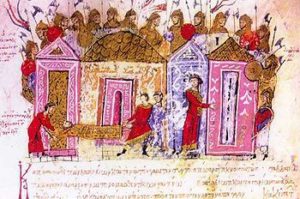 In The Serpentine Key, Sven Thorvaldson serves as emissary to Vladimir, Prince of Kiev, from Basil II, Emperor of the Eastern Roman Empire, bringing in the Norsemen who would eventually become the Varangian Guard.
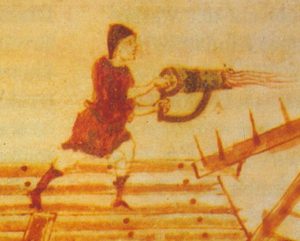 There has been some debate on what Greek Fire actually was. Most historians agree that it made use of petroleum and others throw around combinations of pine resin, quicklime, calcium phosphide, sulfur, or niter. So then let us briefly examine some of these components to the best of my ability, bearing in mind that chemistry has never one of my strong subjects!
 A case has been made for the fly agaric mushroom. Despite the fact that this red fungus, speckled with white shows up in almost every European fairy tale picture book you ever read as a child, it grew in Europe in only isolated areas. It certainly does not grow in Iceland where there is much mention of the berserkers. Furthermore, the effects of the mushroom, unless used very carefully, are more likely to produce real illness than the desired level of hallucination in those who ingest it. The potency of the mushroom is affected by many things: the time of the year it is harvested, where it has been harvested and how it is collected. There is not enough uniformity to produce the desired outcome.
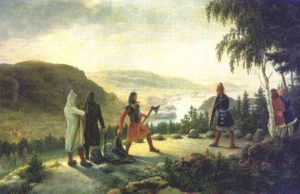 Icelandic Egil’s Saga whose father Skallagrim was a berserker and the son of Kveldulf Bjalfson or Evening Wolf, also a berserker. This very much indicates the condition was genetic and places some weight on its being something like IED which we have today.
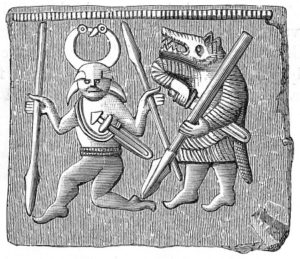 “There was a man named Ulf, son of Bjalf… Ulf was a man so tall and strong that none could match him and in his youth he roved the seas as a freebooter….he was a berserker.” Egil’s Saga.